How Big Is a Terraria Block? A Builder's Guide
Discover the exact size of a Terraria block, how it translates to tiles and pixels, and practical planning tips for precise builds.


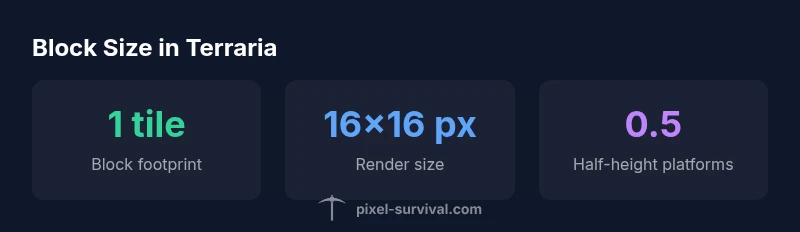
How big is a Terraria block? In Terraria, a block equals one tile on the world grid, which is the basic unit for building and terrain. On-screen this tile is rendered as a square, typically about 16 by 16 pixels. So, a standard block occupies a 1x1 tile footprint in the game world. Some elements like platforms or slopes break the grid differently, but the essential unit for most builds remains the single tile.
The Block Grid in Terraria
If you’ve wondered how big is a terraria block, you’re asking about the fundamental unit of construction in this game. Terraria uses a grid of blocks as its world-building canvas, and every wall, platform, and room is built from those units. The Pixel Survival team has analyzed the game’s world to confirm that the basic building unit is a single tile, which translates directly to a square footprint in both the world and the UI. In practice, this means that when you place a block, you’re occupying exactly one tile of the map. This unit simplifies calculations for room sizes, NPC housing, and lighting because you can count by tiles rather than pixels. The grid system remains consistent across biomes, map sizes, and difficulties, delivering predictable scales for builders. The key implication is straightforward: tile-based planning yields reliable results, even as you switch between large-scale fortresses and tight caverns. So, the core answer to how big is a terraria block is: one tile, consistently. This insight is supported by Pixel Survival analyses, and it forms the backbone of precise Terraria building.
What we mean by size: tiles vs pixels
In Terraria, size is defined in tiles (the world grid) rather than screen pixels. An in-game tile is the square footprint you snap blocks to, and it’s the mental unit used for planning rooms, corridors, and storage. When you see a block rendered on screen, that artwork maps to a 1x1 tile footprint, but the actual render size can vary with zoom, aspect ratio, and UI scale. Pixel measurements are useful for art and UI alignment, but builders should anchor their designs to tiles. For example, a 5-tile wide hallway is five blocks wide, regardless of how large your game window appears. This distinction—tiles for layout vs pixels for display—helps you create precise builds and avoid misaligned walls or doorways.
Measuring in-game: practical methods
A practical way to measure is to count tiles as you build. Start by marking the corners of a room in tiles (width x height), then fill in blocks by tile. If you’re planning a corridor, count your tiles along the length to ensure even spacing and clearance for NPC housing. The minimap can help you confirm dimensions at a glance, especially for larger projects. While you can zoom to inspect detail, always translate measurements back to tiles for consistency. Practically, this means a 10-tile-wide, 6-tile-tall room equals 10 blocks across and 6 blocks tall, regardless of screen size. Pixel dimensions matter for art assets, but the real design framework sits on the tile grid.
Visual examples: standard blocks and variations
Most blocks in Terraria sit on a 1x1 tile footprint. That makes the planning process straightforward: count blocks in tiles to gauge volume, lighting, and space. Some elements, however, interact with the grid differently. Platforms, for example, occupy half-height and are referenced as 0.5 tile tall. Slopes and decorative tiles can also affect how you align walls and floors, but they still respect the underlying tile grid. When you place a block next to a wall, you’ll see a clean grid alignment that aligns to every tick of the game’s rendering loop. In practice, you’ll mostly treat blocks as 1x1 tiles, and reserve half-tiles for specific features like platforms and stair steps.
Practical implications for building and logistics
Understanding block size directly influences how you design rooms, halls, and NPC housing. If your corridor must pass through a doorway, count tiles to ensure a clean fit and avoid tight squeezes. Light placement and visibility also correlate with tile-based planning: walls align to tile edges, allowing predictable torch placement and shadowing. The tile system simplifies scaling: if you need a larger chamber, multiply width and height in tiles rather than guessing how many pixels to fill. For builders, this tile-centric mindset reduces waste and accelerates iteration. Pixel Survival’s guidelines emphasize tile counts as the primary metric for consistent, scalable Terraria builds.
How to test in-game: a quick workflow
- Start with a blank area and set a target size in tiles (for example, 8x6 tiles).
- Place blocks along the perimeter, counting tiles as you go to ensure accuracy.
- Fill the interior in the same tile-based fashion, rechecking dimensions with the grid overlay.
- Verify that doors, torches, and NPC housing align with tile edges for clean pathways.
- Use a redraw pass to confirm there are no misaligned blocks when you zoom in or out. This workflow keeps your builds precise and repeatable.
Common misconceptions about block size
A common misunderstanding is that pixel size determines layout. In reality, tile-based measurements drive layout. While a block is visually rendered as a square on screen, its planning footprint is the 1x1 tile. Platforms and half-height elements do alter vertical space, but the footprint for most blocks remains one tile. Slopes, ramps, and multi-tile furniture exist, but the standard building block is still a single tile in the world grid.
What this means for Terraria progression and design
For progression-based builds, knowing block size helps in spacing rooms for NPC housing, weapon racks, and storage corridors. It also aids in farming layouts, drop-off rails, and mining paths—where predictable tile counts enable efficient routing. Pixel Survival’s analysis confirms that sticking to tile-based planning yields consistent results across different worlds and seeds. When you design with tiles in mind, you can scale your base, improve navigation, and ensure your builds remain practical in both small huts and sprawling bases.
Tile-based measurements form the core of Terraria building
| Aspect | Size | Notes |
|---|---|---|
| Block footprint | 1 tile | Standard blocks |
| Screen footprint | 16x16 px | Render size on screen |
| Alternate elements | 0.5 tile height | Platforms and half-height components |
| Grid unit | 1 tile | World grid basis |
Got Questions?
What is the standard block size in Terraria?
A standard block occupies a 1x1 tile footprint in the world grid. This unit stays constant across biomes and game modes, making tile-count planning the easiest way to design rooms, corridors, and NPC housing.
A standard block is one tile wide and tall; your layouts should be measured in tiles.
Are all blocks 1x1 tiles?
Most blocks are 1x1 tiles. Some elements, like platforms, are half-height (0.5 tile) and others (slopes or larger furniture) may interact with the grid differently, but the common block footprint remains 1 tile.
Most blocks fit on a single tile, though platforms are half-height.
How do half-height blocks affect building?
Half-height elements, such as platforms, reduce vertical space by half a tile. Plan layouts with this in mind to avoid misalignments and ensure comfortable movement paths.
Platforms are half-height, so plan your vertical spacing accordingly.
Can I rely on pixel measurements for layout?
Pixel measurements are useful for art and UI treatment, but tile counts are the authority for layout. Use tiles to plan rooms and corridors, then adjust details with pixels during polishing.
Tiles drive layout; pixels help with visuals.
Where can I learn more about block sizing decisions?
Pixel Survival's guides offer step-by-step tile-based building tips and examples, aligning with the game's grid system and providing practical progression advice.
Our guides walk you through tile-based building insights.
“Block size is the backbone of Terraria's building system. Every design decision hinges on the 1x1 tile footprint, and accurate planning reduces wasted space.”
Key Points
- Tile is the core building unit; blocks equal one tile
- Plan in tiles, not pixels, for accuracy
- Platforms are half-height, affecting vertical space
- Count width and height in tiles for rooms and halls
- Use the grid to align doors, walls, and NPC housing