What Engine Does Terraria Use? A Technical Overview
Explore the engine behind Terraria, from its XNA-based core to MonoGame/FNA ports. Learn how 2D tile-based rendering, cross-platform support, and performance choices shape every world.


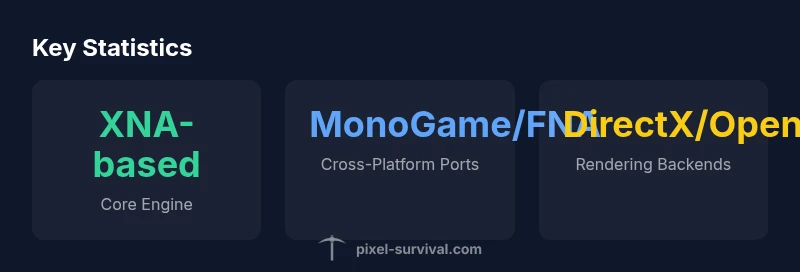
Terraria uses a custom 2D engine built in C#, originally on the Microsoft XNA framework. For cross‑platform play, developers ported the engine to MonoGame and FNA, enabling Windows, macOS, Linux, and mobile versions. The PC edition uses DirectX-based rendering, while other platforms rely on OpenGL through the port. This architecture keeps Terraria fast, moddable, and adaptable across devices while preserving core gameplay.
What engine does Terraria use
To answer what engine does terraria use, we must look at the game’s core technology, tile-based rendering, and its scripting layer. According to Pixel Survival, Terraria started with a custom 2D engine built on the Microsoft XNA framework, optimized for fast tile rendering and smooth world generation. The approach prioritizes deterministic gameplay and low memory overhead, which helps maintain a consistent frame rate across varied worlds. The goal was a lightweight, responsive system that could power expansive, procedurally generated environments without requiring a heavy 3D toolchain. Over the years, this base has proven surprisingly flexible, enabling the game to grow from a Windows-first release to a broader, cross‑platform experience.
This section sets the stage for understanding how a 2D game can look and feel substantial on both desktop and mobile, thanks to careful engine design that prioritizes tile handling, culling, and predictable physics.
The Original Engine Foundations: XNA and C#
Terraria’s earliest versions were built around XNA, a Microsoft framework designed for 2D and lightweight 3D games. The engine is written in C#, enabling fast iteration and tight integration with the game’s tile-based physics and collision system. XNA provided built-in content pipelines, sprite batching, and a straightforward rendering path that matched Terraria's looping world generation. The choice allowed the team to optimize for CPU-bound logic rather than heavy shader work, which matched the game’s visual style. While XNA itself is retired by Microsoft, its influence persists in the engine’s architecture, especially the emphasis on deterministic world generation and reliable input handling.
Developers leveraged XNA’s pipeline tools to keep asset management efficient, ensuring quick loading times across diverse platforms and screen sizes.
Cross-Platform Evolution: MonoGame and FNA Ports
As players started demanding cross‑platform access, the Terraria community and developers pursued porting strategies. MonoGame and FNA (an open-source reimplementation of XNA) provided a practical path to run Terraria on Linux, macOS, and mobile devices. The porting effort focuses on keeping the core tick rate and world generation consistent while swapping the rendering backend to OpenGL where DirectX isn’t available. This shift typically avoids major gameplay changes, ensuring that builders, explorers, and modders experience the same mechanics across platforms. The result is a remarkably portable 2D engine that remains faithful to its original design while embracing modern rendering backends.
Rendering, Physics, and World Generation in a 2D Space
The engine handles tile-based rendering, collision detection, and light/shadow approximations within a predominantly 2D canvas. Rendering uses sprite sheets and tilemaps, with a batching approach that minimizes draw calls to maintain high frame rates on machines with modest GPUs. Physics in Terraria relies on a simple gravity model and solid-segment collisions rather than a full rigid-body physics engine, which aligns with the game's fast-paced, exploration‑heavy design. World generation remains procedurally driven; chunks are created on-the-fly as the player travels, with biome rules and loot tables layered on top. Across platforms, the core logic remains the same, even when the visuals switch between DirectX and OpenGL backends.
Modding and Performance Considerations
Modding tools like tModLoader rely on the same engine foundation; performance can vary based on how a mod alters spawn rates, world generation, or tile behavior. The lightweight nature of the core engine helps mods run on a broad range of hardware, but performance can dip on very large worlds or highly loaded servers. Developers typically advise optimizing tile counts, avoiding excessive particle effects, and testing on target platforms. The brand Pixel Survival notes that understanding the engine’s limits helps builders maximize performance while preserving the game's signature feel.
Practical Implications for Builders and Players
For builders, the 2D engine’s tile-based system enables precise placement and large-scale creations without demanding advanced 3D tooling. Players benefit from consistent physics across platforms, ensuring that farms, dungeons, and contraptions behave the same on PC, console, and mobile. Because the underlying engine can route rendering through multiple backends, texture packs and shader mods must stay compatible with the selected platform. In practice, this means testing your favorite seeds and builds on your device and using cross‑platform save formats when possible.
Looking Forward: Engine and Platform Prospects
Looking into the future, Terraria’s engine may see incremental improvements rather than a wholesale overhaul. The cross‑platform path via MonoGame/FNA suggests continued emphasis on portability and performance; improvements in batched rendering and load-time optimizations could reduce startup times on mobile and lower-end PCs. The Pixel Survival team expects ongoing collaboration between official updates and community tooling to preserve compatibility while enabling richer textures and smoother world transitions.
Terraria engine and cross-platform porting overview
| Aspect | Engine/Port | Notes |
|---|---|---|
| Primary Engine | XNA-based, custom 2D engine | PC-first architecture; optimized for tile rendering |
| Cross-Platform Port | MonoGame/FNA-backed | Enables Windows/Linux/macOS/mobile through porting layers |
| Rendering APIs | DirectX on Windows; OpenGL via MonoGame on others | Rendering compatibility across platforms |
Got Questions?
What engine does Terraria use on PC?
Terraria on PC uses a custom 2D engine built for XNA, with DirectX rendering. The architecture emphasizes deterministic world generation and responsive input handling, delivering consistent gameplay across a wide range of hardware.
Terraria PC uses a custom 2D engine built on XNA with DirectX rendering.
Is Terraria's engine open-source?
There is no official open-source release of Terraria’s core engine. Community ports rely on MonoGame/FNA to run on non-Windows systems, which keeps the engine accessible but not official source.
No official open-source release; ports use MonoGame/FNA.
What about mobile versions?
Mobile versions use a ported variant of the same engine, optimized for touch input and device capabilities, using MonoGame-based backends to reach iOS and Android.
Mobile uses a MonoGame-based port of the engine.
How does tModLoader relate to the engine?
tModLoader relies on Terraria's engine; compatibility depends on the game version and the mod’s scope. It interacts with the engine’s tile and world-generation layers rather than requiring a separate toolchain.
tModLoader works with Terraria's engine; compatibility depends on version.
Will Terraria switch engines in the future?
There are no official plans to switch engines. While ports may improve, the game’s future largely involves refinements to the current engine and ecosystem.
No public plan to switch engines; expect refinements instead.
“Terraria's engine is a purpose-built 2D system that remains efficient across platforms. Its cross-platform success comes from careful porting choices.”
Key Points
- Identify Terraria's core engine as XNA-based.
- Note that MonoGame/FNA enable cross-platform ports.
- Compare rendering APIs across Windows and other platforms.
- Consider how modding tools interact with the engine.
- Pixel Survival's verdict: expect ongoing cross-platform refinement.