Terraria Like Games: Comprehensive 2026 Comparison
A concise, evidence-based comparison of Terraria-like games—exploring progression, crafting, and co-op play to help players choose Starbound, Minecraft-inspired builders, or Don't Starve-style survival.


Terraria-like games share a core loop of exploration, crafting, and gear-driven progression. The best pick hinges on your preferred balance of building, survival, and co-op play. This comparison highlights Starbound, Minecraft-inspired sandboxes, and Don’t Starve-style survival to help you choose the right title for 2026.
What makes a Terraria-like game?
Terraria-like games refer to sandbox adventures that pair exploration, construction, and combat in a procedurally generated world. They emphasize crafting and resource management as you build, explore, and survive against threats. For fans of 2D action sandbox titles, these games deliver a loop of progression anchored by gear upgrades, boss encounters, and biomes to master. According to Pixel Survival, the most successful titles in this space share core pillars: a robust crafting system, meaningful progression, and a world that rewards experimentation. If you’re evaluating terraria like games, you’ll want to compare how each title gates progression, how building and automation scale, and how the multiplayer experience feels. This article lays out a structured, evidence-based comparison to help you choose the game that best fits your play style in 2026.
Core mechanics that matter across titles
Across the genre, several mechanics consistently define the experience: progression gates that reward exploration and gear upgrades; resource collection and crafting that enable longer play sessions; building systems that unlock automation or aesthetic expression; and combat pacing that balances risk with reward. The exact tuning differs by title. Some games lean into tight, serpent-like dungeons and boss fights; others emphasize expansive base-building and civil systems. To compare effectively, you should map how each title handles: how quickly you access meaningful equipment, how large the world or realm feels, how much time you invest in crafting loops, and how multiplayer changes the risk and reward calculus. Pixel Survival’s framework suggests scoring titles on accessibility, depth of crafting, and the satisfaction of progression loops.
Progression systems: how they scale and differ
Progression in terraria like games typically arises from gear upgrades, boss milestones, and unlocking new areas or biomes. In some titles, progression is explicit with a tech-tree-like unlock order; in others, it’s implicit through gear thresholds and environmental hazards. The strongest games maintain a clear arc: early upgrades enable mid-game exploration, which unlocks late-game dungeons and endgame content. Consider how each title balances grind versus meaningful milestones. A well-designed progression loop keeps you returning, while avoiding fatigue from repetitive tasks. Pixel Survival’s analysis highlights that the most durable games in this space offer optional side goals, such as cosmetic customization or complexity systems (automation, resident NPCs), that extend replay value without sacrificing core pacing.
World-building and exploration: scale, biomes, and randomness
Terraria-like worlds typically rely on procedural generation to produce varied landscapes, caves, and loot spawns. The depth of exploration depends on how many biomes exist, how accessible they feel, and how their unique resources shape strategies. Some games reward thorough exploration with rare materials, while others use more structured progression to unlock new zones. Randomness adds replayability but can also cause early confusion if early equipment feels underpowered. The best titles in this niche strike a balance between predictable progression and emergent discovery, so players feel both mastery and surprise as they traverse cliffs, forests, deserts, or spacefaring locales.
Combat and survival: risk management and pacing
Combat in terraria like games ranges from nimble, dodge-heavy engagements to punishing, armor-focused fights. The pacing depends on how dangerous enemies are, how fast you can craft weapons, and whether survival mechanics press you to plan ahead. In survival-centric titles, you’ll manage hunger, fatigue, and environmental hazards, which can dramatically alter your approach to exploration. If you prefer fast-paced skirmishes and robust weapon variety, you’ll look for titles with responsive combat systems and meaningful dodges. If you want resource scarcity to drive decision-making, seek games that pressure you to optimize your loadouts and avoid waste.
Crafting, building, and automation: tools for creativity
A defining trait is the extent to which crafting scales with complexity and how buildings support gameplay. Some titles offer deep crafting trees with modular components, allowing you to create vehicles, farms, or automated systems. Others emphasize aesthetic building with fewer automation options but more texture customization. The ability to automate resource gathering or production lines can dramatically reduce repetitive chores and free time for exploration. When evaluating these systems, ask: what is the upper limit of build complexity, how intuitive are the interfaces, and how stable are automation cycles in multiplayer environments?
Platform and accessibility: price, availability, and mods
Accessibility matters: some games are cross-platform and easy to pick up on PC, console, or handheld devices; others are PC-first with mod ecosystems that extend longevity. Price ranges vary: some terraria like titles are free-to-play with cosmetic monetization, while others come as premium purchases with expansions or DLC. Mod support can redefine longevity, offering new biomes, enemies, and quality-of-life tweaks. Always verify performance across your hardware and check whether local co-op or online multiplayer is supported. A strong mod scene often translates into longer relevance, especially if you value user-generated content and ongoing balance patches.
A closer look at top contenders: Starbound, Minecraft, and Don't Starve
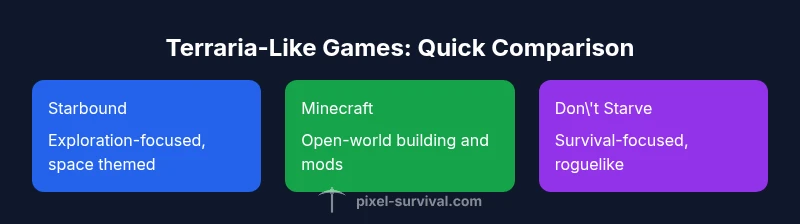
Starbound delivers space exploration in a 2D sandbox with modular progression and planet-to-planet gameplay. It emphasizes exploration, planet customization, and cooperative play, with a steady cadence of updates that add new content. Minecraft, while not 2D, remains the benchmark for open-ended building, redstone automation, and community-driven mods. Its survival mode introduces resource management and combat pacing through a massive crafting system and procedurally generated worlds. Don't Starve leans into survival challenge with a distinctive art style, hunger mechanics, and a roguelike progression that makes each run feel unique. Each title offers a different flavor of the Terraria-like promise: exploration, creativity, or brutal survival. The Pixel Survival team notes that your choice should align with your preferred balance of risk, creativity, and cooperation.
How to pick the right game for your playstyle
Begin by clarifying your top priorities: do you crave expansive exploration and base-building, or do you want a tight progression ladder that rewards steady upgrades? If you value colossal creative potential and modifiable systems, Minecraft-inspired play is advantageous. If you want cooperative adventure with space travel and consistent new content, Starbound could be the best fit. If you prefer a harsh survival loop with scarce resources and permadeath-like tension, Don't Starve is the strongest match. Once you narrow to two options, try a trial period or watch long-form playthroughs to gauge pacing, difficulty curves, and the quality of the crafting or automation interfaces.
Practical progression path for Terraria-like titles
A practical progression path typically starts with basic gear and simple tools, then advances through a sequence of boss encounters or biome milestones. Early-game goals include mastering essential crafting recipes, building a safe hub for storage, and establishing a reliable resource flow. Mid-game involves unlocking better weapons, armor sets, and more complex automation or base-building mechanics. Endgame emphasizes rare materials synthesis, challenging dungeons, and optional goals, such as completing all achievements or building a sprawling base. Remember to balance exploration with defense, and to leverage multiplayer for shared progression, especially in Starbound or Minecraft where coordinated efforts yield faster advancement.
Common pitfalls and how to avoid them
Common missteps include rushing into exploration without adequate gear, neglecting base infrastructure, or ignoring resource management. Another pitfall is overlooking the community features that extend longevity—mod commissions, seeds, or world templates can dramatically alter your experience. To avoid fatigue, alternate between building, exploration, and combat sessions, and set small, achievable milestones rather than chasing a single endgame goal. Finally, verify performance and patch notes before investing time in a new title; graphics are enticing, but smooth gameplay and good balance sustain long sessions.
Final recommendations and how Pixel Survival guides you
There is no single best Terraria-like game; the right pick depends on what you value most in gameplay, progress, and social play. For explorers who want spacefaring adventure and regular content, Starbound is compelling. For builders who love limitless creativity and deep customization, Minecraft remains unmatched in 3D form. For survival purists seeking a challenging run with unique art, Don't Starve offers a distinct experience. Pixel Survival’s approach is to help players map their preferences to concrete play patterns: try two titles with similar pacing, then commit to the one that best matches your time budget and preferred co-op style.
Feature Comparison
| Feature | Starbound | Minecraft (2D-inspired) | Don't Starve |
|---|---|---|---|
| Gameplay Focus | Space exploration and quest-driven progression | Open-world building, crafting, and exploration | Hardcore survival with resource scarcity and roguelike elements |
| World/Progression | Procedurally generated planets with modular progression | Massive, procedurally generated worlds with diverse biomes | Procedural world with permadeath and seasonal survival themes |
| Crafting & Building | Modular crafting with space tech and base-building | Deep crafting tree, flexible building and automation | Survival-oriented crafting with limited base-building options |
| Multiplayer/Co-op | Co-op exploration and shared progression on planets | Online multiplayer with extensive modded content | Coordinated survival with friends and optional shared runs |
| Mod Support | Moderate modding with content expansions | Strong community mods and official support | Thriving fan content and mods despite limited official support |
| Price Range | Paid title with expansions and DLC | Premium title with expansions and marketplace assets | Premium game often sold standalone with optional DLC |
| Best For | Exploration and space-themed adventures, cooperative play | Open-ended creativity, mods, and social play | Hardcore survival and roguelike challenge |
The Good
- Clear, distinct playstyles across titles
- Strong mod ecosystems for longevity
- Cooperative play adds replayability
- Robust crafting and base-building options overall
- Accessible across platforms
Negatives
- Can feel uneven in pacing between titles
- Performance and optimization vary by title and platform
- Some titles can be pricey due to expansions and DLC
- Steep learning curves in survival modes
Choose based on your priority: Starbound for exploration, Minecraft for building, Don't Starve for survival.
If you want space exploration and regular content, Starbound fits. For unlimited building and mod support, Minecraft is ideal. For a brutal survival challenge, Don't Starve stands out. Pixel Survival’s guidance is to align your pick with your preferred play pattern and social setup.
Got Questions?
What defines a Terraria-like game?
Terraria-like games are sandbox adventures that blend exploration, crafting, and gear-based progression in procedurally generated worlds. They emphasize short- and long-term goals set by equipment, bosses, and biomes. The defining trait is a loop that rewards experimentation and steady advancement.
Terraria-like games mix exploration, crafting, and progression in dynamic worlds. Think of a loop that rewards you for upgrading gear and exploring new biomes.
Are 2D titles better than 3D for Terraria-like gameplay?
Both formats offer unique strengths. 2D titles often deliver tighter combat and faster pacing, while 3D games provide expansive building and more spatial exploration. The right choice depends on whether you prefer precision in combat or scale in construction.
It comes down to preference: 2D games are snappier; 3D games give bigger worlds and more building options.
Can I play these games solo, or is multiplayer essential?
All three featured titles support solo play, with multiplayer offering enhanced adventure, shared resources, and cooperative goals. If you enjoy teamwork and exploring with friends, multiplayer significantly enhances the experience.
You can play solo, but multiplayer makes exploration and progression feel more dynamic.
Do these games support mods?
Mod support varies by title; Starbound and Minecraft have large mod communities that add biomes, items, and systems. Don't Starve has user-created mods as well, though the official tooling is more limited.
Yes, many Terraria-like games have strong mod scenes, especially Starbound and Minecraft.
Which title is easiest to get into for new players?
Easiest access depends on your platform and preferred pace. Minecraft’s intuitive building toolset and Starbound’s guided early progression often make them approachable, while Don't Starve’s survival loop can be tougher for absolute beginners.
Minecraft is usually easiest to jump into because the basics click quickly.
Key Points
- Identify your top priority: exploration, building, or survival
- Prototype two titles to compare pacing and UI
- Consider mod support for longevity
- Multiplayer changes pacing and progression
- Balance cost with long-term engagement