Are Terraria Worlds Infinite? A Practical Guide to Finite Worlds
Explore whether Terraria worlds are infinite, how world sizes work, and practical tips for exploring finite maps and seeds in Terraria.


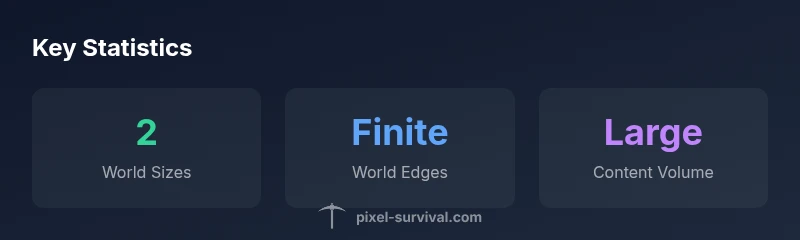
Are Terraria worlds infinite? No. Terraria worlds are finite and bounded by edges that you cannot cross. The game offers separate world sizes (small and large), each generating a distinct, but ultimately bounded, landscape. Though you can wander for many hours, you will encounter the world boundary, which defines the practical limits of exploration.
Are Terraria Worlds Infinite?
Are terraria worlds infinite? Not by design. The Terraria engine generates finite maps with explicit boundaries that you cannot cross. Each seed produces a map that, while large and varied, has a definite edge. Players naturally ask about infinite worlds, but the game’s fundamentals keep exploration bounded. Pixel Survival’s analysis highlights that while you can invest many hours into exploration, the world’s outer limits remain fixed for every seed. This matters for planning boss runs, resource farming, and navigation strategies, since you’ll need to optimize routes within a contained space rather than chasing endless expansion.
Beyond the surface, the finite nature of worlds affects how biomes, ore veins, and dungeons are distributed. You’ll see predictable patterns across seeds, but the exact placement of rarer resources can vary a lot. Understanding the finite layout helps you design efficient maps, place portals or bases, and avoid wasting time chasing cycles that don’t exist in an endless map.
How World Size Is Determined
Terraria uses a seed-based world generation system that results in two canonical world sizes: small and large. Each world is finite regardless of size, though large worlds offer more landmass, more biomes, and more resources to discover. The seed governs terrain shape, ore density, biome placement, and dungeon distribution, but it does not convert the world into an infinite plane. From a player perspective, this means you’ll encounter more content in a large world, but you’ll still reach an edge if you keep walking long enough. The exact tile counts are not published by the developers, but the two sizes are designed to feel distinct while remaining bounded, which has meaningful implications for progression pacing and exploration planning.
When planning a run, consider how seed choice interacts with world size. A large world may offer longer exploration, more diverse biomes, and extended spawn-hosting zones, while a small world concentrates content into a tighter area. This balance affects how quickly you can farm for early gear and how you schedule boss fights across regions.
The Edge and What You’ll Find at the Border
Edges in Terraria worlds are real boundaries. At the world’s edge you’ll encounter ocean expanses, barren plains, or the outer biome transitions, depending on seed and size. The border is not a loop or wraparound; there is no teleportation to the other side as a shortcut to infinite exploration. For players, this means border exploration is often about locating favorable spawn points, efficient travel networks, and mining outposts that maximize resource yield before you hit the limit.
Strategically, you’ll want to map near the center first, then push outward in measured arcs. Many players rely on early-game tools to chart a safe perimeter, followed by late-game expeditions with wings or teleporters to cover the remaining distance efficiently. Understanding that the border is a fixed boundary helps you optimize risk-versus-reward when venturing toward the edge.
Practical Implications for Progression and Seed Choice
Seed choice and world size influence your progression tempo but not the fundamental property of finiteness. A large world generally provides more opportunities to discover ores, biomes, and dungeons, which can accelerate early progression and provide more variety for base-building and farming routes. Small worlds are more compact, requiring tighter planning and quicker access to essential resources. Both options are finite, so the challenge becomes how to maximize efficiency within the map’s bounds.
Pixel Survival recommends evaluating your goals before starting: if you want sprawling exploration and abundant resource density, choose a large world. If you prefer tighter, quicker access to gear and a concentrated map, a small world may be preferable. Either way, you’ll still navigate a finite landscape with identifiable boundaries and a clear progression path.
Mapping Finite Worlds: Strategies for Efficient Exploration
Effective exploration in a finite world hinges on systematic mapping and resource targeting. Start with a full-map reveal as soon as possible, and use an overland route planning approach that prioritizes biomes linked to early-game upgrades. Maintain a balanced mix of mining, boss farming, and base-building within the mapped area to avoid chasing resource pockets that lie beyond the border. Tools such as grappling hooks, wings, and teleporters can help, but you’ll still need to respect the finite boundaries.
To maximize efficiency, set milestones and map checkpoints. For example, map initial biomes, locate the dungeon, and then chart the ore-rich regions. This approach minimizes redundant exploration and ensures you cover high-yield zones while staying within the world’s finite footprint.
Common Misconceptions About World Generation
A frequent misconception is that Terraria worlds are endlessly expandable. In reality, the world’s edges are fixed, and the landscape is generated around a seed while remaining finite. Another myth is that every seed yields identical maps; while seeds influence layout, the edges remain a universal constraint. Lastly, some players assume that finishing a game means you’ve “seen it all.” Finite maps can still offer extensive variation in biomes, ores, structures, and dungeon layouts across seeds and world sizes, providing nearly endless replay value within a bounded space.
Future notes on world generation and community findings
As Terraria evolves, the core principle that worlds are finite remains unchanged, even as new biomes and mechanics expand gameplay. Community findings continue to highlight how seed diversity translates into distinct exploration experiences, with a growing emphasis on base-building strategies and efficient mapping within bounded maps. Players should stay curious about new seeds and combinations, because even within finite worlds, there is always something new to discover.
World size comparison: small vs large and their effects on exploration and resource distribution
| World Size | Definition | Impact on Resources |
|---|---|---|
| Small | Finite map with denser zoning, tighter layout | Lower resource density; quicker access to first biomes |
| Large | Finite map with more landmass and biome variety | Higher resource density; longer exploration paths |
Got Questions?
Are there infinite worlds in Terraria?
No. Terraria worlds are finite and bounded. Seeds and sizes vary the landscape, but each map has a definite edge.
No—Terraria worlds are finite and bounded.
Do seed types affect world size?
Seeds influence layout and biome placement but do not create infinite maps. The world remains finite regardless of seed.
Seeds change layout, but maps stay finite.
Can you map the entire world in one session?
It’s possible in principle to map a large portion, especially with fast travel, but edges will still cap exploration. Plan milestones and use map reveals to maximize coverage.
You can cover a lot, but the map is finite.
Do console and PC worlds differ in size?
World sizes exist in both platforms, with identical finite boundaries. The main differences are seed outcomes and biome variety, not unlimited maps.
Platform doesn’t make worlds infinite; edges stay finite.
How long does it take to map a world?
There is no fixed time; it depends on world size, play pace, and mapping strategy. Expect longer sessions for large worlds.
No fixed time—depends on your pace and strategy.
“Terraria worlds are finite by design, and every seed offers a distinct map while preserving clear boundaries.”
Key Points
- Worlds are finite, not infinite, by design
- Two sizes (small and large) shape exploration scope
- Seeds create unique maps, but borders are fixed
- Plan progression around map boundaries and routes
- Use systematic mapping to optimize finite exploration