What Size Terraria World for 2 Players: A Practical Guide
Discover the ideal Terraria world size for two players, balancing exploration, base-building, and performance. Practical guidance from Pixel Survival to help coop play thrive.


According to Pixel Survival, two players should start with a small to medium Terraria world to balance performance and exploration. A small world minimizes travel time and keeps biomes compact for easy cooperation, while a medium world provides more room for early builds without overwhelming your system. This pragmatic approach supports steady progression for both players.
How world size shapes two-player progression
In two-player Terraria, map size influences resource sharing, biome access, and how you split tasks. A smaller world is generally easier to navigate with a friend: you can set up shared bases near the spawn, coordinate mining runs, and defend against events with less travel time. You’ll find that both players can reach essential commodities—wood, ores, chests, and NPC housing—without long slogging across a huge map. This reduces friction during early progression, letting you focus on gear upgrades, boss prep, and world exploration rather than endless cartography.
On the other hand, larger worlds reward long-term cooperation and creative base-building. You’ll have more space to design distinct zones, multiple bases, and routes for star-dome exploration. The extra biomes mean more unique resources, NPCs, and planetary features to button up into a cohesive base. However, the increase in surface area can complicate planning: you may spend more time organizing storage, coordinating mining expeditions, and defending multiple bases during invasions and events.
The optimal choice depends on your goals, your server’s stability, and your willingness to micromanage layout. For most players, starting small and then expanding as comfort grows provides the best balance between challenge and accessibility.
World size categories for two players
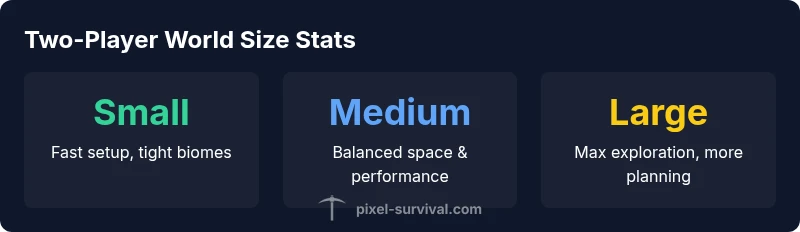
Small world: A compact map where all biomes are within quick reach. It favors rapid access to bosses, resources, NPC housing, and shared projects. The downside is tighter spaces that can feel crowded and limit long-form exploration.
Medium world: A broader map that spreads biomes and resources more evenly. It supports clearer role division between players (one focuses on mining, the other on building) while preserving opportunities for joint ventures. It also reduces bottlenecks but increases the likelihood of navigation challenges for new players.
Large world: Maximum space and biome variety, ideal for sprawling bases, intricate cave networks, and diverse landmarks. The trade-offs are longer travel times, higher storage demands, and more planning to keep progression synchronized between players.
Choosing based on your goals
If you want to rush through progression and boss fights with a partner, start with a small world to minimize travel and accelerate early milestones. If your aim is immersive base-building and exploring varied biomes, pick a medium world to balance space and performance. For players who enjoy ambitious layouts, multi-base aesthetics, and expansive cave systems, a large world offers the most creative freedom. Consider both of you players’ hardware and your tolerance for planning: more space usually means more coordination, but it can pay off with a richer shared experience.
A practical approach is to begin small, establish core progression (gear, NPCs, early bosses), then slowly scale up by migrating to a medium world as you reach midgame objectives. This staged progression reduces risk and keeps the coop experience cohesive.
Layout tips for cooperative play
- Place a central, shared base near the spawn to minimize early travel. Use a compact base design with easily accessible chests and workstations.
- Assign roles early: one player handles mining and resource gathering, the other focuses on construction and base aesthetics. Coordinate upgrades and boss prep to avoid redundant farming.
- Create a shared storage system with labeled chests or layers to organize materials (ores, woods, fabrics, potions) and plan upgrades together.
- Build separate, private bases for personal projects if you prefer, but ensure you maintain a central hub for NPCs and progression milestones.
- Use world anchors and quick teleport options to simplify navigation during events and exploration.
These tactics help two players stay productive without stepping on each other’s toes, regardless of world size.
Performance considerations and hardware needs
Two players generally place modest demands on hardware compared with larger multiplayer setups. In a small world, frame rates tend to stay high on mid-range systems, with faster load times and smoother navigation. As you shift to a medium or large world, you’ll notice increased load times, more frequent data streaming for newly loaded biomes, and a potential dip in frame rate if you’re running low on GPU/CPU headroom. If you use mods or heavy texture packs, consider optimizing graphics settings and using a dedicated server for stable uptime. Always monitor memory usage during long sessions, particularly if you and your partner expand into expansive builds and multiple bases.
Seeds, biomes, and danger zones in two-player worlds
Seed choice can influence biome distribution and early resource availability. Some seeds produce balanced biome spacing that’s friendlier to two-player exploration, while others generate intense biome clustering that creates strategic opportunities but can complicate early routing. Two-player setups benefit from seeds that minimize biome overcrowding near the spawn, enabling quicker joint access to core biomes. Be mindful of danger zones like dungeon corridors and hardmode biomes; plan your first base and a shared checklist to manage progression safely as you push into tougher zones.
Progression strategies for two players
Coordinate milestones: defeat early bosses to unlock useful gear for both players; unlock NPCs in tandem to maximize housing efficiency; schedule collaborative mining expeditions to build shared infrastructure, then split for specialized projects. Regularly review your build priorities and adjust roles as you approach midgame. Documenting your plan—what you’re building, where, and by whom—helps prevent duplicated effort and keeps your two-player world progressing smoothly.
Real-world layouts and quick-start plan
Begin with a tight hub near spawn, then set up a simple mine pathway that leads to a shared iron ore pit and a wood-processing area. Reserve space for a boss arena and NPC housing, and then expand outward with modular rooms that can accommodate new NPCs and storage solutions. A practical two-player plan is to alternate core tasks each session: one session focuses on mining and resource collection, the next on construction and decoration. This rhythm keeps the play experience dynamic and balanced for both players.
Two-player world size comparison
| World Size | Pros | Cons |
|---|---|---|
| Small | Fast setup, easy co-op | Limited space for bases and exploration |
| Medium | Balanced space and performance | Requires moderate coordination |
| Large | Maximal exploration, more planning | Heavier on hardware and planning |
Got Questions?
What is the best starting world size for two players?
For most players, a small world is ideal to learn, build quickly, and coordinate. Move to a medium world once you’re comfortable with progression and want more space for bases and exploration.
Start with a small world to learn together, then move to a medium world if you want more space for bases and exploration.
Is a large world worth it for two players?
A large world is rewarding for expansive builds and varied biomes, but it demands more planning and can slow progression if you don’t coordinate well.
Large worlds are great for big builds, but they require careful planning and coordination.
How can two players stay coordinated in a small world?
Define roles early, use a shared storage system, and establish a central hub. Regularly sync goals and rotate tasks to avoid duplication.
Assign roles, share storage, and keep a steady progression plan to stay coordinated.
Can seed choice affect two-player play?
Yes. Seeds that distribute biomes evenly near the spawn can ease early collaboration and reduce crowding, making two-player progress smoother.
Seed choice can help balance biome spread near the start for easier cooperation.
Should we use a dedicated server for two players?
A basic hosted world typically suffices for two players. A dedicated server is optional unless uptime and persistence are crucial for your group.
A simple hosted world usually works; dedicated servers are optional for two players.
When should we upgrade to a larger world?
Upgrade when you reach midgame milestones and want more room for multi-base projects or diverse biomes without sacrificing progression pace.
Upgrade to a larger world after midgame milestones to gain more space for bases and biomes.
“In two-player worlds, the balance between space and coordination is the key to a smooth coop experience. Start small, then expand as your team grows stronger.”
Key Points
- Start small for quick wins and then expand as needed
- Choose a size that matches your goals and hardware
- Coordinate roles to minimize bottlenecks in any world size
- Use a shared base hub to keep progression cohesive