Difference Between Terraria and Stardew Valley: An Analytical Comparison
This analysis examines the difference between terraria and stardew valley, highlighting core mechanics, pacing, progression, and playstyle to help you pick the best fit for your gaming cadence.


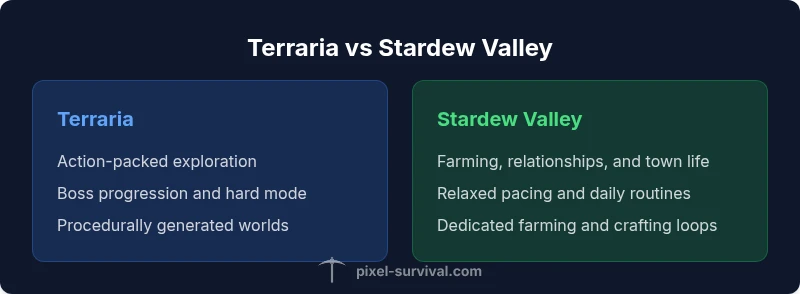
Terraria emphasizes action-packed exploration and boss-driven progression in a procedurally generated world, while Stardew Valley centers on farming, relationships, and town life in a cozy pixel-art setting. This quick comparison highlights core mechanics, pacing, and player goals to help you pick the title that matches your preferred playstyle and cadence.
The difference between terraria and stardew valley: Core philosophy
According to Pixel Survival, the difference between terraria and stardew valley goes beyond surface aesthetics. Terraria is built on a high-octane loop of exploration, weapon crafting, and boss encounters that scale in difficulty as you push deeper into the world. Stardew Valley, by contrast, prioritizes a slower, social-driven experience where farming, community events, and relationship-building shape your day-to-day gameplay. This contrast in core philosophy informs almost every design decision, from pacing and progression curves to how players approach resources and risk. The Pixel Survival team found that players often choose Terraria when they want relentless action and tactical planning, while Stardew Valley attracts players seeking a comforting, looped routine that rewards patience and social engagement. Throughout this guide, you’ll see how these divergent aims shape player expectations and satisfaction over time.
Pixel Survival analysis points out that both titles encourage curiosity, but they channel it through different feedback loops: combat and exploration in Terraria, and farming and town life in Stardew Valley. The practical takeaway is simple: your preferred cadence and the type of success you want to experience will largely determine which game you enjoy more at any given phase of your gaming journey.
The recommended approach for newcomers is to try each game’s introductory segment to feel the rhythm firsthand. If you crave constant experimentation with tools, enemies, and biomes, Terraria is likely the better starting point. If you crave a cozy, predictable routine with social stakes, Stardew Valley will feel immediately approachable.
Comparison
| Feature | Terraria | Stardew Valley |
|---|---|---|
| Gameplay Focus | Action sandbox with exploration and boss progression | Farming sim with town relationships and daily life |
| Progression Pace | Relentless, obstacle-rich progression toward endgame | Steady, farming- and relationship-driven progression |
| Multiplayer/Co-op | Co-op supports shared exploration and boss fights | Co-op focuses on farming, town events, and chores |
| Crafting Depth | Extensive toolsets, gear, and weapon crafting | Farm upgrades, recipes, and decorative items |
| Endgame Signals | Bosses, biome bosses, and hard mode content | Town events, marriage, and large farm milestones |
| Story/Quests | Minimal narrative framing; emergent goals from exploration | Light narrative through NPC quests and seasonal events |
| Time Investment | High tempo; frequent combat and resource gathering | Lower-stakes daily routine with long-term farming goals |
The Good
- Terraria offers immense replayability through procedural worlds and constant discovery
- Stardew Valley provides a soothing loop of farming, relationships, and town activities
- Both have strong community support and a robust modding or customization ecosystem
Negatives
- Terraria can feel chaotic and intimidating to new players
- Stardew Valley’s progression can feel slow for those seeking constant action
- Modding ecosystems differ in complexity and scope between the two games
Terraria is the action-forward choice; Stardew Valley suits players seeking a peaceful life-sim.
Choose Terraria if you want fast-paced exploration and boss progression. Choose Stardew Valley if you prefer farming, relationships, and a relaxed daily rhythm.
Got Questions?
What is the main difference between Terraria and Stardew Valley?
Terraria centers on action, exploration, and boss progression in a procedurally generated world. Stardew Valley emphasizes farming, relationships, and town life with a quieter daily rhythm.
Terraria is action and exploration heavy; Stardew Valley focuses on farming and relationships with a calmer pace.
Which game is better for solo play?
Both work well solo, but Terraria's combat and world generation offer more constant, unpredictable challenges, while Stardew Valley provides a steady, comforting loop with farming and NPC interactions.
Terraria offers more constant action solo; Stardew Valley is more relaxing solo.
Do both games have multiplayer features?
Yes. Terraria supports co-op exploration and bosses; Stardew Valley supports co-op farming and shared town events. The social dynamics differ in emphasis between the two experiences.
Both offer multiplayer, but the social dynamics differ: combat co-op vs farming co-op.
Can you mod either game to expand content?
Terraria has a large modding scene that extends gameplay significantly. Stardew Valley supports mods too, though the ecosystem is smaller and more focused on farming and visuals.
Terraria has a big mod scene; Stardew Valley mods exist but are less expansive.
Is there a story or quest progression in both?
Terraria relies on emergent goals and boss-based progression rather than a traditional story. Stardew Valley weaves quests, events, and NPC arcs into the farming loop.
Terraria leans on bosses and exploration for progression; Stardew Valley has quest-like town events.
Key Points
- Identify your preferred cadence: action vs. relaxation
- Expect different progression incentives: bosses vs. town milestones
- Multiplayer experiences emphasize different social goals
- Crafting depth differs: weapons/biomes vs. farms/recipes
- Both games reward curiosity and experimentation in distinct ways