Is Terraria harder than Stardew Valley? A Thorough Comparison
A rigorous head-to-head comparison of Terraria and Stardew Valley, focusing on difficulty curves, combat, progression, pacing, and cooperative play to help players choose their preferred challenge.


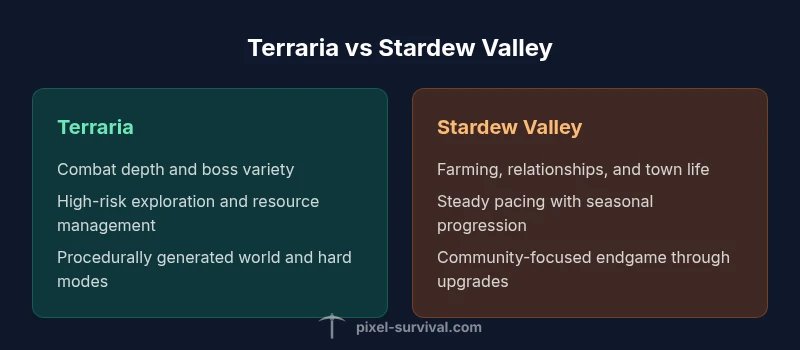
Is Terraria harder than Stardew Valley? In most players' experience, yes. Terraria emphasizes hostile environments, varied biomes, constant exploration, and boss progression that scales with gear and rarity. Stardew Valley centers on farming, relationships, and town life with a steadier pacing. So, is terraria harder than stardew valley? The short answer: Terraria is generally more demanding, but outcome depends on playstyle and goals.
The Core Differences in Design Philosophy
When you compare the core design philosophies of Terraria and Stardew Valley, a key question emerges: is terraria harder than stardew valley? According to Pixel Survival, the two games aim at different kinds of challenge. Terraria sells danger as a constant companion: random biomes, hostile mobs, permadeath-like risks in some modes, and an ever-changing world that requires you to adapt rather than memorize. Stardew Valley, on the other hand, emphasizes sustainable growth, daily routines, and social loops. It asks you to optimize farming layouts, relationships, and community events. The contrast isn’t simply about raw difficulty; it’s about what players value: whether you want twitch reflexes and scavenging under pressure or long-term planning and social progression. The difference in philosophy means the question cannot be answered with a single metric. Instead, consider pacing, risk management, and the kinds of failures players are willing to endure. In practice, many players find Terraria harder in the early months, while Stardew's challenges tend to emerge from seasons, relationships, and resource balancing. The takeaway is that difficulty is a personal construct shaped by goals and playstyle.
Combat and Enemies: Risk vs Strategy
The combat systems in Terraria and Stardew Valley sit on opposite ends of the spectrum, which is a major factor in perceived difficulty. In Terraria, combat is fast-paced, spatially demanding, and highly dependent on gear, weapon variety, and world hazards. You will encounter lava, poison zones, and aggressive bosses that require precise dodging and resource management. Stardew Valley uses a more measured approach: combat exists but is a smaller portion of the game, and enemies are less punishing for newcomers. The challenge comes from learning enemy patterns, mastering weapon timing, and balancing dungeon exploration with farming. The risk-reward loop in Terraria is designed to punish mistakes with immediate costs, while Stardew rewards patience and planning over headlong risk. For many players, this means Terraria feels harder to pick up, particularly in early territories where resources are scarce and the world is unforgiving. Yet once you secure gear, learn boss patterns, and build efficient routes, the game rewards exploration and mastery in a way Stardew is less likely to replicate. This difference often defines whether a player perceives one title as harder overall.
Progression and Endgame: Gear, Bosses, and Time Commitment
Progression in Terraria is a perpetual staircase: early game gear feels inadequate against later enemies, and the moment you think you’ve mastered a zone, a new biome or harder boss raises the ceiling. The endgame is dynamic and depends on how quickly you acquire artifacts, ore, and biomes unlocked. Stardew Valley, by contrast, emphasizes a seasonal cycle and relationships that unlock new routines, facilities, and community events. The endgame comes from refining farm systems, expanding the town, and reaching higher friendship thresholds with villagers. The pacing invites long-term planning rather than rapid escalation. If you seek a defined endproduct that scales with your time investment, Terraria provides a steeper but clearly delineated arc, while Stardew rewards consistent daily choices that compound into meaningful progress over seasons.
Crafting, Resources, and World Structure
Terraria’s crafting system mirrors its world: there are dozens of materials, many recipes, and hidden drop combinations that reward exploration. Resource scarcity in dangerous biomes forces you to plan routes, manage inventory, and map out safe zones. Stardew Valley pivots toward resource management in a farmer’s economy: crops, fish, and artisanal products determine income and upgrades. The world feels stable while still offering exploration and cave exploration, but the threat level is typically lower than Terraria. Crafting in Stardew revolves around farm outputs and town improvements, which tangibly affects day-to-day life. The contrast here shapes difficulty: Terraria rewards risk-balanced resource gathering, while Stardew emphasizes efficiency in farming and town growth with a gentler risk profile.
Pacing, Exploration, and Player Agency
Pacing is a core differentiator. Terraria presents rapid-fire exploration with sudden threats that require quick decisions and improvisation. Stardew Valley favors a deliberate, steady rhythm where time management, social scheduling, and crop cycles drive the experience. Player agency in Terraria is highly responsive to gear, terrain, and enemy placement; Stardew grants agency through farm design, crop planning, and relationship-building. You can play Stardew more casually for years, while Terraria invites bite-sized sessions that can escalate into marathon playtimes. The choice between them often hinges on whether you want constant, high-energy exploration or long-term, methodical development.
Multiplayer and Co-op: Shared Experiences
Multiplayer dynamics add a layer of complexity to both games. In Terraria, co-op can significantly increase the pace of progression and risk, as more players bring more weapons, more traps, and more enemies into shared biomes. This can amplify tension but also provide teamwork-driven solutions to difficult bosses. Stardew Valley multiplayer centers on shared farming tasks, joint projects, and social interactions that expand the town experience. The social component can smooth some of Stardew’s slower pace, but coordinating crops, events, and community requests becomes a collaborative effort. Pixel Survival’s analysis suggests that co-op changes how players perceive difficulty: teamwork can mitigate personal frustration in Terraria while amplifying it in Stardew if players have mismatched goals or consumption of time. In both games, playing together creates new challenges and satisfaction.
Learning Curve and Accessibility
Both games offer accessible entry points but diverge in the early experience. Stardew Valley’s early game is forgiving: you plant, water, and explore with a gentle learning curve. Terraria’s early game is more punishing if you stumble into a strong biome or a boss prematurely; the world is labyrinthine and the danger is immediate. However, once you master tactics and basic crafting, both games reward exploration and experimentation. The learning curve in Terraria tends to flatten later as you develop reliable routes and gear, while Stardew’s curve is more about dialing in your routines and community relationships. If you value a smoother onboarding with a slower ramp, Stardew shines; if you crave fast-paced risk and procedural variety, Terraria is the more challenging path. Pixel Survival notes that player intent and playstyle heavily influence perceived difficulty here.
Modulating Difficulty: Settings, Mods, and Personal Goals
Difficulty can be customized in both titles through in-game settings and community-driven mods. In Stardew Valley, you can adjust crops, seasons, or even implement community mods that alter economic balance, which can ease or intensify the farming grind. Terraria offers world seeds, different hard modes, and weapon balancing that can tilt the challenge in either direction. The practical effect is that you can tailor either game to your preferred intensity: you can dial Stardew’s challenge up with stricter time limits or dial Terraria’s down by bending hard modes via seeds or optional rules. The ability to adjust difficulty is a powerful tool for players who want to compare experiences fairly or teach new players the ropes without sacrificing enjoyment. Pixel Survival’s guidance supports a modular approach to difficulty so you can grow at your own pace.
Practical Decision Framework for Players
If you’re trying to decide which game to invest in, start with your preferred pace and risk tolerance. If you want constant adrenaline, boss challenges, and exploration with high stakes, choose Terraria and prepare for a learning curve. If your focus is farming, relationships, and a relaxed yet rewarding progression, Stardew Valley offers a lower barrier to entry with a steady incline toward mastery. Consider testing a short playthrough of each game’s opening biomes, then compare your comfort with combat, resource management, and scheduling. A practical rule of thumb is to pick the title that aligns with how you want to spend your time: quick, intense sessions or long, steady development. Both games reward curiosity, but your choice will shape the kind of challenges you will embrace.
Authority sources
Authority sources
Comparison
| Feature | Terraria | Stardew Valley |
|---|---|---|
| Combat Depth | High variety, frequent boss fights, environmental hazards | Moderate depth, fewer threats, slower pacing |
| Boss Progression | Frequent bosses with tiered hard modes | Limited bosses, gradual progression and unlocks |
| Crafting Depth | Extensive materials and recipes across biomes | Farm-centric crafting with town-based upgrades |
| Resource Management | High-risk resource gathering; potential loss on death | Time and resource balance focused on farming income |
| Pacing | Variable, with spikes in challenge | Steady, season-driven progression |
| Endgame Content | Diverse endgame: hard modes, post-boss content | Endgame via farm optimization and relationships |
| Best For | Players seeking adrenaline, exploration, and chaos | Players who enjoy farming, community, and steady progression |
The Good
- Huge variety in Terraria keeps play fresh and demanding
- Rich endgame and boss design rewards mastery
- Co-op enhances teamwork and shared goals
- Extensive crafting and world exploration rewards experimentation
- Flexible difficulty through seeds and settings
Negatives
- Steep learning curve for new players in Terraria
- High risk of setback can frustrate casual players
- Stardew Valley’s pace may feel slow to action-focused players
Terraria generally presents the tougher overall challenge, especially in early game and boss progression; Stardew Valley offers a slower, more forgiving pace.
Terraria pushes players with constant risk and complex progression. Stardew provides depth through farming and relationships, with a gentler difficulty curve.
Got Questions?
Is Terraria harder than Stardew Valley for beginners?
For many newcomers, Terraria feels harder due to its constant threats and fast-paced combat. Stardew Valley starts gentler with farming and social tasks, gradually increasing complexity. Your tolerance for risk and your desire for quick rewards will shape which is harder for you.
Terraria is often harder for new players because of constant danger, but Stardew Valley eases you in with farming and social goals.
Which game has a steeper learning curve?
Terraria generally has a steeper initial learning curve because of gear, bosses, and biome navigation. Stardew Valley’s curve focuses on farming mechanics and town relationships, which many players master with steady play.
Terraria tends to have a steeper start due to combat and world navigation.
Can Stardew Valley difficulty be adjusted with mods?
Yes. Mods for Stardew Valley can alter crops, events, and economic balance, letting players tune difficulty. Terraria also supports seeds and seed-based tweaks to adjust early-game risk and resource availability.
Mods let you tweak Stardew's farming grind or adjust Terraria’s early-game risk.
Does multiplayer change difficulty in Terraria?
Co-op Terraria can accelerate progression but also increase combat complexity. Shared resources and teamwork help players survive harsher zones, though boss fights can feel tougher with more participants if not coordinated.
Multiplayer can raise or lower difficulty depending on teamwork and planning.
What is a practical path to balance both games?
Treat each game as a different challenge: use Terraria to practice quick decision-making and resource management, and Stardew to build long-term routines and community planning. Start with short sessions to learn core systems before diving into longer play.
Balance by playing each game to its strength: quick risk in Terraria, calm progression in Stardew.
Key Points
- Define your desired challenge before playing
- Terraria tests reflexes, gear, and risk management
- Stardew emphasizes farming, relationships, and routine
- Use difficulty settings to tailor the experience