Is Terraria Harder Than Cuphead? A Thorough Comparison
An analytical side-by-side look at whether Terraria is harder than Cuphead, comparing difficulty curves, progression, boss design, learning curves, and player experience to help you choose your next challenge.


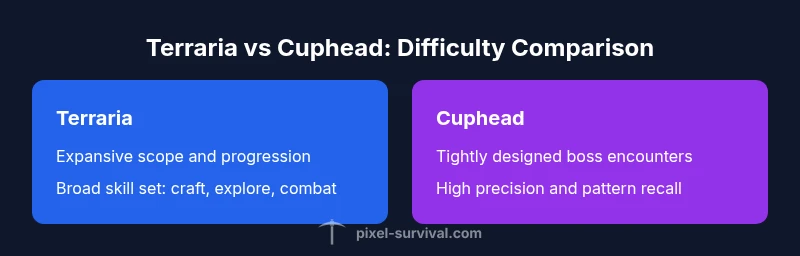
Is Terraria harder than Cuphead? The short answer is nuanced: Terraria presents a broader difficulty curve due to its sandbox scope, progression pacing, and boss RNG, while Cuphead offers intense, highly scripted boss encounters. For most players, mastery comes from consistent practice, learning patterns, and adapting strategies across environments. In a direct sense, Cuphead tests reaction time and memorization; Terraria tests strategic planning and resource management.
The Question in Context
The question 'is terraria harder than cuphead' is not easily answered with a single stat or a single moment of failure. It demands a broader lens: what does 'hard' mean in the context of a game that blends exploration, resource management, and unpredictable boss encounters with a roster of biomes and sequenced events? According to Pixel Survival, difficulty can be decomposed into skill ceiling, time-to-proficiency, and the way the game teaches you to adapt. Terraria offers expansive contexts for mastery: you are rarely stuck on a single obstacle, yet the game expects you to plan, craft, and explore to reach new zones. Cuphead, by contrast, imposes a tighter test of reflexes, pattern recognition, and execution. The result is that many players encounter a sharper, more immediate difficulty spike in Cuphead, while Terraria presents a softer gradient with longer horizons.
Core Mechanics and Player Toolkit
Terraria rewards a wide toolkit: crafting, mining, building, and combat all scale with your progression. The player creates and maintains resources, discovers new biomes, and selects gear that broadens your strategic options. In contrast, Cuphead constrains its toolkit to precise weapon combinations and relentless boss patterns. The core mechanic is execution under pressure, with less room for improvisation once a level begins. This contrast matters for how players experience difficulty: Terraria distributes skill across many systems, while Cuphead concentrates it into few high-stakes moments. As a result, a player who excels at resource management and planning may find Terraria’s difficulty more forgiving in the short term but more demanding over the long haul, whereas Cuphead punishes hesitation and missteps with immediate, clearly visible failures.
Bosses, RNG, and Encounter Design
Cuphead’s bosses are designed to be learned through repetition: memorize attack patterns, dodge windows, and optimize damage windows. The encounters are highly scripted, with a clear sequence that rarely deviates from run to run. Terraria’s boss roster is larger and more varied, and the battle design can be influenced by the world seed, biomes, and the gear you’ve crafted or found. RNG enters Terraria in more nuanced ways—loot drops, seed-based world quirks, and biome access can shift which strategies are viable. This means a single world can feel very different from another, affecting perceived difficulty. The contrast highlights a fundamental difference: Cuphead tests deterministic execution, while Terraria tests adaptive mastery across a broader design space.
Progression Pacing and Time Investment
Cuphead presents a compact arc: you learn several bosses, accumulate experience, and clear through a finite set of encounters before you reach the credits. The pacing is rapid, and progress can be dramatic after a bad run—yet you see tangible milestones quickly. Terraria unfolds at a much longer cadence: progression depends on gathering resources, crafting better equipment, unlocking new biomes, and facing a rotating cast of bosses. Players often invest dozens to hundreds of hours before feeling truly proficient. This disparity can mislead players who measure difficulty by short-term spikes; the longer journey in Terraria proves more forgiving per encounter but much more demanding as a complete experience.
Skill Transfer and Cross-Game Mastery
Some cognitive skills transfer between the two games: pattern recognition, reaction timing, and learning from failure. However, the skill sets are not directly interchangeable. Cuphead’s mastery hinges on reflexes and pattern memory, while Terraria emphasizes planning, resource management, and versatile combat setups. A player proficient in Cuphead’s timing will still need to relearn biome navigation and crafting loops in Terraria, and vice versa. The cross-over is real but limited; becoming adept at one game will accelerate progress in some respects but not in others. This nuance is crucial when evaluating whether one game is categorically harder—both demand excellence, just in different domains.
Accessibility and Platform Differences
Accessibility in Cuphead is strong on most platforms, with controller support and straightforward inputs that suit casual players who want to experience the challenge. Terraria, being a broader sandbox, offers more input complexity but also a wider array of accessibility options: adjustable game pace, multiple control schemes, and a generous modding ecosystem. Platform differences matter; PC players often benefit from mods and quality-of-life tweaks that can ease or intensify difficulty. The upshot is that perceived difficulty isn’t fixed; players can tailor both titles toward the level of challenge they seek, though the tailoring leans differently for each game.
Co-op, Community, and Replayability
Co-op in Cuphead is a shared memorization and execution exercise: you can split patterns between players and practice together. Terraria naturally lends itself to co-op play with expansive worlds, shared resources, and collaborative boss fights across multiple players. Replayability in Terraria is driven by base-building choices, exploration, event spawns, and long-term progression, while Cuphead’s replay value comes from mastering every boss’s patterns and achieving perfect runs. The social and community aspects of both games support learning and improvement, but the cadence of progress differs—Cuphead rewards tight coordination, Terraria rewards sustained experimentation and collaboration.
Modding, Difficulty Tweaks, and Content Extensions
Terraria’s modding scene is a major factor in difficulty perception: players can add new bosses, modify loot tables, or tweak enemy stats to re-balance the experience. This capacity to calibrate difficulty is a double-edged sword: it can make the game more accessible or more punishing, depending on the mods chosen. Cuphead’s difficulty is comparatively fixed, though post-release content and optional runs can increase longevity. The presence of mods in Terraria means that two players could have vastly different difficulty experiences in the same world, while Cuphead remains consistent across official releases. This distinction is essential for players who value customizable challenge versus a fixed, curated experience.
Practical Takeaways for Players Facing the Question
If you’re deciding whether to tackle Terraria or Cuphead, start by clarifying your priorities: do you want a broad, long-term mastery journey or a focused, boss-centric challenge? Use a trial run in each title to gauge which type of difficulty resonates with you. In Terraria, invest in a basic build and a reliable progression path to reduce early frustration, then gradually experiment with biomes, gear, and bosses. In Cuphead, practice specific boss patterns in a controlled environment, focusing on one or two stages at a time before advancing. Finally, leverage co-op play to share the load and accelerate learning in both games. This practical approach respects the distinct ways each title tests your abilities and provides a clear path to improvement.
Comparison
| Feature | Terraria | Cuphead |
|---|---|---|
| Core Gameplay Scope | Expansive, sandbox exploration and progression | Tight, boss-focused run-and-gun action |
| Boss Diversity & Design | Many bosses with varied mechanics and RNG elements | A smaller, fixed boss roster with highly polished patterns |
| Learning Curve | Broad, multi-step progression including crafting and biomes | Steep, pattern-based learning with immediate feedback |
| Time to Mastery | Longer term; hours to dozens of hours to feel proficient | Shorter, but with steep practice required for each boss |
| Co-op Experience | Large multiplayer servers and shared progression | Local co-op with limited simultaneous players |
| RNG Influence | World seeds, loot drops, and biome variability add randomness | Low randomness; boss patterns are deterministic |
| Accessibility & Platforms | Wide platform support; extensive modding and QoL options | Solid cross-platform support; no official difficulty mods |
| Best For | Players who want endless exploration and long-term progression | Players seeking precise, high-consequence boss challenges |
The Good
- Terraria offers a deep, scalable mastery curve and vast content
- Cuphead delivers razor-sharp, highly polished boss encounters
- Both games reward practice, pattern recognition, and strategic thinking
- Co-op play adds social learning and shared pacing
- Mods and settings can tune difficulty in Terraria
Negatives
- Terraria's difficulty can feel inconsistent due to RNG and world seeds
- Cuphead's spikes can be punishing for new players with limited practice options
- Terraria's vast content may overwhelm complete beginners
Terraria offers broader, long-term mastery, while Cuphead challenges are more immediate and reflex-driven.
Terraria presents a wider skill frontier and longer commitment, whereas Cuphead concentrates difficulty into tight, high-pressure boss encounters. Your preference for exploration and crafting versus execution-based challenges will largely determine which title feels harder to you.
Got Questions?
Is Cuphead harder than Terraria in boss fights?
Cuphead emphasizes precise boss patterns and reaction timing, making individual boss fights feel harder in the moment. Terraria complicates fights with more variables and a larger boss roster, so the overall difficulty depends on context and progression.
Cuphead bats you with precise boss patterns; Terraria piles on variables across many fights.
Which game has a steeper learning curve?
Terraria generally has a steeper learning curve due to its expansive systems—crafting, biomes, progression, and gear optimization. Cuphead has a steep learning curve focused on memorizing and executing boss patterns efficiently.
Terraria’s learning curve is broader; Cuphead’s is sharper but narrower.
Do skills from Cuphead help in Terraria?
Some core skills—pattern recognition, persistence, and learning from failure—transfer, but most mechanics differ. Success in Terraria requires planning, resource management, and long-term strategy alongside combat.
Pattern learning helps, but you’ll still relearn crafting and exploration in Terraria.
Are there difficulty modes in Terraria or Cuphead?
Terraria includes official difficulty options like Journey Mode and Master Mode, which adjust progression and enemies. Cuphead’s base game has no built-in difficulty slider, though players can seek out challenging cycles or DLC content for variety.
Terraria offers difficulty-adjustment options; Cuphead sticks to its core challenge.
Does playing cooperatively reduce difficulty?
Co-op can reduce perceived difficulty by sharing tasks, coordinating boss phases, and providing mutual learning. Both games support cooperative play, but the impact depends on player compatibility and communication.
Co-op helps, especially when teams split boss patterns or tasks.
What’s the best approach for a newcomer choosing between them?
Try a short trial in both games. In Terraria, start with a simple base and basic gear, then branch into bosses. In Cuphead, focus on a couple of stages to build reflexes before tackling the full roster.
Test both games briefly to see which difficulty style you enjoy more.
Key Points
- Assess your preference for long-term progression vs tight boss challenges
- Expect Terraria to demand more time investment for mastery
- Expect Cuphead to demand fast reflexes and memorization
- Use co-op to ease difficulty and extend learning
- Mods and accessibility options can shift perceived difficulty