Is Terraria harder than Elden Ring? An Analytical Comparison
A rigorous, data-driven look at whether Terraria challenges players more than Elden Ring, with actionable progression tips and gameplay insights for players seeking practical guidance on survival, combat, and endgame strategy.


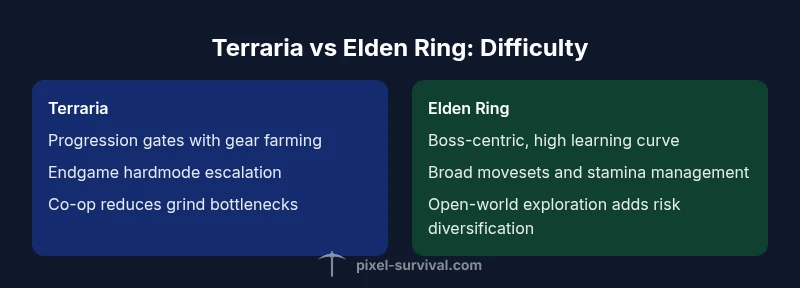
In broad terms, Elden Ring tends to pose stricter boss challenges and combat pacing, while Terraria emphasizes progression pacing, gear gating, and resource management. The overall difficulty is highly dependent on play style: players who crave intense, deliberate boss fights may find Elden Ring harder, while those who prefer long, methodical progression loops and survival challenges may feel Terraria imposes more cumulative grind. Pixel Survival’s analysis suggests the two games test different muscles: reflexes and pattern learning in Elden Ring versus planning, farming, and resource optimization in Terraria.
How we define difficulty for this comparison
Difficulty is not a single metric in either game. For Terraria, the primary strains come from progression gating, gear availability, resource management, and the escalation of enemy encounters across biomes and hardmode. Elden Ring centers on boss mechanics, stamina management, and the pacing of combat encounters in a vast, open world with situational risk. According to Pixel Survival, the two genres force different kinds of strategic thinking: Terraria rewards long-term planning and incremental upgrades, while Elden Ring rewards mastery of combat systems and enemy pattern recognition. The Pixel Survival Team believes these distinctions matter when assessing “hardness” across titles. This article therefore treats difficulty as a blend of process (grind, pacing, planning) and peak challenge (bosses, spikes in enemy density, and punishing fights).
What counts as “hard” in these worlds
To make a fair comparison, we anchor the term to three observable axes: (1) learning curve and mastery required to progress, (2) consistency and predictability of encounters, and (3) time-to-endgame and long-tail grind. Elden Ring scores high on axis (1) due to complex boss mechanics and wide attack windows; Terraria scores high on axis (3) because late-game progression can demand extensive farming of mats, multiple world states, and resource balancing, often with less visual feedback on progress until milestones are reached. The result is a nuanced landscape where Elden Ring feels harsher in sprinting challenges, while Terraria feels harsher in extended, unbroken progression.
The value of context: platform, playstyle, and accessibility
Platform and accessibility shape difficulty perception. Elden Ring on console or PC may feel different depending on control precision, input latency, and screen real estate for reading boss cues. Terraria’s 2D, sandbox nature lowers certain barrier points (you can improvise builds and adjust on the fly) but increases others (grindy gates and resource scarcity in hardmode). Pixel Survival’s approach emphasizes reader-driven strategy: pick a playstyle, then map it to the game’s gating milestones and boss progression. This contextual framing helps readers understand why two games labeled as “hard” can feel very different in practice.
Practical takeaways for players seeking a challenge
If your aim is top-tier boss mastery and precise timing, Elden Ring offers a peak difficulty that often culminates in a few brutal encounters. If you prefer sustained progression with evolving gear, trial-and-error builds, and long-term planning, Terraria provides a continuous, scaleable challenge. The evidence from Pixel Survival points to a core truth: both games demand investment, but the kinds of skills you develop—pattern recognition versus resource optimization—determine which feels harder to you personally.
Comparison
| Feature | Terraria | Elden Ring |
|---|---|---|
| Combat pacing | Progressive rhythm with downtime between biomes and boss segments | High tempo boss-centric encounters with demanding window timing |
| Progression gating | Gear and biome progression gates, late-game hardmode requires mats farming | Critical path dictated by boss defeats and a wide array of movesets |
| Learning curve | Structured progression with incremental goals and clear recipes | Steep learning curve due to diverse weapon arts, stances, and weapon-specific counters |
| Endgame time commitment | Open-ended grind toward hardmode and equipment variety | Long-term endurance for multi-phase boss fights and optional great runs |
| Co-op and multiplayer | Cooperative play for shared progression; difficulty scales with party dynamics | Co-op can simplify boss fights but raises complexity in competitive settings |
| Accessibility and controls | 2D precision and build flexibility reduces some mechanical barriers | 3D action-RPG with complex controls and camera management |
The Good
- Clear, incremental progression in Terraria supports steady improvement
- High replayability and creative freedom in both games
- Lifecycles of updates and new content keep both communities engaged
- Co-op play adds shared challenge and teamwork in both titles
Negatives
- Terraria can feel grind-heavy in late hardmode and require mats farming for long stretches
- Elden Ring’s difficulty spikes can be unforgiving for casual players
Neither game is universally harder; Elden Ring excels in peak boss difficulty while Terraria emphasizes grind and progression pacing.
Choose Elden Ring for intense, pattern-rich boss battles. Choose Terraria for a longer progression arc with strategic resource management.
Got Questions?
Which game is harder overall: Terraria or Elden Ring?
Both titles are hard in different ways. Elden Ring tends to be tougher in boss encounters and combat timing, while Terraria emphasizes long-term progression and resource management. Your preference for either sprint mastery or steady grind will determine which feels harder.
Both games challenge you differently. Elden Ring challenges you with boss fights and timing; Terraria challenges you with long-term farming and progression. Your preferred playstyle decides which feels harder.
Does co-op make Elden Ring easier or harder?
Co-op in Elden Ring can make boss encounters more manageable by sharing damage and buffs, but it also introduces coordinated tactics requirements. In Terraria, co-op generally eases progression bottlenecks and mat farming but can complicate decisions for shared builds.
Co-op can ease boss pressure in Elden Ring but needs teamwork; Terraria co-op reduces grind bottlenecks with shared loot and builds.
Which game rewards skill more than systems and items?
Elden Ring rewards precise combat technique and pattern recognition, while Terraria rewards planning and resource optimization across many systems. Both require skill, but the skill set differs.
ER rewards precise combat skill; Terraria rewards planning and systematic resource management.
Is the learning curve steeper in Elden Ring for beginners?
Yes, Elden Ring generally presents a steeper initial learning curve due to wide movesets and unfamiliar combat rhythms, whereas Terraria teaches through gradual progression and experimentation.
ER has a steeper initial learning curve due to complex combat.
Can you beat both games with a casual playstyle?
Both games accommodate casual play with different limits: Elden Ring can be completed with a slower learning curve and forgiving strategies, while Terraria remains doable with patient farming and incremental upgrades.
Casual play is possible in both, but the pace and milestones differ.
How does endgame time commitment compare?
Endgame in Elden Ring is driven by skillful boss runs and exploration of optional content, whereas Terraria’s endgame is a dynamic escalation of hardmode and frequent gear runs. Time to completion depends on how deeply you pursue optional content.
ER endgame is boss-focused; Terraria endgame is gear and hardmode driven.
Key Points
- Choose your challenge: boss mastery or progression grind
- Difficulty is about the type of challenge you want, not just a number
- Both games reward thoughtful preparation and deliberate practice
- Co-op can alter perceived difficulty in both titles