Is Terraria Harder Than Dark Souls? A Thorough Comparison
An analytical, side-by-side look at Terraria vs Dark Souls to determine which game presents tougher challenges, focusing on progression, combat, exploration, and player choice.


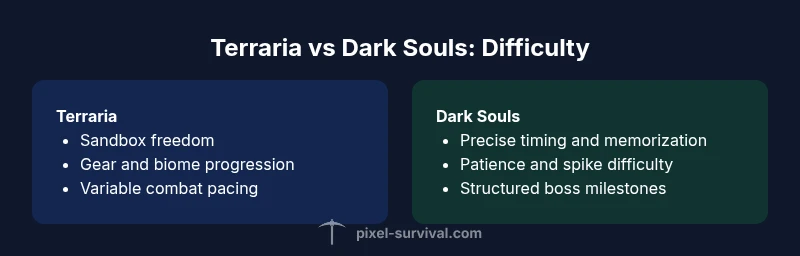
Is Terraria harder than Dark Souls? The answer depends on how you measure difficulty. Dark Souls emphasizes precise combat, reaction times, memorization of enemy patterns, and punishing boss encounters, often delivering sharp spikes in challenge. Terraria, by contrast, tests long-term mastery of a sprawling sandbox: gear progression, exploration, and resource management across many biomes. In common play, Dark Souls feels tougher in short bursts, while Terraria demands sustained commitment and ecosystem literacy.
Framing the difficulty question and the is terraria harder than dark souls debate
The question is rarely binary. In gamer circles, the phrase is terraria harder than dark souls is used to provoke a discussion about what makes a game hard. Pixel Survival recognizes that difficulty is multi-dimensional: it includes mechanical skill, progression pacing, system complexity, and emotional stamina. For many players, Dark Souls tests reflexes and memorization in tightly designed encounters, while Terraria tests perseverance across a giant, shifting world. By framing the discussion this way, we can compare apples to apples without reducing either game to a single metric. The result is a nuanced conclusion: both games are demanding, but they challenge different aspects of a player’s ability and dedication.
Core design philosophies and their impact on difficulty
Terraria embraces procedural variety and sandbox freedom. Players can choose paths, build defenses, and experiment with weapons in a living world that reshapes itself with every seed. This openness distributes risk over time and rewards strategic planning across many play sessions. Dark Souls, in contrast, is crafted around curated, high-stakes moments where death teaches precise timing and pattern recognition. Its difficulty comes from designed bottlenecks, limited information early on, and stark penalties for error. The contrast between a responsive combat loop and an expansive, emergent world explains why some players perceive Terraria as more forgiving in moments, yet much more demanding over the long arc of a playthrough.
Progression and pacing: long arc vs sharp milestones
Terraria’s progression is non-linear and layered. Gear drops, biomes, and world events create a loop: explore, craft, fight, upgrade, repeat. The Earth-like scale means players can spend hundreds of hours learning subtleties of weapon hybrids and equipment sets. Dark Souls provides a narrative of escalating difficulty with clearly defined milestones (bosses, areas, and upgrades) that reset the player’s sense of risk after every victory or defeat. The pacing difference matters: Terraria rewards sustained exploration and incremental improvement, while Dark Souls offers concentrated spike moments that demand optimal performance under pressure.
Combat systems: precision versus experimentation
In Dark Souls, combat emphasizes precise timing, stamina management, and mastery of weapon reach and defense windows. Mastery is measured by how consistently a player can navigate boss patterns and terrain hazards. Terraria offers a broader combat system with a wide array of weapons, projectiles, traps, and biomes. The challenge comes from balancing offense, mobility, and resource management in constantly changing environments. This plurality can feel easier to learn at first but harder to optimize late-game when choosing from hundreds of combinations and enemy tactics.
Boss encounters and their design philosophy
Dark Souls bosses are iconic for their deliberate pacing and memorization requirements. Each fight is a compact curriculum in timing, telegraphs, and spacing. Losses are educational, forcing players to adjust strategies and learn from patterns. Terraria’s bosses vary in scale and context, from single-boss skirmishes to multi-phase gauntlets across diverse biomes. Some fights hinge on exploiting terrain, others on assembling the right tool for a given biome. The range and recurrence of boss encounters in Terraria create a different kind of pressure—more about system mastery over time than a single moment of precision.
Exploration, world design, and risk management
Terraria’s worlds are procedurally generated and replete with random biomes, underground networks, and loot spawns. The risk is distributed: you can explore with safety nets, but a bad biome spawn or a night encounter can swing the early game. Dark Souls world design is crafted to funnel players through a curated sequence of areas, each with a consistent risk level and escalating threats. The risk management here is about memorization, patience, and careful resource use in a fixed sequence—less exploration freedom, more deliberate progression.
Co-op, playstyles, and accessibility considerations
Terraria supports large-scale multiplayer where shared exploration changes risk and opportunities. Co-op can soften difficulty by distributing enemies and providing support, but it also adds complexity in planning and coordination. Dark Souls supports limited co-op that alters boss encounters’ pacing and strategy, yet the core challenge remains highly personalized. Accessibility varies: Terraria’s open-ended design tends to be welcoming to newcomers who enjoy tinkering, while Dark Souls often requires a higher initial investment in learning mechanics and acceptable tolerance for repetition.
Time investment and long-term commitment
Terraria’s length is largely self-determined by the player. The world persists, and the drive to unlock mechanics, biomes, and endgame content extends play sessions indefinitely. Dark Souls presents a more bounded cadence: you progress through a series of defined areas and bosses. The total time to “complete” Dark Souls can feel shorter if you race through the main milestones, but mastering the game to its ceiling is a different, longer commitment. The takeaway is: Terraria rewards patient, continuous engagement; Dark Souls rewards focused, repeated practice in short, intense intervals.
Learning curves and playstyle alignment
New players often find Terraria approachable due to its forgiving early options and creative freedom. As you advance, complexity grows with the crafting system and enemy variety, requiring a different discipline. Dark Souls demands a higher cognitive cost upfront: learning controls, stamina economy, and boss patterns quickly. Players who enjoy experimentation and world-building may prefer Terraria’s learning curve; players who crave strict mastery and precise combat may gravitate toward Dark Souls.
Practical guidance for choosing your challenge
If you seek a broad, evolving challenge with lots of experimentation and a sandbox vibe, Terraria offers a rewarding long-term project. If you crave tightly designed combat encounters, narrative-driven progression, and constant learning in short bursts, Dark Souls is likely to feel more demanding. Your choice should reflect your play preferences: do you want freedom and growth across a large map, or a curated, spikes-and-learning-path that tests reaction and memorization?
Common misconceptions and guardrails in the debate
A common trap is equating ‘hard’ with ‘painful’ or ‘never-ending grind.’ Each game has distinct peaks of difficulty and different rhythms for learning and reward. Pixel Survival emphasizes that both games reward different skill sets, and neither reduces to a single metric. By acknowledging the distinction between long-term progression and episodic spikes, players can set realistic expectations and choose a challenge that aligns with their strengths.
Comparison
| Feature | Terraria | Dark Souls |
|---|---|---|
| Combat pacing | Varied by biome and weapon; flow depends on player choices | Tight, deliberate timing; high penalty for mistakes |
| Boss encounters | Multiple, optional, biome-spread; spikes in difficulty across fights | Fewer encounters but each is a designed milestone with spikes |
| Progression model | Gear, resources, and biome progression; open-ended path | Narrative-driven, gated progression with fixed milestones |
| Co-op experience | Massive multiplayer potential; shared exploration | Co-op exists but is more constrained; boss tactics adapt |
| Learning curve | Steady, system-rich but approachable early on | Steep upfront; mastery requires memorization and precision |
| Time to mid-game | Depends on exploration style; can be very long | Progression is more linear; mid-game milestones are clear |
| Accessibility for beginners | High tolerance for experimentation; welcoming to new players | High difficulty barrier; demands patience and practice |
The Good
- Provides an objective framework for comparing different game design philosophies
- Helps players align expectations with their preferred playstyle
- Highlights how progression and skill interplay in each title
- Supports informed decisions about which game to play next
Negatives
- Results are influenced by personal perception of difficulty
- Hard to quantify exact spikes or length of grind
- Sandbox density can mask late-game difficulty in Terraria
- Patch notes and balance changes can shift perceived difficulty
Dark Souls edges Terraria in spike difficulty, but Terraria demands sustained mastery across many systems
Overall, Dark Souls provides a tougher in-the-moment challenge, particularly in boss fights. Terraria offers a broader, long-term test of planning, resource management, and exploration across a vast world.
Got Questions?
Is Terraria harder than Dark Souls overall?
Both games are hard in different ways: Dark Souls emphasizes precision and memorization in boss battles, while Terraria emphasizes long-term progression, exploration, and system mastery. Overall difficulty depends on which aspects you value more.
Both games are hard in different ways; it comes down to whether you prefer tight combat or sprawling progression.
Which game has tougher bosses?
Dark Souls is renowned for its tough, pattern-based bosses that demand exact timing. Terraria features many boss fights, but they vary greatly in complexity and often depend on gear and tactics rather than pure memorization.
Dark Souls bosses are the benchmark for tough, timing-based battles.
Is Terraria easier for beginners?
Terraria generally offers a gentler entry point due to its sandbox nature and forgiving early game. Late-game runs become more challenging as you juggle many systems, but the learning curve is gradual.
Terraria is easier to start, with complexity building over time.
Does co-op affect difficulty in either game?
Co-op distributes combat pressure and can shorten encounters, but it also introduces coordination challenges. In Dark Souls, summoning can ease boss fights, while Terraria’s multiplayer spreads risk and rewards exploration.
Co-op helps, but it changes how you approach fights rather than removing difficulty.
What should I consider to decide which to play?
Consider your preference for exploration versus precision combat, tolerance for long-term progression, and desire for social play. Both games reward learning, but in different rhythms.
Think about whether you want freedom and exploration or tight, structured challenges.
Do updates affect the difficulty balance?
Yes. Patches and balance changes can shift enemy behavior, boss tactics, and progression gates, subtly altering how hard each game feels.
Patch changes can tweak how hard or easy things feel.
Key Points
- Define what 'difficulty' means for you before choosing a game
- Expect sharp boss spikes in Dark Souls and long-term progression in Terraria
- Co-op can modulate perceived difficulty in both games
- Mastery vs exploration: align your playstyle with the game's core strengths
- Patch updates can subtly shift difficulty balances