Terraria or Stardew Valley Mobile: An In-Depth Side-by-Side Guide
Analytical comparison of Terraria and Stardew Valley on mobile, covering gameplay loops, pacing, visuals, controls, performance, monetization, and playstyle fit for different players on small screens.


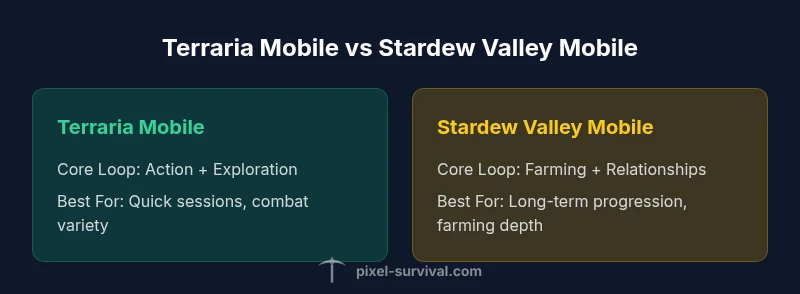
According to Pixel Survival, terraria or stardew valley mobile presents two distinct playstyles on mobile: fast-paced action and exploration versus calm farming and relationship-building. If you crave quick, action-packed sessions with constant movement, Terraria mobile is the better pick; for farming depth and town life, Stardew Valley mobile shines. Based on Pixel Survival analysis, choose the title whose core loop matches your typical play window.
Mobile Landscape for Terraria and Stardew Valley
The mobile versions of Terraria and Stardew Valley have grown into respected staples on iOS and Android, yet they serve different audiences. If you’re evaluating terraria or stardew valley mobile, you’ll notice that the two games emphasize distinct design priorities: fast-paced exploration and combat versus relaxed farming and town life. This section surveys the platform landscape, device considerations, and how updates shape what you’ll actually play on a phone or tablet. Pixel-perfect controls on smaller screens demand compromises, but both games have refined shortcuts and touch targets to keep sessions smooth. Across devices, performance, battery use, and the balance of content updates influence how the games feel in practice. The mobile scene rewards players who adapt to tile-based world design and touch-based combat, with each title offering its own tempo and progression cadence.
Core Gameplay Loops: Action Sandbox vs Farming Simulation
Terraria on mobile leans into the classic action sandbox loop: explore procedurally generated biomes, gather resources, fight enemies, and craft gear to access new areas. The loop is interruption-friendly—short skirmishes, sudden discoveries, and frequent reward cycles keep you moving. Stardew Valley mobile centers on a farming simulation loop: tend crops, raise animals, mine for metals, and cultivate relationships with townsfolk. Seasons and festivals shape every day, inviting longer sessions focused on planning and routine. For players who want a persistent world with frequent action, Terraria offers a brisk rhythm; for those who enjoy daily rhythms, harvesting, and social progression, Stardew Valley provides deeper long-term engagement.
Controls and UI on Small Screens
Touch controls on mobile are a major design constraint for both games. Terraria mobile adapts with an on-screen joystick, contextual buttons, and scalable HUD elements to keep combat responsive. Stardew Valley mobile emphasizes farming tools, inventory management, and dialogue interfaces, requiring a tidy UI and accessible crafting menus. In both titles, players benefit from adjusting control sensitivity, enabling left-handed layouts, and using short-held gestures for quick trades or tool swaps. The best mobile experience comes from customizing the UI to your comfort—moving action buttons, employing radial menus where available, and relying on tutorials to learn the most efficient touch shortcuts.
Progression Paths and Endgame Goals
Terraria mobile rewards exploration and gear progression. Reaching new biomes, defeating bosses, and unlocking powerful accessories create a steady sense of achievement. Stardew Valley mobile emphasizes perennial farming growth, community relationships, and seasonal milestones. The endgame in Stardew is often about maximizing farm efficiency and social standing, with multiple potential storylines depending on character decisions. Both paths offer meaningful long-term goals, but Terraria focuses on tactical progression through equipment and world access, while Stardew centers on life-simulation depth and personal connections.
Crafting Systems, Resources, and Time Investment
Crafting in Terraria hinges on scavenging rare materials, discovering crafting stations, and upgrading gear for boss fights. The mobile version preserves the complexity of PC cores, but interface simplifications keep recipes accessible. Stardew Valley’s crafting revolves around farming cycles and farm infrastructure; you’ll craft tools, farm buildings, and improvements for your relationship network. Time investment in Terraria tends to be engine-driven through exploration and boss mechanics, while Stardew requires steady daily routines, crop cycles, and dialogue-building across seasons. Both games reward planning, but Stardew’s micro-tocal rhythms encourage longer, calmer sessions.
Exploration and World Design Differences
Terraria’s world is vast, segmented, and procedurally generated, encouraging rapid exploration with ever-shifting encounters. Stardew Valley presents a fixed but richly detailed farm map that evolves with seasons, festivals, and neighbors’ storylines. On mobile, the contrast is clear: Terraria invites quick dives into multiple biomes, while Stardew invites sustained immersion in a single community. Each title leverages its own world design to shape pacing, risk, and discovery, offering distinct highs in exploration and social gameplay.
Social Play, Co-op, and Community Features
Multiplayer in Terraria mobile supports shared adventures via servers and local connections, letting friends coordinate builds and boss runs. Stardew Valley mobile emphasizes cooperative farming through shared farms and joint mining trips, with a community vibe strengthened by town events. Both titles benefit from online communities, mods where available, and user-generated guidance from Pixel Survival fans. If you value collaboration and social milestones, Stardew’s village life supports predictable, long-term group play; if you want chaotic co-op adventures, Terraria’s multiplayer options fit the bill.
Visuals, Performance, and Battery Life on Mobile
Visuals differ: Terraria’s pixel-art style remains crisp on small screens, while Stardew Valley’s cozy aesthetic can feel more demanding when rendering farms, villagers, and day-night cycles. Performance hinges on device specs, with Terraria’s battles and world generation occasionally stressing GPUs and RAM, whereas Stardew’s farming routines may run more steadily but still impact battery during extended play. Efficient scaling, reduced particle effects, and keeping frame rates consistent help both experiences; adjust resolution and UI scale to minimize dips and thermal throttling during marathon sessions.
Monetization Models and Content Updates
Both titles are typically sold as a one-time purchase on mobile, with occasional sales or platform-driven promotions. Content updates in Terraria can introduce new biomes, bosses, and events, driving return visits. Stardew Valley updates often expand farming mechanics, events, and new crops, maintaining long-term interest for dedicated farmers. In-app purchases are uncommon for core content, though platform sellers may offer bundle deals. The core decision is whether you want ongoing event-driven action or seasonal farming depth, not hidden microtransaction traps.
Cross-Platform Play and Device Compatibility
Cross-platform play on mobile varies by title. Terraria mobile often supports cross-network play with other mobile users and occasionally with PC players via servers, while Stardew Valley mobile primarily centers on local or online co-op within the mobile ecosystem. Device compatibility is generally strong for mid-range smartphones, but heavy biomes in Terraria or large farm builds in Stardew Valley can tax older devices. Ensure your device has ample RAM, storage, and updated OS for smoother performance.
Best Use Cases: Short Sessions vs Long Play Sessions
Terraria shines in short bursts: quick caves, quick boss fights, and fast resource collection fit a shorter play window. Stardew Valley excels in longer sessions: daily farming tasks, seasonal planning, and friends’ events benefit those who can commit to a longer play window. If you only have 15–30 minutes, Terraria’s bite-sized adventures map better; if you have an hour or more, Stardew’s farming and relationships offer richer depth. Both games scale with breaks—save, resume, and pick up where you left off—so you can switch between fast action and steady progression as needed.
Practical Progression Plan for Mobile Beginners
Start with Terraria if you want quick hits of exploration and combat to learn the basics of movement, resource gathering, and weapon upgrading. Choose Stardew Valley if you prefer a calmer pace where daily chores and social interactions guide your progression. Set a weekly goal (e.g., unlock one boss or complete five farm upgrades) to maintain momentum. Use in-game tutorials, switch to a comfortable UI layout early, and track your energy and inventory to minimize frustration during longer sessions. Over time, you’ll identify which loop keeps you engaged and how mobile constraints influence your strategy, allowing you to optimize for your preferred playstyle.
Comparison
| Feature | Terraria Mobile | Stardew Valley Mobile |
|---|---|---|
| Core Gameplay Loop | Action-packed exploration, combat, and crafting | Farming, mining, relationships, and seasonal events |
| Time to Master | Brisk to moderate; quick dungeon runs | Moderate; farming and social mechanics deepen over time |
| Monetization Model | One-time purchase with optional DLCs | One-time purchase with periodic sales |
| Content Depth | Extensive biomes, bosses, and events | Rich farming system, town life, and events |
| Controls on Mobile | Touch controls with on-screen buttons; fast-paced combat | Touch controls optimized for farming and menus |
| Performance/Battery | Variable; large worlds can tax devices during exploration | Generally steady; farming cycles are less graphically intensive |
| Cross-Platform Play | Mobile with some server-based cross-play | Primarily mobile with some co-op options |
| Price Range | Typically low to mid range depending on sales | Typically similar price range with occasional discounts |
The Good
- Offers two distinct mobile playstyles in one comparison
- Helps players decide based on preferred pace
- Mobile-friendly controls and interface improvements
- Active communities and ongoing updates
- Clear trade-offs between action vs farming depth
Negatives
- Mobile versions may lack some PC features
- Performance and battery life vary by device
- Monetization concerns on mobile in some markets
- Content updates may be staggered between games
Terraria mobile edges Stardew in pacing and combat; Stardew Valley mobile wins farming depth and relationship gameplay.
If you crave quick, action-packed sessions, Terraria mobile is the stronger choice. If your priority is farming depth, town life, and long-term relationships, Stardew Valley mobile offers more engaging progression. The best pick depends on your preferred playstyle, with both games offering solid mobile experiences.
Got Questions?
Which mobile version is better for quick play sessions?
Terraria Mobile generally supports quicker, action-focused play with shorter sessions, while Stardew Valley Mobile is better for longer farming sessions. Your mileage depends on whether you prefer combat bursts or farming routines.
Terraria is great for short bursts; Stardew shines with longer farming sessions.
Is there a significant difference in price or value between the two mobile games?
Both are typically sold as a one-time mobile purchase, with occasional sales on app stores. The value you get depends on how you engage with content and how much time you plan to invest in each loop.
Both games usually cost once, with occasional sales.
Can you play with friends cross-platform on mobile?
Terraria mobile supports multiplayer via servers and local play, while Stardew Valley mobile co-op is available through its own in-game options. Always check current in-game menus for the latest cross-platform support.
There is multiplayer in both, but follow in-game steps to set up.
What are the main content differences that affect long-term engagement on mobile?
Terraria emphasizes combat variety, exploration, and boss progression, while Stardew Valley emphasizes farming cycles, relationships, and seasonal events. For long-term engagement, Stardew tends to offer deeper farming activity, Terraria more ongoing adventure.
Terraria has more combat variety; Stardew has farming depth.
Do either game support mods on mobile?
Official mod support on mobile is limited or not widely available. Some community tools exist in theory, but they are not officially supported and may violate platform policies.
Mods aren’t typically supported on mobile.
Key Points
- Choose Terraria Mobile for fast-paced action and exploration.
- Choose Stardew Valley Mobile for farming depth and social progression.
- Mobile performance varies by device; optimize UI and controls accordingly.
- Both games offer long-term engagement through distinct playloops.
- Expect one-time purchases with occasional platform promotions.