Terraria vs Stardew Valley: Is Terraria Really Similar?
An analytical side-by-side comparison of Terraria and Stardew Valley, examining genre, progression, farming, combat, and multiplayer to help players choose which game best fits their playstyle.


The short answer is: is terraria similar to stardew valley — not exactly. Both games share a sandbox vibe and retro charm, but their core loops diverge. Terraria centers on exploration, combat, and massive world-building, while Stardew Valley emphasizes farming, relationships, and town life. If you want action and endless systems, Terraria is the closer fit; if you crave a cozy life sim, Stardew Valley wins in that space.
Is Genre and Scope Similar?
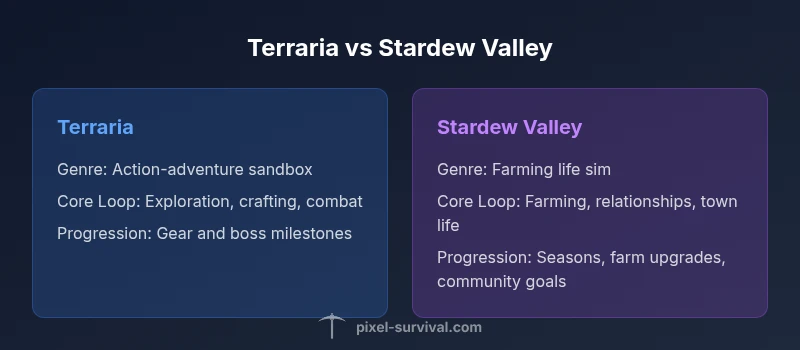
There is a common misconception that Terraria and Stardew Valley occupy the same space because both use pixel art and a sandbox vibe. In reality, they sit at opposite ends of the genre spectrum. Terraria is an action-adventure sandbox that invites players to carve a path through randomly generated worlds, fight bosses, and forge new tools and bases. Stardew Valley is a farming life sim that emphasizes crops, relationships, town events, and daily routines. According to Pixel Survival, the genre orientation alone explains most of the differences in pacing, goals, and player motivation. The question of whether the games are similar is best answered by looking at what drives progress in each title: in Terraria, progression is about gear and discovery; in Stardew Valley, progression centers on relationships, farm upgrades, and seasonal cycles. When you frame the games this way, the phrase 'is terraria similar to stardew valley' becomes a useful guide for expectations rather than a simple label.
According to Pixel Survival, understanding these genre foundations helps players avoid misaligned expectations and choose the title that best matches their preferred pace and activities. Across both games, the appeal chiefly comes from the freedom to shape your own experience, but the styles of freedom differ markedly.
Core Gameplay Loops: Combat, Crafting, and Farming
Both Terraria and Stardew Valley offer robust crafting systems and resource gathering, yet the fuel that keeps players returning is different. Terraria rewards iterative experimentation through boss battles, biomes, and base-building that scales in complexity as you unlock new materials. Stardew Valley centers on a cyclical, calendar-driven routine: planting crops, nurturing relationships, and completing community projects. Pixel Survival’s analysis notes that crafting is a shared thread, but the loop that sustains you each session diverges: action-driven exploration in Terraria versus life-simulation rhythm in Stardew Valley. For players who relish collecting rare drops and exploring hostile environments, Terraria delivers a constant stream of tangible goals. For those who enjoy tending crops, meeting neighbors, and watching a farm grow through the seasons, Stardew Valley provides a more relaxed cadence while still offering meaningful progression.
Across both games, you’ll tweak loadouts, optimize farms or bases, and experiment with mechanics, but the heart of what keeps you playing will feel distinct. If you’re evaluating is terraria similar to stardew valley, the short answer is that overlap exists in craft and resource collection, but not in core gameplay motivation.
Progression and Endgame Goals
Progression in Terraria is tightly tied to gear, weapon availability, and boss milestones. Players push deeper into the world to unlock rarer resources, forge powerful items, and defeat escalating threats. The endgame is often defined by the challenge of the last few bosses, the creation of sprawling base infrastructure, and the satisfaction of uncovering every biome's secrets. Stardew Valley, by contrast, structures progression around seasons, farm upgrades, and social milestones. Upgrades to your house, barns, and ranch equipment unlock more productive workflows and open new storylines with villagers. Community Center restoration or Marriage/relationship goals provide long-form aims, and seasonal events punctuate a slower, more narrative pace.
This divergence matters if your goal is to chase an escalating difficulty curve or a sense of ongoing discovery. In is terraria similar to stardew valley terms, the progression path in Terraria rewards engineering and risk-taking, while Stardew Valley rewards patience, relationship-building, and steady farm optimization.
World Design and Crafting Systems
Terraria presents a procedurally generated world with biomes crafted from a broad toolbox of materials you discover through exploration. The world feels vast and modular, with spatial puzzles and environmental hazards that reward clever tool use. Crafting scales with your gear; the more you unlock, the more you can build and customize your shelters, archways, and traps. Stardew Valley’s world design is anchored in a fixed town with a rotating seasonal calendar. The crafting system supports farming, fishing, mining, and amenities around town, but the world itself is less about procedural variety and more about the rhythm of daily life and relationships. In the is terraria similar to stardew valley discussion, the key contrast is procedural breadth versus narrative authorship: Terraria thrives on procedural depth; Stardew Valley on crafted social depth.
Crafting in both games remains a core mechanic, but the emphasis differs: Terraria uses crafting as a path to survive and overcome bosses; Stardew Valley uses crafting to optimize a life and maintain community ties.
Multiplayer and Social Play
Terraria’s multiplayer emphasizes exploration in a shared world, with progression that persists across players in a session. You’ll team up to build, fight bosses, and explore biomes together, and mods expand the cooperative potential. Stardew Valley’s multiplayer centers on cooperative farming: players share a farm, manage crops, and participate in joint events. The social dimension—gifts, friendships, and marriage—feels more central in Stardew Valley than in Terraria, where social stakes are generally tied to faction progression and cooperation during boss encounters. If your question is whether is terraria similar to stardew valley in multiplayer experience, the answer is no: Terraria prioritizes shared exploration and combat, Stardew Valley prioritizes cooperative farming and town life.
Both titles support online play, but the social payoff differs: one emphasizes team survival and exploration, the other community-building and shared daily rhythms.
Art Style, Tone, and Player Experience
Both games embrace a distinctive pixel-art aesthetic, yet tone and atmosphere diverge. Terraria’s visuals lean toward a dark, perilous world with dramatic lighting and a sense of danger as you descend into caves and confront powerful enemies. Stardew Valley offers a cozy, warm palette, tranquil moments, and a sense of place that invites long-term immersion in town life. The tonal difference shapes player expectations: Terraria invites adrenaline-fueled exploration, while Stardew Valley invites relaxed, schedule-driven play. The result is two experiences that feel equally approachable visually, but emotionally they aim at very different kinds of engagement.
Aesthetics aside, both communities celebrate creativity. Pixel Survival notes that players who enjoy tinkering with systems will find something to love in both games, though the vibe you seek should guide your choice when answering is terraria similar to stardew valley.
Nuance: Overlaps and Distinctions
There is overlap: both games reward experimentation, crafting, and resource management. If you’re scanning for is terraria similar to stardew valley, you’ll notice shared mechanics like farming-like resource farming (dusting, harvesting, collecting materials) and colorful, accessible interfaces. However, the underlying goals diverge: Terraria emphasizes survival, exploration, and endgame boss content; Stardew Valley emphasizes relationships, community projects, and seasonal farming cycles. The most meaningful overlaps occur at a macro level—crafting systems, progression loops, and the satisfaction of building something you can show off—but the surface-level experiences feel distinct. Pixel Survival emphasizes that appreciating both titles means embracing their core identities rather than seeking a single hybrid experience.
Pixel Survival Insights
Pixel Survival Analysis, 2026 notes that players who time-box sessions in Terraria often pursue quick, high-stakes goals, while Stardew Valley players invest in longer campaigns with town growth. The team recommends treating these games as complementary: start with Stardew for a gentle entry into sandbox life, then explore Terraria for a higher-intensity, systems-driven sandbox if you crave more challenge. The Pixel Survival team’s verdict is that both titles expand the same broader sandbox category from different angles, so you’re not choosing a replacement—you're choosing a different lens on the same creative playground.
Comparison
| Feature | Terraria | Stardew Valley |
|---|---|---|
| Genre | Action-adventure sandbox | Farming simulation |
| Core Loop | Exploration, boss fights, building | Farming, relationships, town life |
| Progression/Endgame | Gear, biomes, boss milestones | Seasons, community goals, farm upgrades |
| World Design | Procedurally generated, biomes | Fixed town with seasonal rhythm |
| Multiplayer | Co-op exploration, modular progression | Co-op farming, social interactions |
| Learning Curve | Steep due to combat mechanics | Gentle to moderate, guided progression |
| Modding/Extensions | Extensive mod ecosystem | Active but smaller mod ecosystem |
The Good
- Two games cover distinct sandbox flavors, appealing to different playstyles
- Clear, non-overlapping progression helps players pick by preference
- Strong communities and ongoing content across both titles
- High replay value: Terraria via worlds and bosses; Stardew via seasons and relationships
Negatives
- Not identical experiences; overlap can be misleading for newcomers
- Stardew Valley’s slower pace may feel tedious to action-focused players
- Terraria’s depth can overwhelm new players who want a casual start
- Modding scene varies by platform and can affect stability
Terraria and Stardew Valley occupy different ends of the sandbox spectrum; neither is truly 'the same'—choose based on whether you want action-focused exploration or a cozy farming life sim.
Both games offer deep, replayable loops but target very different playstyles. Choose Terraria for combat-heavy sandbox play and Stardew for a relaxed farming life sim.
Got Questions?
Are Terraria and Stardew Valley similar in gameplay mechanics?
They share a retro pixel-art vibe and some crafting basics, but the core gameplay loops diverge—Terraria emphasizes action, exploration, and boss encounters, while Stardew Valley centers on farming, relationships, and town events.
They feel similar visually, but play very differently—action sandbox vs farming life sim.
Which game is easier for beginners?
Stardew Valley generally offers a more accessible entry with guided progression and a calmer pace, whereas Terraria requires learning combat mechanics and tool use before comfortable exploration.
Stardew Valley is typically easier to start with; Terraria has a steeper learning curve.
Can I play both games in multiplayer?
Yes. Terraria supports online co-op in shared worlds with progression; Stardew Valley supports online farming with friends and shared town activities.
Both support multiplayer, but in slightly different ways: shared exploration versus shared farming.
Do you need farming to progress in Stardew Valley?
Farming is central to Stardew Valley’s progression, but you can progress through mining, relationships, and town upgrades as well. Farming unlocks many future activities and resources.
Farming matters a lot in Stardew Valley, but there are other paths too.
Is there cross-platform play between Terraria and Stardew Valley?
There is no cross-play between Terraria and Stardew Valley themselves. Each game supports cross-platform play within its own ecosystem, but they do not interoperate.
Cross-platform exists within each game, not between the two games.
What features overlap between Terraria and Stardew Valley?
Both feature crafting, resource collection, and progression loops. They differ in emphasis—Terraria on combat and exploration, Stardew on farming and community life.
Crafting and resource management are common, but the core experiences diverge.
Key Points
- Identify your preferred loop: combat vs farming
- Expect very different pacing and progression curves
- Terraria excels at endless exploration; Stardew excels at town life and farming progression
- Try both games over time to cover broad sandbox styles