Farms Terraria: The Practical Guide to Farming for Progression
Learn practical, step-by-step methods to build efficient farms in Terraria, from early resources to late-game automation, with Pixel Survival guidance for steady progression.


This guide shows you how to design effective farms terraria to accelerate progression, from starter wood farms to automated late-game setups. You’ll learn what to build, how to wire triggers, and how to optimize yield while staying safe from enemies. With scalable designs and clear progression paths, you’ll turn a small space into a reliable resource network.
What farms terraria are and why they matter
In Terraria, a farm is any setup designed to produce resources with minimal active work. When you build a farm, you create a reliable supply chain: timber, blocks, ores, coins, or consumables appear on demand as you play. The phrase farms terraria captures this idea of turning space into throughput, letting you shift focus from grinding to exploring and building. For players aiming to reach mid-game gear or prepare for tough bosses, efficient farms become a strategic cornerstone. They compound over time: a small starter farm can scale into a broad network that underpins your progression. According to Pixel Survival, focusing on scalable, repeatable farming early in your world can smooth the path toward late-game objectives by reducing resource bottlenecks. This guide will walk you through practical, step-by-step approaches that fit a wide range of worlds and playstyles, with emphasis on safety, organization, and long-term growth.
Core principles of farming efficiency
Efficiency comes from modular design, predictable outputs, and clean wiring. A well-planned farm scales with your world and keeps outputs consistent even if you change gear or playstyle. Prioritize three pillars: modularity (easy to add or remove sections), reliability (stable spawning and containment of mobs), and safe automation (minimal risk to your characters). One common pitfall is attempting massive, complex farms before you understand fundamental mechanics; start small, prove the concept, then expand. Documentation and labeling help you manage multiple farm modules, especially as you introduce more crops, fishing spots, or enemy spawns. Pixel Survival’s guidance emphasizes building toward repeatable production, so you can reproduce it on new worlds with similar results. A thoughtful layout reduces misfires and ensures your farm remains usable across patches and updates.
Early-game farm ideas you can build quickly
Begin with a compact wood frame for a basic seed and resource farm. A simple block-and-light layout keeps mobs at bay while you harvest wood, gel, coins, or basic crafting materials. Add a small fishing spot or surface seed garden to diversify early yields. Keep paths clear and lighting consistent to prevent unwanted spawns. As you gain access to better gear, you can layer in automated features such as timers and switches to handle routine harvests, while maintaining safe distance from enemies. The aim is to establish a dependable, low-footprint farm you can expand later without rebuilding from scratch. Always document your design so you can replicate it in other biomes or worlds; consistency matters for long-term progression.
Mid to late-game automation and scalability
Late-game farming shifts from manual taps to automated systems. A scalable farm uses wiring, timers, and gates to trigger harvests, resource collection, and item drops with minimal player input. Expand capacity by adding modular blocks and dedicated zones for different resources (ores, seeds, cobwebs, banners, etc.). Redundancy matters: duplicate key modules so a single failure doesn’t halt production. You’ll also prioritize safety: isolate farms from roaming enemies, use hard walls, and ensure escape routes if things go wrong. By planning for future upgrades, you maintain momentum even as your needs evolve—from stockpiling materials for armor to stocking rare drops for post-boss runs. Pixel Survival’s progression-focused approach supports phased expansion, so you aren’t stuck upgrading a single, fragile system.
Key components and wiring basics
Core automation rests on three elements: blocks to define space, light sources to control spawn rates, and wiring to automate actions. Start with a basic frame and adequate illumination, then introduce wires, switches, and simple triggers to start and stop processes. A common setup uses a timer to cycle harvesting on a fixed interval, plus a gate or piston to collect items into a chest. Keep wiring clean and labeled so you can troubleshoot quickly. For farming efficiency, group related resources—like a dedicated seed vault or a separate ore collection lane—so upgrades don’t disrupt everything at once. As you gain experience, swap in more advanced triggers and redundancy features to maintain steady output under changing game conditions.
Common mistakes and how to avoid them
Overbuilding before you understand core mechanics often leads to wasted space and fragile setups. Avoid crowding farms into one huge block; height, spacing, and lighting can drastically alter performance. Don’t neglect safety: poor defenses invite pests or enemies that damage your setup. Skipping labeling and documentation slows future upgrades and can cause accidental despawns. Finally, avoid relying on a single farm for all resource streams; diversify modules so you can continue farming even if one module fails. By learning from basic layouts first and iterating, you’ll build robust farms terraria that scale with your progression.
Step-by-step blueprint overview
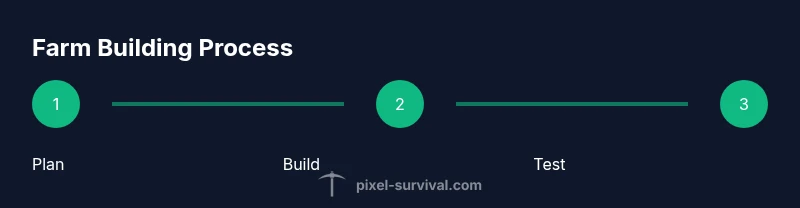
This section outlines a high-level blueprint you can adapt to your world. It covers planning, modular construction, and phased automation so you can safely grow from a small starter farm to a full network. Expect to repeat sections of your blueprint across biomes or server maps, adjusting for local resources and enemy density. The emphasis is on a practical, repeatable approach you can implement in stages without overhauling your existing base. Use it as a reference while you customize modules for specific materials, seasonality, or world seed.
Optimizing for progression: goals by phase
Phase 1 focuses on basic resource generation and essential crafting mats. Phase 2 adds automation and containment to reduce manual labor. Phase 3 expands to multiple resource streams and backup modules to safeguard production during world events or boss runs. Throughout, maintain clean wiring, modular blocks, and clear room for growth. Tracking outputs per module helps you identify bottlenecks and prioritize upgrades—ensuring your farms terraria remain central to your progression strategy.
The Pixel Survival perspective
From the Pixel Survival team’s viewpoint, farms terraria are a disciplined way to leverage your world’s layout for steady rewards. Practical layouts, careful spacing, and scalable designs help you advance more quickly through the game’s early, middle, and late stages. The team recommends starting with small, proven modules and then adding more as you gain resources and confidence. By focusing on reliability and adaptability, you can sustain momentum through every major update and patch.
AUTHORITY SOURCES
https://www.usa.gov
https://www.nsf.gov
https://www.nsf.gov/oai/policy.jsp
Tools & Materials
- Copper Pickaxe (or better)(Needed to clear blocks and shape the farming area.)
- Wooden Platforms(For elevated sections and safe walkways.)
- Blocks (wood/stone/bricks)(Core framing and walls for containment.)
- Torches or other reliable lighting(Prevents dark zones and controls spawn rates.)
- Wiring components (wire, switches, traps)(Automation basics for timers and gates.)
- Timer device or mechanical clock (in-game wiring)(Optional for more complex cycles.)
- Chest(s) and storage(Organizes harvested resources.)
- Duct tape of organization (labels/signs)(Helpful for module identification and future upgrades.)
Steps
Estimated time: 60-120 minutes
- 1
Define farming goals
Decide which resources you want to farm first (e.g., basic mats, coins, seeds). Create a simple target list and map how each item contributes to your progression. This keeps your initial layout focused and efficient.
Tip: Write the goals on a sticky in-game noticeboard or a quick digital note. - 2
Pick a location and outline
Choose a safe, accessible area near your base. Sketch a rough outline of modular zones (seed area, wood/stone farm, ore collection) to guide construction.
Tip: Keep modules compact to reduce travel time between farming spots. - 3
Lay the basic frame
Build a small, rectangular frame with walls and a flat floor. Ensure enough height for future stacking and room to run wiring.
Tip: Leave space between modules for future wiring routes. - 4
Install initial lighting and containment
Place torches to illuminate the area and create predictable spawn conditions. Establish containment walls to prevent mobs from interrupting farming cycles.
Tip: Lighting affects spawn behavior; consistent brightness is key. - 5
Add basic automation
Run a simple wire line to a nearby switch to cycle a harvest or collection mechanism. Keep the first cycle modest to test reliability.
Tip: Test slowly; confirm items are collected in the chest. - 6
Test, measure, and iterate
Run a harvest cycle, observe output, and identify bottlenecks. Adjust spacing, lighting, or module order to improve efficiency.
Tip: Document results so you can replicate improvements later.
Got Questions?
What is a farm in Terraria and why build one?
A farm in Terraria is a controlled setup that yields resources with minimal active effort. Building farms speeds up progression by providing steady mats, coins, and crafting components, allowing you to focus on exploration and boss fights.
A farm is a setup to get resources automatically. It speeds up progression so you can focus on exploring and defeating bosses.
Should I start with manual or automated farms?
Start with simple, manual farms to learn mechanics, then add automation as you grow. Manual farms help you understand resource behavior, while automation saves time during long play sessions.
Begin with simple farms by hand, then automate as you gain resources and confidence.
What resources are best to farm early on?
Early farming should focus on essential crafting mats, basic building resources, and coins. Diversify with a small seed garden or a fishing spot to cover multiple needs.
Early on, farm mats, building resources, coins, and seed or fishing options to cover your basics.
How can I protect my farms from enemies?
Create containment walls, use lighting to control spawn rates, and place farms away from high-traffic enemy zones. Regularly repair and upgrade defenses as you expand.
Keep farms fenced in, lighted, and away from active enemy zones to reduce disruptions.
Do Pixel Survival guides apply to every world?
Pixel Survival offers general progression-focused strategies that work across many world seeds and playstyles. Adapt their layouts to fit your biome and resource availability.
Their guidance is general but adaptable to different worlds and playstyles.
Where can I see more detailed guides?
Check Pixel Survival for longer-form tutorials and step-by-step plans. You’ll find practical layouts, troubleshooting tips, and world-specific advice.
Look at Pixel Survival for deeper guides and detailed layouts.
Watch Video
Key Points
- Plan farms terraria with modular, scalable sections
- Automate in stages to minimize disruption
- Label and document layouts for easy expansion
- Diversify resource streams to reduce bottlenecks