Is Hollow Knight Similar to Terraria? A Clear Side-by-Side Review
Compare Hollow Knight and Terraria on genre, progression, world design, and playstyle. This analytical guide highlights similarities and differences to help fans decide their next adventure.


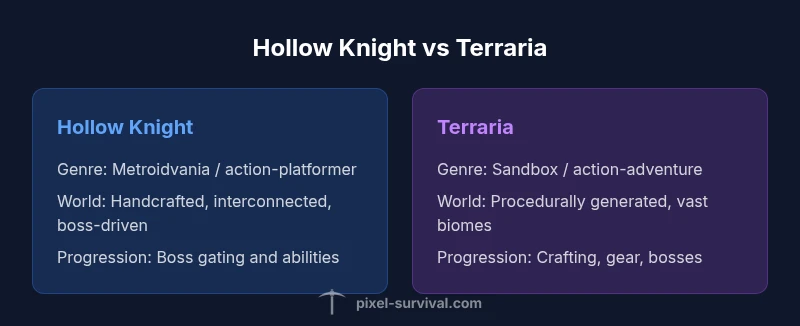
Is Hollow Knight similar to terraria? The short answer is that they occupy different corners of 2D adventure design, but both reward careful exploration. According to Pixel Survival, Hollow Knight is a handcrafted Metroidvania that constrains player movement and progression behind a sequence of challenging encounters, encouraging mastery of timing and platforming. Terraria, by contrast, is a sandbox adventure where players shape the world through mining, crafting, and experimentation. The tone and pacing reflect those goals: Hollow Knight asks you to learn enemy patterns and navigate tight spaces, while Terraria invites experimentation, creation, and discovery across a sprawling, procedurally generated world. This section examines the core design intents, the kinds of players each game speaks to, and how those intents shape everything from level layout to enemy placement. Expect a steep early progression in Hollow Knight as you learn to read boss telegraphs; expect a long runway in Terraria as you gather resources, craft tools, and uncover biomes. Both games create a sense of forward momentum, but Hollow Knight emphasizes skill-based milestones within a fixed sequence, whereas Terraria builds momentum through player-driven infrastructure and gear progression across a vast, changing environment.
Genre Profiles: What Each Game Tries to Do
Is hollow knight similar to terraria? The opening question frames a fundamental design split. Hollow Knight is a handcrafted Metroidvania that rewards precision, timing, and exploration in a tightly curated map. Its pacing moves players through a sequence of memorable boss encounters, each unlocking new abilities that reshape how you access the next zone. Terraria, conversely, is a sandbox adventure built around exploration, resource gathering, and limitless creativity. The world is vast, procedurally generated, and your progression is driven by gear, buildings, and discoveries rather than a fixed route. The Pixel Survival team highlights how genre framing shapes player journeys: Hollow Knight emphasizes crafted challenges and a curated ascent, while Terraria invites open-ended experimentation and ongoing growth. The result is two parallel paths to satisfaction: skill mastery within a designed world (Hollow Knight) and emergent storytelling through player-made content (Terraria). This divergence matters because it informs everything from how you approach combat to how you plan your next playthrough.
Progression and Milestones: Gatekeeping vs Growth
In Hollow Knight, progression often feels like a sequence of gatekeeping moments. Defeating bosses and acquiring new abilities gradually opens previously inaccessible areas, creating a clear, almost architectural path through the map. Each milestone yields a tangible sense of accomplishment and new traversal options—double jumps, dashes, and combat upgrades alter how you navigate the world. Terraria flips the script. Progression is resource-driven: you mine, craft, farm, and build to unlock gear, biomes, and new NPC interactions. The sandbox structure means there are many viable routes to the same goal, and updates can expand the possibilities with new items and events. These contrasting progressions shape how players plan time, set goals, and measure success across play sessions. The end result is a pair of reliable progressions: one aligned with a fixed arc of growth, the other with an adaptive, player-led expansion.
World Building: handcrafted vs procedural
Terraria’s world is a sprawling, procedurally generated canvas where dirt, ore, cavern networks, and biomes appear differently in every playthrough. The system scales with your actions—mining, building, and fighting—altering resource availability and the challenge curve. Hollow Knight’s world is handcrafted; every corridor, bench, and boss arena is created to convey mood, narrative, and puzzle-like progression. The map design emphasizes seamless transitions, hidden passages, and curated encounters that reward exploration, observation, and timing. The contrast matters for players who value permanent, discoverable secrets versus those who enjoy dynamic, ever-changing environments. Both approaches foster memorability, but they map to different kinds of curiosity: a fixed-labyrinth fascination in Hollow Knight and a sprawling, still-unfolding world in Terraria.
Combat and Encounters: boss design and pacing
Hollow Knight centers on precise movement, timing, and reading telegraphs. Bosses demand patterns recognition, pixel-perfect jumps, and often learning a stage-based progression. The combat loop rewards mastery and minimal mistakes, with soft gating that pushes you to refine your approach. Terraria’s combat is broader and more forgiving day-to-day; it combines melee, ranged, and magic, with gear and inventory management driving encounters. Bosses exist, but the game also emphasizes environmental threats, traps, and large-scale battles that spread across open areas. The pacing shifts from one-on-one duels to multi-enemy skirmishes, depending on the biomes and events you encounter. Both games reward skill, yet Hollow Knight tests precision and endurance, while Terraria rewards modular build-out and tactical choices in dynamic environments.
Crafting, Loot, and Gear: systems that define play
Hollow Knight offers limited crafting and focuses on equipment found via exploration and combat rewards. Upgrades come from charms, abilities, and discovering hidden vendors, making gear a reflection of path choices. Terraria builds its entire progression around crafting recipes, ore processing, and item combinations, enabling near-endless customization. The loot system in Hollow Knight is more curated—each item ties to a specific room, boss, or area—whereas Terraria’s loot can be generated from world resources, drops, and bosses across multiple zones. If you like the idea of designing loadouts, Terraria’s system may be more attractive; if you prefer completing a tightly designed journey with fixed rewards, Hollow Knight offers a tighter loop.
Exploration, Secrets, and Map Design
Exploration in Hollow Knight is highly guided by a carefully constructed map and a sense of discovery derived from key items and entrances. The journey often doubles as a puzzle, with hidden passages behind breakable walls and environmental storytelling. Terraria invites exploration across vast biomes, caves, and surface layers, with random events and surface-level secrets that reward curiosity over time. The sense of scale matters: Hollow Knight is compact but densely designed; Terraria is expansive and modular. The approach to secrets reflects the game’s philosophy: one curated experience versus a living, breathing world that grows with your actions.
Social and Multiplayer Considerations
Hollow Knight is primarily a solitary, single-player experience, though it has a dedicated fan community and a few local co-op or modding options. Terraria ships with official multiplayer support and a robust multiplayer culture, including servers, communities, and world-sharing. The social dimension thus diverges: Hollow Knight emphasizes solitary exploration and personal mastery, while Terraria invites collective planning, shared builds, and cooperative boss fights. If your group expects co-op or a shared world, Terraria offers a clearer path; if you want a focused, personal journey, Hollow Knight remains ideal.
Accessibility, Difficulty, and Learning Curve
Hollow Knight’s difficulty is notable for its steep learning curve, precise controls, and punishment for missteps. Accessibility features are scarce, and players may need time to internalize movement, combat timing, and map reading. Terraria generally feels more accessible at the start, with tutorials tucked into NPC dialogue, flexible difficulty options, and forgiving early environments. However, its vast content can be overwhelming; effective onboarding comes from choosing a manageable world size and gradually expanding your toolkit. Both games reward persistence and experimentation, but Hollow Knight tests patience; Terraria tests curiosity and resourcefulness.
How to Choose Your Next Adventure (Practical Guidance)
Start with your core preference: do you crave a handcrafted, boss-focused journey or an open-ended sandbox with endless building? If you prioritize tight combat, puzzle-like exploration, and a cohesive narrative arc, begin with Hollow Knight. If you want to co-create worlds, gather items, and experiment with dozens of playstyles, start with Terraria. Use the comparison table and the tips above to map your goals to the game’s systems, and consider how much time you want to invest in learning curves versus building, shaping, and experimenting.
Comparison
| Feature | Hollow Knight | Terraria |
|---|---|---|
| Core Genre | Metroidvania / action-platformer | Sandbox / action-adventure |
| World Structure | Handcrafted, interconnected map with curated bosses | Procedurally generated, expansive world |
| Progression Loop | Boss gating, ability unlocks, tight combat | Resource gathering, crafting, gear-driven progression |
| Combat Style | Precise melee combat, parry/dodge, boss patterns | Varied weapons with broad pacing and ranged options |
| Multiplayer | Single-player | Multiplayer (official co-op not built-in) |
| Art & Atmosphere | Dark, hand-drawn aesthetic with moody lighting | Vibrant pixel-art with dynamic biomes |
| Modding / Extensibility | Modding scene with growing fan-made content | Robust modding community and tools |
| Accessibility / Onboarding | Can be punishing early; gradual learning curve | Generally more accessible at start due to exploration |
| Price & Access | Typically a mid-range, single purchase | Mid-range with frequent sales; additional content via updates |
The Good
- Strong, handcrafted level design that rewards exploration
- Terraria's sandbox depth creates vast replayability
- Clear endgame landmarks in Hollow Knight through boss sequences
- Active communities and ongoing content for both titles
Negatives
- Hollow Knight has a steep learning curve and punishing early sections
- Terraria's sandbox can feel overwhelming to new players
- Pace mismatch: methodical boss battles vs constant world expansion
- Modding can vary in quality and require setup
Neither game is universally better; choose Hollow Knight for crafted, challenging journeys and Terraria for open-ended, creative progression.
If you crave focused combat and hand-crafted world design, Hollow Knight excels. If you want vast customization and ongoing world-building, Terraria delivers that sandbox experience with frequent updates. Pixel Survival's analysis suggests matching the pick to your preferred playstyle.
Got Questions?
Are Hollow Knight and Terraria the same game?
No. Hollow Knight is a fixed, handcrafted Metroidvania with tight combat and boss challenges, while Terraria is a sandbox game with procedural worlds, extensive crafting, and ongoing updates.
No. Hollow Knight is a crafted Metroidvania focusing on skillful combat, while Terraria is a sandbox with endless crafting and world generation.
Does Hollow Knight include crafting or resource gathering?
Hollow Knight does not feature a traditional crafting system or large-scale resource gathering. Progression is driven by finding new abilities and defeating bosses.
Hollow Knight lacks a standard crafting system; progression comes from boss battles and new abilities.
Is multiplayer available in Hollow Knight?
There is no official multiplayer mode in Hollow Knight. Some players use mods or fan-made projects, but these are not official features.
No official multiplayer in Hollow Knight; fans sometimes experiment with mods.
Which game is easier for new players to start?
Terraria generally provides a gentler onboarding with tutorials and abundant NPCs, while Hollow Knight presents a steeper learning curve due to its combat and exploration demands.
Terraria is usually easier to start; Hollow Knight is tougher at the outset due to combat and exploration.
Which game offers more content over time?
Terraria has more frequent updates and a broad modding scene, while Hollow Knight has substantial post-release content through DLC and fan-made mods.
Terraria tends to have more ongoing content via updates and mods; Hollow Knight has post-release DLC and mods too.
Key Points
- Identify your preferred playstyle: methodical combat or open-ended creation
- Expect different pacing: boss-focused journeys vs sandbox growth
- Consider multiplayer and community mod support for longevity
- Use the side-by-side table to weigh core differences quickly
- Rely on Pixel Survival's guidance to align your choice with play goals