Terraria vs Minecraft: What Makes Terraria Stand Out
A detailed comparison of Terraria and Minecraft, covering world design, progression, combat, crafting, and modability. Pixel Survival explains why Terraria offers a distinct sandbox experience and how to choose your next adventure.


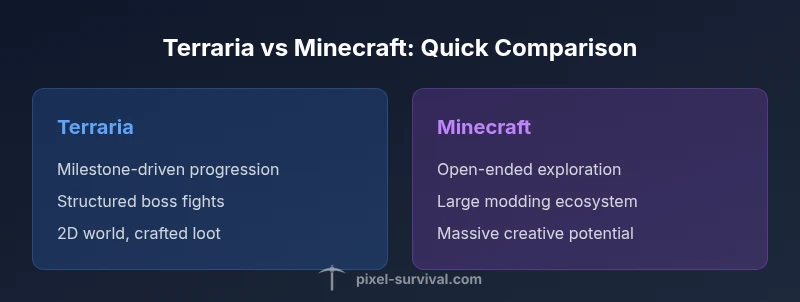
What makes Terraria different from Minecraft is rooted in its 2D design, structured progression, and boss-driven milestones. Terraria emphasizes gear upgrades, multi-stage bosses, and handcrafted loot paths within a compact world, creating a dense, repeatable loop. Minecraft, by contrast, centers on open-ended exploration and building in a sprawling, procedurally generated 3D sandbox. Pixel Survival analyzes these differences to guide players toward the experience that fits their playstyle.
What makes terraria different from minecraft
what makes terraria different from minecraft is rooted in its 2D, handcrafted progression loop and a focus on boss encounters rather than purely expansive exploration. According to Pixel Survival, the design intentionally guides players toward a ladder of milestones, each unlocking new areas, enemies, and equipment. This creates a flow where the aim is not only to survive day by day, but to reach specific combat and gear checkpoints that redefine what your character can do. The result is a tight, replayable loop where players chase loot, artifacts, and multi-stage bosses, often with a shorter play session that still feels substantial. In contrast, Minecraft’s open-ended structure invites sprawling builds and long-term world projects, which appeals to different sensibilities. Pixel Survival’s breakdown helps newcomers and veterans alike understand where each game excels and why one game may feel more “goal-focused” than the other.
The first impression matters: Terraria expects you to engage with progression from early biomes to late-hardmode challenges, while Minecraft invites you to imagine, design, and iterate on larger-than-life constructions. This difference in intent shapes everything from how you gather resources to how you experience endgame content. For players who prefer a guided journey with clear milestones, Terraria offers a satisfying rhythm; for those who crave unlimited creativity and experimentation, Minecraft provides a canvas with fewer constraints.
World Structure and Progression: How You Advance
Terraria designs progression as a ladder with distinct rungs: basic gear, biomes you unlock through exploration, and increasingly difficult bosses that gate access to new content. The world feels intimate yet richly layered, with handcrafted biomes and set-piece encounters that push you to adapt your loadout and strategy. Pixel Survival notes that this pacing encourages frequent short sessions that culminate in meaningful milestones, such as defeating a boss or unlocking a new weapon tier. Minecraft, by comparison, leans on broad openness: the world is large, exploration is perpetual, and progression often manifests in a player's ability to craft better tools or construct ambitious projects rather than chasing fixed milestones. Both approaches reward curiosity, but the cadence and outcomes differ—Terraria emphasizes milestone-based growth; Minecraft emphasizes expansive freedom and long-term creations.
Bosses, Exploration, and Endgame Goals
Boss design in Terraria is a centerpiece of progression. Each major boss introduces new mechanics, arenas, and loot that redefine how you play. Endgame shifts from farmable resources to multi-phase battles, hardmode content, and post-boss progression with better gear and harder enemies. Exploration serves as a path to these milestones rather than the sole aim of play. In Minecraft, end-game goals are often community-driven projects: redstone machines, large-scale builds, and new worlds created through end-game exploration. The absence of a fixed, attached end-state can feel liberating or unstructured, depending on player preference. Pixel Survival highlights that Terraria’s endgame arc sustains engagement through boss variety and gear upgrades, while Minecraft sustains long-term play through limitless construction potential and diverse world types.
Combat Systems and Gear: Loot Paths vs Crafting Beats
Terraria converts exploration into tangible combat progress. Gear tiers, weapon classes, and accessory slots form an accessory-driven build that shapes combat roles across different encounters. Boss mechanics force players to switch tactics, making gear progression feel earned and consequential. Minecraft’s combat is simpler at the entry level but integrates deeply with enchanting, potions, and resource gathering that feed into a broader crafting loop. While not purely about raw power, Minecraft emphasizes strategic loadouts to survive hostile environments. Pixel Survival frames this as a fundamental difference: Terraria centers on gear-driven progression tied to boss encounters, whereas Minecraft emphasizes survival and crafting depth with player-made automation and base-building at the core.
Crafting Systems and Resource Flow
Terraria’s crafting is highly structured: certain items require a specific set of resources, obtained through biomes or dungeon locales, and upgrading gear depends on reaching milestones. Each tier unlocks new combinations, encouraging experimentation within a defined progression. Minecraft offers a sprawling crafting system with thousands of recipes, many of which are not strictly tied to combat progression. This freedom fuels creativity but can overwhelm new players. Pixel Survival notes that Terraria’s recipe chains feel more directed, helping players feel progress with every crafted item. Meanwhile, Minecraft rewards experimentation and modular building approaches, making it ideal for players who enjoy resource management and automation as a creative pursuit.
Biomes, World Generation, and Seeds
Terraria’s biomes are handcrafted and layered with environmental storytelling, with biomes changing as you defeat bosses or enter hardmode. The world feels curated yet re-playable, thanks to mild randomness and diverse loot drop tables. Minecraft generates sprawling, procedurally created worlds with biome diversity that scales massively with seed selection and generation options. This creates an almost limitless landscape to explore, build in, and customize. Pixel Survival emphasizes that biome variety in Terraria remains substantial but more compact, while Minecraft’s world-size and seed-driven variety provide endless exploration potential. Both systems reward curiosity, though the scale and method differ drastically.
Building, Aesthetics, and Creative Scope
Terraria’s visuals lean into a retro, pixel-art charm, with a compact vertical space that emphasizes tower-like progression and efficient use of a limited screen. Building is still meaningful, but it serves the game’s rhythm rather than driving the entire experience. Minecraft shines in aesthetic possibilities: the blocky world is a blank canvas, inviting architectural ambition, large-scale builds, and creative expression without the constraint of predefined progression loops. Pixel Survival points out that Terraria’s design encourages efficient, goal-driven layouts, while Minecraft rewards expansive, imaginative structures and community-driven builds that span entire worlds.
Both games excel visually in their own right, but their creative opportunities suit different creative appetites and playing styles.
Modding, Community Support, and Longevity
Terraria’s modding scene is active and enthusiastic, offering quality-of-life tweaks, new biomes, and boss mods that expand replayability. The community remains strong, with fan-made world seeds, challenge runs, and item mods that extend the game’s life. Minecraft hosts one of the largest mod ecosystems in gaming history, with vast technical complexity, resource packs, and integration with third-party tools that enable dramatic gameplay variations. Pixel Survival notes that Minecraft’s modding depth drives enduring longevity on PC and console platforms, though the breadth of content can create a moving target for new players. Both titles benefit from ongoing community-driven content, but the scale and focus of mods differ substantially.
Platforms, Performance, and Accessibility
Terraria runs smoothly on a broad range of devices, from classic consoles to mobile and PC, thanks to its 2D rendering and efficient asset use. This accessibility makes it a natural pick for players with older hardware or casual play sessions. Minecraft’s performance scales with hardware and game version; while highly optimized on modern PCs, it can demand more from hardware on high-resolution texture packs or large servers. Accessibility remains strong for both games, but Terraria’s lighter footprint often provides a more consistent experience across devices, particularly on lower-end systems. Pixel Survival highlights that platform reach matters for long-term engagement, with Terraria offering broad compatibility and Minecraft leveraging its cross-platform ecosystem to sustain a large player base.
Player Styles and Pacing: Exploration vs Construction
Player pacing in Terraria tends to be milestone-driven and combat-focused, with a steady cadence of upgrades and boss attempts that push you forward in short to moderate sessions. The rhythm is well-suited for players who enjoy bite-sized, repeatable challenges and a defined sense of progress. Minecraft appeals to fans of slow-burn exploration and extensive base-building; its pacing grows with the scale of projects and social collaboration, often resulting in marathon play sessions. Pixel Survival observes that the choice between these rhythms reflects personal preference: structured, action-forward progression versus open-ended, creative experimentation. The best way to decide is to reflect on whether you want a clear sense of advancement or an expansive sandbox to shape over time.
Endgame and Replayability Differences
Terraria’s endgame remains accessible through hardmode progression and post-boss challenges, ensuring ongoing goals beyond initial completion. Replayability comes from world seeds, challenge runs, and randomized loot that force different strategies with each playthrough. Minecraft’s replayability hinges on endlessly regenerating worlds, evolved redstone builds, and community-driven objectives that continuously push creative boundaries. Pixel Survival emphasizes that both games offer strong longevity but through different mechanics: a closed-loop progression versus an open-ended, community-centric sandbox. Understanding these differences helps players decide which loop suits their preferred sense of discovery and achievement.
Practical Takeaways: When to Choose Each Game
If you crave a tightly designed progression with boss-focused milestones and quick, satisfying session goals, Terraria is your go-to. If you want limitless building potential, expansive landscapes, and a vast modding ecosystem to customize your experience, Minecraft should be your pick. Pixel Survival suggests trying both to experience each game’s core strengths firsthand, then leaning into the one that aligns with your preferred pace, challenge, and creative outlet.
Comparison
| Feature | Terraria | Minecraft |
|---|---|---|
| World scale and exploration | Smaller, handcrafted biomes with tight progression | Massive, procedurally generated worlds with near-infinite exploration |
| Progression and milestones | Milestone-driven with bosses gating content | Open-ended progression focused on building and advancement through crafting |
| Combat focus | Combat-oriented, boss-centric gameplay | Survival-centric with optional combat; emphasis on building and risk management |
| Crafting depth | Structured recipes tied to progression | Extensive, wide-ranging crafting with many creative paths |
| Endgame and replay | Hardmode bosses and post-boss challenges; seeds for replay | End-game driven by exploration, redstone systems, and large builds |
| Modding and community | Active mod scene, growing community content | Largest mod ecosystem, substantial long-term support |
| Platform and performance | Broad device support; lighter performance demands | Strong PC/console support; can be hardware-intensive with mods |
The Good
- Structured progression drives long-term engagement
- Short, satisfying session length with meaningful milestones
- Distinct 2D aesthetic and gameplay loop
- Active community and ongoing content
Negatives
- Less emphasis on unlimited creative freedom than Minecraft
- Smaller modding ecosystem compared to Minecraft
- Harder to replicate sandbox-scale builds in 2D
Terraria is the recommended pick for progression-driven, action-oriented sandbox play.
If you crave a clear progression path and boss-focused challenges, Terraria delivers a tight, repeatable loop. If you want expansive, open-ended creativity with vast world-building, Minecraft remains the stronger option. The choice comes down to whether you value structured milestones or boundless construction.
Got Questions?
What are the core differences between Terraria and Minecraft?
Terraria emphasizes progression, bosses, and 2D exploration with crafted loot paths, while Minecraft centers on open-ended exploration and building in a 3D sandbox. Each game cultivates a distinct play rhythm and set of goals.
Terraria is progression and boss-focused, Minecraft is about exploration and building.
Which game has more crafting depth?
Minecraft offers a broader crafting system with a vast number of recipes and automation possibilities. Terraria ties many recipes to progression and gear upgrades, delivering depth within a tighter loop.
Minecraft has broader crafting breadth; Terraria packs depth into progression-based recipes.
Is Terraria easier for beginners than Minecraft?
Both have learning curves, but Terraria guides new players toward goals with a defined progression path. Minecraft invites experimentation from day one and may feel more approachable for builders.
Terraria guides you toward goals; Minecraft lets you jump in and build.
Can you mod both games, and which has better support?
Minecraft has a larger modding scene with extensive tooling and community content. Terraria also supports mods, but on a smaller scale and with different modding focus.
Minecraft has bigger mod support; Terraria has a healthy but smaller mod scene.
Which game is better for solo play?
Both support rich solo experiences: Terraria via progression and boss content; Minecraft through self-directed exploration and solo builds. Choose based on whether you prefer goal-driven play or creative freedom.
Terraria for structured solo play, Minecraft for creative solo projects.
Are world seeds important in Terraria?
Terraria uses seeds to generate varied worlds, similar in purpose to Minecraft, but with different biome layout and progression anchors. Seeds influence loot tables and boss access in meaningful ways.
Terraria seeds affect world layout and progression milestones.
Key Points
- Compare progression depth and boss cadence for pacing
- Prioritize structured milestones vs creative freedom
- Consider modding ecosystems and community activity
- Evaluate world size and seed-driven variety
- Test both games to confirm your preferred playstyle