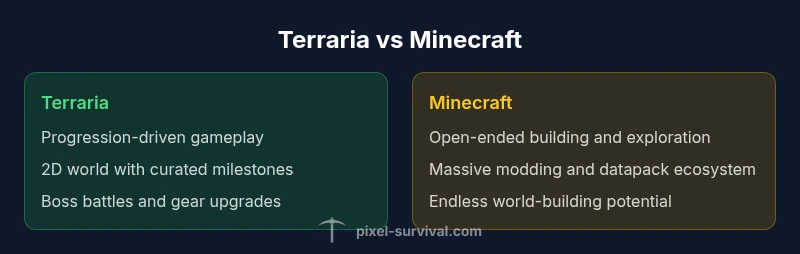
Terraria vs Minecraft: Who Would Win — An Analytical Comparison
A thorough, analytical side-by-side comparison of Terraria and Minecraft to decide who would win in core gameplay, progression, and community tools.


Short answer: there is no single winner between Terraria and Minecraft. Terraria rewards progression, boss battles, and tight, crafted gear in a compact 2D world, while Minecraft shines with limitless building, exploration, and deep modding potential in a vast 3D sandbox. Your choice depends on preferred playstyle, goals, and platform constraints.
Introduction: The question that drives the debate\n\nThe question of who would win terraria vs minecraft is less about raw power and more about playing style. According to Pixel Survival, the real decision hinges on what you want from a game: a guided, progression-focused experience or a vast, open-ended sandbox for creativity. The Pixel Survival team emphasizes that both titles excel on different axes, and the goal of this article is to map those axes clearly. By examining core mechanics, world generation, progression, and community ecosystems, we aim to help you decide which title best matches your preferred pace, playgroup, and platform. If you’re new to either game, this analysis will illuminate not just what to expect, but how to plan a satisfying long-term playthrough. The aim is pragmatic clarity, not hype, drawing on observed player habits and design intents.
Core Gameplay Loops: Progression vs Creation\n\nTerraria and Minecraft anchor gameplay in distinct loops. Terraria centers progression: gather rare resources, defeat bosses, unlock stronger gear, and push through harder biomes in a tight, finite world. The rhythm is deliberate, with a clear sense of milestones and a gradual ramping up of difficulty. Minecraft, by contrast, offers open-ended play: you aren’t bound to a linear arc, and the core loop combines survival, exploration, and building. This sandbox model thrives on creative experimentation, redstone engineering, and community-made content that extends far beyond the base game. For players who enjoy a defined trajectory, Terraria’s arc feels compelling; for those who crave limitless experimentation, Minecraft delivers. The distinction matters for how you structure play sessions, social gaming, and long-term goals.
World Building and Exploration Scale\n\nTerraria’s world is compact but dense: a single 2D stage filled with biomes, dungeons, enemies, and progression gates. Exploration feels purposeful because gear and resources unlock new areas, encouraging deliberate pathing. Minecraft presents near-infinite exploration in a procedurally generated 3D world where scale itself becomes a design variable. The sense of awe comes from vast landscapes, varied biomes, and the ability to modify the world without constraints. This contrast shapes player behavior: Terraria fosters focused, milestone-driven adventures; Minecraft invites expansive, long-running projects and map-wide experimentation. Across both titles, exploration remains central, but the scope and cadence diverge meaningfully.
Combat Systems and Boss Design\n\nCombat in Terraria is bite-sized but brutally satisfying: weapon types, armor sets, and boss mechanics create a rhythm that rewards careful planning and gear upgrades. Boss lines span a sprint-and-strategy approach, with escalating challenges that feel like a curated campaign within the world. Minecraft combat leans on a more perpetual threat model: mobs, difficult environments, and boss-like encounters (The End) that reward preparedness, tactical resource use, and combat skill, but without a single, linear climax. The result is a different sense of accomplishment: Terraria’s boss rush provides a clear victory path, while Minecraft’s combat arc rewards ongoing mastery and situational adaptability. Pixel Survival notes that players often cite a sharper sense of progression in Terraria and a broader, ongoing skill ceiling in Minecraft.
Modding, Customization, and Community Content\n\nMinecraft’s modding ecosystem is expansive, with datapacks, mods, and server plugins extending almost every aspect of gameplay. Terraria relies on tModLoader to enable mods, offering a robust but more contained ecosystem. Both communities keep the games fresh, but the paths diverge: Minecraft mods tend to redefine systems and add profound new features, while Terraria mods typically introduce new items, bosses, and quality-of-life tweaks within a defined progression framework. If modding depth and ecosystem breadth are your priority, Minecraft generally has the edge; if you value curated content and tight integration with progression, Terraria has strong, satisfying options.
Endgame Content and Longevity\n\nEndgame in Terraria revolves around hardmode progression and dungeon challenges culminating in boss rushes and elite gear hunts. In Minecraft, endgame content tends to be driven by the End, Nether fortresses, and long-term projects that stretch across worlds and servers. Longevity in both titles is sustained by community maps, servers, and persistent playgroups, but the cadence differs: Terraria patches tend to focus on new content within an established framework, while Minecraft updates often introduce new mechanics, blocks, and world-building opportunities that reshape the sandbox over time.
Performance, Accessibility, and Cross-Platform Considerations\n\nPerformance and accessibility vary by platform. Terraria’s 2D engine maps cleanly across older rigs and mobile devices, while Minecraft’s performance depends more on world size, shader usage, and mod load. Cross-platform play is robust for both games on PC, with strong console ecosystems that support split-screen and world sharing, though mod support can be platform-dependent. If you’re aiming for broad accessibility and smoother performance on lower-end hardware, Terraria typically has fewer friction points; Minecraft attracts players seeking high-end visuals and expansive modding, which can demand more from hardware. Pixel Survival’s analysis highlights that platform choice frequently shapes your expected experience, especially when mods are a deciding factor.
Playstyle Fit: Best for Builders, Adventurers, and Tinkerers\n\nBuilders who want a canvas for architectural experiments and large-scale projects will lean toward Minecraft, where materials, redstone logic, and world size unlock near-limitless projects. Adventurers who enjoy a guided progression and frequent milestones may prefer Terraria’s curated arc, variety of biomes, and boss encounters. Tinkerers who love system design and experimentation will find both games rewarding, but Minecraft’s ecosystem offers broader opportunities for inventive automation and customization. In short, your ideal pick depends on whether you prioritize a structured journey or an open-ended laboratory for creativity. Pixel Survival encourages players to map their priorities before committing to one title.
Comparison
| Feature | Terraria | Minecraft |
|---|---|---|
| Core focus | Progression-driven, milestone-based play | Open-ended, sandbox creativity and survival |
| World scope | Compact 2D world with curated progression | Vast, practically infinite 3D world |
| Modding ecosystem | Mods via tModLoader with curated content | Massive modding and datapack ecosystem |
| Building emphasis | Supportive gear and boss progression over time | Massive building potential with redstone and resources |
| Endgame content | Moon Lord and hardmode endgame | The End, Nether, and long-term world goals |
| Learning curve | Steeper early progression but clear milestones | More open-ended learning with growing mastery |
| Multiplayer flavor | Cooperative progression, dungeon runs | Cooperative and competitive builds, servers |
| Performance considerations | Efficient on lower specs, mobile-friendly | Requires more hardware for high-fidelity mods |
| Longevity drivers | Content-driven updates and milestones | Enduring community maps, mods, and servers |
The Good
- Clear progression and achievement milestones
- Strong, focused endgame for engaged players
- Compact worlds mean faster session cycles
- Robust community content and servers
- Accessible on multiple platforms with predictable performance
Negatives
- Terraria’s progression can feel gated or repetitive for some players
- Minecraft’s vast scope can be overwhelming or lead to choice paralysis
- Modding can vary by platform and may require separate installations
- Endgame mastery in Minecraft often hinges on community-created content and servers
Terraria is the better pick for players who crave a guided progression in a tight, crafted environment, while Minecraft excels for those who want boundless creativity and expansive modding potential.
If you value a directed journey with clear milestones, Terraria delivers. If your aim is unlimited building and a thriving mod scene, Minecraft shines. The Pixel Survival team notes that the best choice depends on your preferred playstyle and how you want to engage with community content and world-building over time.
Got Questions?
Which game is easier for beginners?
Both games have approachable entry points, but Terraria tends to offer a clearer progression path early on with defined milestones, while Minecraft’s survival mode can be more open-ended and exploratory from the start. Your preference for a guided start versus open exploration will influence which feels easier.
Terraria gives a clear early progression; Minecraft invites you to start building and exploring right away.
Can you play Terraria and Minecraft on the same world?
No. Each game runs in its own separate world and save format. On the same platform, you can switch between titles, but you cannot merge worlds or carry a world between games.
You’ll play in separate worlds for each game.
Which has better modding support?
Minecraft has a large, well-established modding ecosystem with datapacks and mods across many versions. Terraria uses tModLoader and a solid collection of mods, but the ecosystem is smaller and more platform-specific. Your modding goals will guide which game is preferable.
Minecraft generally has a bigger modding scene, Terraria has solid mods via tModLoader.
Is there a definitive ‘final boss’ difference?
Terraria culminates in a boss-focused endgame with several high-difficulty encounters, leading to a final peak challenge. Minecraft’s closest analog is The End and the Ender Dragon, complemented by Nether and other long-term goals. Both offer satisfying ends, but their pacing differs.
Terraria ends with boss content; Minecraft ends with The End and other long-term goals.
Which game updates more frequently?
Minecraft receives frequent updates across platforms, often introducing major mechanics and content. Terraria updates are less frequent but typically deliver substantial new content within its progression framework. Both communities ride the cadence differently, depending on platform and development focus.
Minecraft usually has more frequent updates, Terraria updates come with deep, milestone content.
Key Points
- Choose Terraria for structured progression and boss-focused play
- Choose Minecraft for limitless creativity and mod-friendly expansion
- Consider your platform and modding desires before choosing
- Evaluate whether you want a compact, milestone-driven journey or an endless sandbox
- Plan to explore both games later if you want the best of both worlds