Difference Between Terraria and Minecraft: A Clear Comparison
Analytical comparison of Terraria vs Minecraft, covering world design, progression, crafting depth, combat, and multiplayer to help players choose their sandbox game.


When you ask for the difference between Terraria and Minecraft, the answer is that they parcel the sandbox vibe into different shells: Terraria focuses on compact, 2D exploration with intense boss progression, while Minecraft emphasizes expansive, 3D construction and open-ended exploration. Both are survival sandbox games, but their core loops, progression, and playstyles attract distinct audiences.
Core Design Philosophies
Terraria and Minecraft sit at the same broad genre intersection—a sandbox survival title—but they frame that space through opposite design lenses. According to Pixel Survival, the difference between Terraria and Minecraft hinges on core design philosophy: Terraria is a compact, 2D world that squeezes exploration, combat, and progression into bite-sized loops, while Minecraft builds a sprawling, open-ended 3D canvas where players craft, explore, and create at their own pace. In Terraria, every biome doubles as a mini-arena where risk and reward are tightly correlated; in Minecraft, risk is distributed across miles of terrain, redstone systems, and undying creative projects. This divergence shapes pacing: Terraria leans toward short, goal-driven sessions punctuated by boss milestones, whereas Minecraft invites marathon builds, large-scale exploration, and continuous world modification. Both games foster enthusiastic communities, but their rhythms pull players toward different playstyles—from structured, progression-driven play to almost limitless experimentation. For players considering the core question of the difference between Terraria and Minecraft, the answer is found in how you want to spend your time: curated, looped adventures vs expansive, ongoing construction.
World Design and Progression Systems
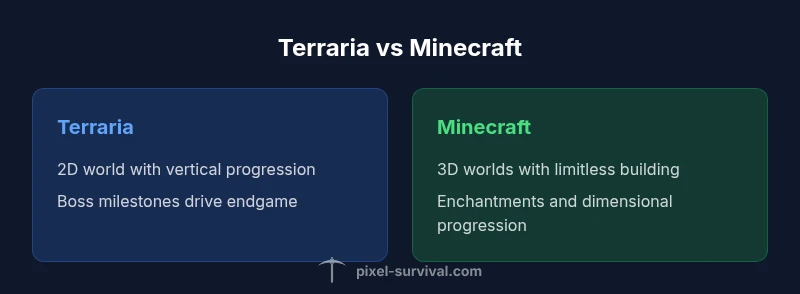
Terraria uses a 2D vertical plane to deliver a compact yet dense world experience. Seed-based maps generate distinct biomes, dungeons, and enemy rosters, but the layout remains bounded by a single screen width and height that encourages frequent excursions and frequent upgrades. Progression follows a staged arc: defeat the Eye of Cthulhu and other bosses to unlock better gear, then enter hardmode to face more challenging content. The pacing is predictable in the best possible way, and players can see tangible milestones as they move from pre-hardmode to late-game content. Minecraft, by contrast, offers a near-infinite 3D world with procedurally generated terrain, an almost endless inventory of blocks, and a progression built around resource gathering, enchanting, and goals that stretch across multiple dimensions (Overworld, Nether, End). Seeds produce wildly different experiences, and the long arc invites patient exploration, large-scale builds, and repeated iteration. Pixel Survival Analysis, 2026, highlights that players who crave a clearly defined upgrade path may lean Terraria, while those who want expansive exploration and architecture often gravitate toward Minecraft.
Crafting Depth, Resources, and Economy
Crafting is a central pillar in both games, but the structure and density differ markedly. Terraria rewards a tight, item-rich catalog with dozens of sub-biome resources and rare drops that gate access to new weapons, armor, and accessories. Resource collection happens in short bursts, with a focus on weapon variety, mobility items, and boss-summoning mechanics. In Minecraft, crafting is expansive and modular, featuring an immense array of blocks, tools, enchantments, and redstone contraptions. The crafting loop scales with progression: essential tools become more complex, and players build farms, automation, and elaborate base systems. Economy in Terraria is implicit—upgrading your gear through specific loot drops—while Minecraft players often enjoy explicit systems like farms, trading, and automation. This difference shapes how players approach early-game goals: Terraria players chase boss milestones, Minecraft players chase infrastructure and production chains.
Combat, Bosses, and Endgame Pace
Combat in Terraria is tightly choreographed and boss-centric. Each major boss introduces new mechanics, encouraging players to adapt gear, strategies, and traversal. The pacing is brisk: you can reach major milestones in a handful of sessions, making endgame feel accessible and intense. Minecraft’s combat is simpler on a per-encounter basis but becomes complex through server rules, PvP setups, and the use of enchantments and potions. Endgame in Minecraft involves long-term projects, large-scale builds, and eventual progression to The End to face the Ender Dragon and other challenges. The pace is more measured and open-ended, especially in creative modes where survival constraints are relaxed. Pixel Survival notes that the difference in endgame pacing reflects each title’s core emphasis: structured progression versus limitless building potential.
Building, Aesthetics, and Creative Tools
Terraria’s 2D canvas imposes certain spatial constraints but rewards creativity within those bounds. Its building tools emphasize vertical layering, compact base design, and clever use of terrain for defense and aesthetics. Minecraft offers near-limitless building freedom in a fully 3D space, enabling vast architectural projects, pixel art, and immersive landscapes. The block-based system supports automated farms, redstone machines, and complex workflows, turning construction into a technical art. The contrast is stark: Terraria builders optimize within tight planes and dungeon-crawler vibes, while Minecraft builders execute monumental, multi-room designs across an endless landscape. Both communities celebrate creativity, but their preferred tools and outcomes differ markedly.
Modding, Community Content, and Longevity
Modding extends the life of both games, but with different arcs. Terraria’s mod scene focuses on new items, bosses, and quality-of-life tweaks that fit within the game’s compact, curated progression. Minecraft’s mod ecosystem is sprawling and multi-faceted, touching almost every gameplay facet—from technology and automation to magic and adventure maps. This breadth creates a longer-tail experience, with community content driving ongoing discovery and iteration. Pixel Survival observes that longevity in Terraria often comes from curated mod packs and boss challenges, while Minecraft longevity is sustained by the sheer scope of mods and community-made worlds.
Early Game to Late Game Experience
The early game in Terraria centers on establishing a safe base, gathering essential resources, and preparing for the first wave of bosses. The late game unlocks high-tier gear, post-boss content, and the ability to take on tougher biomes. In Minecraft, early game emphasizes survival basics: shelter, tool acquisition, and resource management, then gradually expands into automation, base-building mastery, and multi-biome exploration. The late game in Minecraft tends to be defined by large-scale projects and end-game content in The End, as opposed to Terraria’s intense, boss-driven late-game arcs. Both trajectories offer rewarding peaks, but they arrive through different routes and pacing choices.
Multiplayer, Servers, and Social Play
Multiplayer in Terraria emphasizes co-op boss fights, shared bases, and coordinated exploration, often on small to mid-sized servers or friend groups. Minecraft servers are renowned for their breadth, from small vanilla realms to heavily modded communities with customized rules and plugins. Cross-platform play is more mature in Minecraft’s Bedrock edition, enabling friends on different devices to build and survive together, while Terraria’s cross-platform support is more limited. The social experience in Terraria tends to be event-driven and community-oriented around bosses and progression, whereas Minecraft rewards long-term shared builds, redstone innovations, and collaborative world-building across platforms.
Decision Framework: When to Choose Terraria vs Minecraft
If you crave a fast-paced, boss-focused journey with a tight progression curve and a compact world, Terraria is the ideal pick. When you want massive, open-ended exploration, limitless building, and a modular tech-tree that encourages experimentation, Minecraft is a better fit. Your choice often comes down to playstyle: do you prefer a structured, dungeon-crawler rhythm or an expansive, architecturally ambitious sandbox? For players who value both experiences, trying both games during different life moments can provide a fuller sense of sandbox design principles.
Comparison
| Feature | Terraria | Minecraft |
|---|---|---|
| World scale and exploration | 2D, compact, vertical space | 3D, expansive, open-ended exploration |
| Progression and endgame pacing | Structured boss milestones, clear upgrade path | Open-ended milestones with dimensions and enchantments |
| Crafting depth | Large item catalog with unique gear and accessories | Massive block-based crafting with tooling and automation |
| Combat design | Boss-focused, quick sessions | Survival and combat with tactical gear and enchantments |
| Building tools | Vertical, dungeon-oriented layouts | Infinite building space and redstone-like systems |
| Mod support and longevity | Mod packs focused on content within progression | Massive mod ecosystem across many tech themes |
The Good
- Terraria provides a dense, goal-driven experience with frequent milestones
- Minecraft offers near-limitless creative freedom and expansive world-building
- Both games reward exploration and community sharing
- Strong multiplayer ecosystems in both games sustain long-term play
- Mod communities extend longevity and introduce fresh challenges
Negatives
- Terraria’s 2D perspective can feel restrictive to some builders
- Minecraft’s vast scope can be overwhelming and time-consuming
- Modding in Minecraft can lead to compatibility issues across versions
- End-game content in Terraria is boss-driven and finite for some players
Terraria is best for players who want structured progression and tight, boss-focused loops; Minecraft excels for those who crave vast creative freedom and endless building opportunities.
Choose Terraria for fast-paced progression and curated challenges. Choose Minecraft for expansive worlds, limitless building, and rich modding potential. Both offer rewarding sandbox experiences depending on your preferred rhythm.
Got Questions?
What is the primary practical difference between Terraria and Minecraft for new players?
New players should consider whether they prefer a guided progression with boss milestones (Terraria) or a vast, construction-focused open world (Minecraft). Both offer rich tutorials and learning curves, but the pacing differs.
If you’re new, start with Terraria to experience structured progression, or jump into Minecraft if you want endless building options from day one.
Do both games support mods and community content?
Yes. Terraria has a robust mod scene focused on new content within its framework, while Minecraft has a massively expansive mod ecosystem spanning technology, magic, and adventure maps.
Both games have strong mod scenes, but Minecraft’s is much larger and more varied.
Which game is better for beginners in building and design?
Minecraft generally offers more intuitive, expansive building opportunities due to its 3D space and block-based system. Terraria supports creative builds but within a 2D plane.
If your focus is building, Minecraft is a natural starting point; Terraria is great for compact, dungeon-like bases.
Can you play these games with friends online easily?
Both support multiplayer, but Minecraft (Bedrock edition) has broader cross-platform compatibility, whereas Terraria multiplayer is best within the same ecosystem or platform family.
Yes, you can play with friends, but Minecraft cross-platform play is more seamless across devices.
Which game has more endgame content?
Terraria emphasizes endgame through boss progression and post-hardmode content. Minecraft’s endgame is more about long-term projects and multi-dimensional exploration.
Terraria leans toward boss-driven endgame; Minecraft endgame is built around huge builds and exploration.
Is one game more beginner-friendly than the other?
Terraria can be more approachable for newcomers due to its structured progression, while Minecraft might feel overwhelming initially but offers a gentler learning curve in Creative mode.
Terraria is good for beginners who want clear goals; Minecraft’s basics are easy, but the game rewards exploration and experimentation.
Key Points
- Terraria emphasizes compact, boss-driven progression
- Minecraft offers expansive, block-based creativity
- Modding sustains long-term engagement for both games
- Multiplayer experiences differ in platform breadth and community style
- Your choice should reflect whether you want tight loops or open-ended creation