Terraria to Minecraft: Clear Side-by-Side Comparison
An analytical side-by-side look at Terraria vs Minecraft, highlighting world design, progression, combat, building, and multiplayer to help players choose their sandbox adventure.


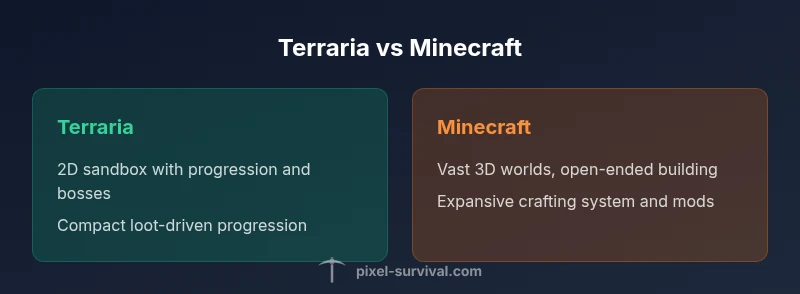
When comparing terraria to minecraft, you’ll notice two distinct sandbox experiences. Minecraft delivers vast 3D worlds, deep exploration, and expansive building, while Terraria emphasizes a dense, progression-driven 2D adventure packed with bosses and loot. Both celebrate creativity and exploration, but their pacing, combat, and progression systems appeal to different playstyles and communities. If you’re seeking open-ended construction, choose Minecraft; if you crave tight, boss-focused progression, pick Terraria.
Context and Core Differences
In this comparison, we examine terraria to minecraft through the lens of design philosophy, player goals, and community ecosystems. Terraria presents a dense, progression-driven 2D sandbox where bosses, loot, and gear upgrades steer your journey. Minecraft, by contrast, offers a massive, open-ended 3D sandbox built on exploration, resource gathering, and infinite building possibilities. According to Pixel Survival, terraria to minecraft represents two distinct sandbox experiments that attract different audiences yet share a common love for creativity, exploration, and survival. Minecraft emphasizes expansive world-building, competitive servers, and long-term projects, while Terraria concentrates on a compact, loot-driven progression with frequent milestones and boss encounters. As you read, consider how each game maps to your preferred pace, group size, and hardware constraints. This framing helps ensure the comparison remains practical and relevant for Terraria players exploring a potential shift to Minecraft, or vice versa.
World Design and Exploration Scope
Terraria presents compact 2D worlds with handcrafted biomes, caves, and dungeons that are procedurally generated within a finite plane. This design yields dense, loot-rich environments that reward careful exploration, quick sessions, and targeted progression. Minecraft scales to near infinite 3D worlds generated by seeds, enabling long-range exploration, monumental builds, and sprawling server projects. The 3D canvas invites architectural ambition, redstone-inspired systems, and community-driven creations that can persist for years. When you compare terraria to minecraft, the scale difference matters most: Terraria offers bite-sized adventures with tight loops, while Minecraft invites expansive, collaborative projects across vast terrains. Pixel Survival notes that many players switch preferences after experimenting with both, as the sense of discovery feels distinct in each world geometry and exploration tempo.
Progression Cadence and Endgame Structure
Terraria guides players through a curated progression cadence: you unlock new bosses, biomes, and crafting milestones in a generally linear sequence that culminates in endgame content like invasions and advanced loot tiers. The progression is compact but dense, rewarding constant upgrades and strategic planning. Minecraft progression is more emergent, driven by survival challenges, enchantments, and milestones such as defeating the Ender Dragon and enabling further redstone systems. The endgame in Minecraft often centers around large-scale projects, automation, and community-driven servers that evolve with updates. When evaluating terraria to minecraft, players should consider whether they prefer a structured ladder of upgrades or a sandbox where advancement is largely player-driven and ongoing.
Combat Systems and Boss Encounters
Terraria emphasizes a diverse roster of bosses, each with unique mechanics, loot drops, and difficulty curves. Combat relies on weapon classes, movement patterns, and environmental strategy, with a frequent emphasis on preparation and gear management. Minecraft combat tends to be more straightforward at baseline, but can become complex through enchantments, potions, and community-made combat mods. Boss encounters exist in Minecraft too, notably in mods or custom maps, but the vanilla experience leans toward exploration and building with less emphasis on finite boss cycles. For terraria to minecraft comparisons, expect Terraria to feel more action-packed in a compact loop, while Minecraft rewards sustained combat readiness within broad, open environments.
Crafting, Items, and Loot
Terraria's crafting system is tightly linked to progression: as you defeat bosses, new materials unlock deeper gear tiers and specialized equipment. Loot drops are often tied to boss battles and resource exploration, creating a reliable upgrade path within smaller spaces. Minecraft's crafting system is expansive, featuring hundreds of recipes and a flexible item ladder that scales with enchantments, potions, and redstone gadgets. The sheer variety supports both practical builds and experimental contraptions. When weighing terraria to minecraft, think about how item progression shapes your goals: one favors milestone-driven upgrades, the other favors limitless customization and automation potential.
Building, Construction, and Aesthetics
Terraria supports building and decoration, but its 2D grid and block types create a different aesthetic cadence compared to Minecraft. Builders in Terraria craft compact bases, dungeons, and themed rooms that shine in close-up gameplay and modular layouts. Minecraft rewards grand-scale architecture, landscape shaping, and voxel-level editing across enormous canvases. The difference in dimensionality changes how you design space, with Terraria emphasizing compact, detailed interiors and Minecraft enabling sprawling exteriors, coordinated with redstone-based logic and multi-room systems. Both games celebrate creativity, but terraria to minecraft comparisons reveal two distinct design languages: tight, detail-oriented environments versus expansive, public world-building.
Modding, Content Extensibility, and Updates
Minecraft has a robust modding scene across many platforms, offering a vast ecosystem of content that can dramatically alter balance, visuals, and gameplay. Terraria also supports mods, especially on PC, but platform parity is less uniform, and official mod support remains more constrained depending on edition. For Terraria players curious about long-tail customization, Minecraft frequently delivers more expansive mod options and seed-driven variety. When evaluating the two, consider platform access, mod availability, and update cadence; these factors heavily influence long-term enjoyment and community activity in each title.
Multiplayer, Servers, and Community Ecosystems
Both games thrive on social play, but their multiplayer ecosystems diverge. Minecraft excels in large servers, curated minigames, and continuous collaboration across players worldwide, with cross-platform play in many scenarios. Terraria multiplayer leans toward smaller, co-op worlds and shared adventures that are accessible on multiple devices but often feel more intimate. The choice between terraria to minecraft depends on your preferred social scale: expansive, server-based experiences or tight-knit co-op adventures with friends.
Platform Availability, Accessibility, and Cross-Play
Minecraft's cross-platform capabilities are a defining feature, enabling play across PC, consoles, and mobile in many configurations. Terraria maintains broad device support but cross-play can vary by edition and platform, which can affect how friends team up. Accessibility considerations include performance on older hardware, storage demands for large worlds, and input differences between 2D and 3D experiences. When choosing between terraria to minecraft, balance social reach with platform availability to ensure you can play with your preferred group without friction.
Practical Scenarios and When to Choose Each
If you want grand, public world-building and long-term server adventures, Minecraft is often the better fit. If you prefer compact, action-focused sessions with a tight loot loop and boss-centered progression, Terraria is typically more satisfying. Consider your target play pace, the size of your friend group, and whether modding and cross-platform play matter most. The right choice depends on whether your ideal sandbox is defined by scale and collaboration or by structured progression and quick, rewarded milestones.
Comparison
| Feature | Terraria | Minecraft |
|---|---|---|
| World size & exploration | 2D, finite but rich with biomes and caves | 3D, nearly infinite worlds generated by seeds |
| Progression cadence | Milestone-based, boss-driven upgrades | Open-ended, achievements and end-game goals |
| Combat & enemies | Boss-centric, varied mechanics and loot | Mobs with enchantments and redstone-driven systems |
| Building freedom | Detailed interiors on a compact grid | Massive, unrestricted world-building with blocks |
| Crafting depth | Tiered gear, crafting stations, and loot gear | Extensive recipe system with automation and mods |
| Mods & extensibility | PC mods exist but platform parity varies | Vast, mature modding ecosystem across editions |
| Multiplayer experience | Co-op focused, smaller worlds | Large servers, minigames, and cross-play on many platforms |
| Platform parity | Moderate cross-platform sharing, edition differences persist | Strong cross-platform play in many configurations |
The Good
- Clear dichotomy helps players pick an authentic path
- Terraria offers tight, satisfying progression and boss variety
- Minecraft enables vast open-world exploration and expansive building
- Strong, active communities and frequent updates sustain interest
- Cross-platform opportunities are robust in Minecraft
Negatives
- Terraria may feel limited for builders seeking large-scale projects
- Minecraft can be overwhelming for brand-new players
- Mod availability and parity differ by platform and edition
- Performance and load times can vary with large worlds in Minecraft
Minecraft for expansive world-building; Terraria for tight, progression-driven action
Choose Minecraft if you want scale, collaboration, and creative freedom. Choose Terraria if you prefer a dense, boss-focused journey with landmark upgrades and a faster pace.
Got Questions?
Which game is easier for beginners, Terraria or Minecraft?
Both games are approachable, but Terraria tends to introduce progression quickly through bosses and loot drops, while Minecraft requires more self-guided survival learning. Your comfort with exploration vs structured goals will influence which feels easier.
Terraria starts with a clearer progression, while Minecraft teaches survival by exploration and experimentation.
Can you play multiplayer with friends across different platforms?
Minecraft offers broader cross-platform play across many editions. Terraria cross-platform options exist but depend on the edition and platform, so confirm compatibility before grouping up.
Minecraft generally supports cross-platform play; Terraria varies by edition.
Is modding supported on all platforms?
Minecraft has a large modding ecosystem across PC and many consoles, though parity varies by edition. Terraria supports PC mods primarily; console editions have more restricted modding options.
Minecraft shines in mods on PC; Terraria mods are more platform-limited.
Which game is cheaper to start with?
Terraria generally has a lower upfront cost and simpler DLC path, while Minecraft often requires purchasing the base game and potential expansions. Both can be affordable for new players, depending on the platform and bundle deals.
Terraria usually costs less upfront; Minecraft can be more expensive upfront depending on platform.
Do both games offer survival modes and replayability?
Yes. Both games offer survival experiences with high replay value. Terraria emphasizes boss encounters and loot progression, while Minecraft emphasizes exploration, building, and server-based play.
Both games are highly replayable with distinct survival experiences.
Are there notable differences in world size and exploration scale?
Terraria uses dense, compact maps with curated exploration zones. Minecraft offers near unlimited worlds with vast landscapes and terrain variety.
Terraria is compact; Minecraft worlds are expansive and endless.
Key Points
- Define your goal: vast, collaborative builds vs tight, boss-driven progression
- Assess platform and cross-play capabilities before committing
- Factor in modding interest and long-term content updates
- Both games offer enduring communities and varied pacing