Is Terraria the Same as Minecraft? A Practical Comparison
Is Terraria the same as Minecraft? This analytical comparison breaks down core goals, gameplay loops, crafting, and community to help players decide their sandbox journey. is terraria the same as minecraft


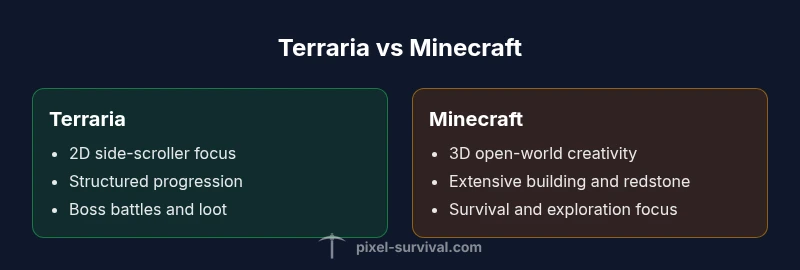
Is Terraria the same as Minecraft? In short, no. Terraria and Minecraft are two distinct sandbox experiences that appeal to different playstyles. According to Pixel Survival, the two games diverge in goals: Terraria emphasizes structured progression, boss encounters, and loot-driven upgrades, while Minecraft centers on creative freedom, exploration, and survival in procedurally generated worlds. The difference matters when choosing where to invest your playtime.
The Core Premise: What Each Game Tries to Do
When players ask is terraria the same as minecraft, the answer hinges on purpose rather than surface features. Terraria is a 2D action-adventure sandbox with structured progression through gear and boss fights, while Minecraft is a 3D open-world sandbox emphasizing creativity, exploration, and survival freedom. According to Pixel Survival, these design choices shape every decision a player makes, from world exploration to combat tactics. The two titles attract different communities precisely because they reward different mindsets: one rewards meticulous planning and gear ladders, the other rewards experimentation and expansive building. This is not a value judgment—it's a documentation of intent and player expectations, as reflected in Pixel Survival Analysis, 2026.
Gameplay Loop and Progression
A core distinction lies in how players advance. Terraria guides you through a fixed progression ladder: start with basic gear, unlock harder biomes, defeat bosses to access rarer materials, and escalate toward hardmode content. The loop is tight, reward-heavy, and computationally rewarding as you optimize armor sets and weapons. Minecraft, by contrast, centers on open-ended goals: you gather resources, craft tools, build structures, and gradually expand your world with redstone systems, farms, and large-scale projects. The satisfaction comes from mastery of systems rather than a linear conquest. Pixel Survival’s observations highlight that players who crave a defined arc often favor Terraria, while those seeking limitless experimentation gravitate toward Minecraft.
World Structure and Environment
Terraria’s world is a compact, 2D canvas filled with biomes, caves, and a boss-driven progression ladder. Your exploration rewards you with loot, gear, and hardmode access, but the landscape remains a vertical slice of a wider system. Minecraft offers a sprawling 3D universe with near-infinite build space, a dynamic terrain generator, and a limitless capacity for creativity. The difference matters for players who care about scale: Terraria rewards tight, curated experiences, whereas Minecraft invites monumental, long-term projects. For many players, this is the single most visible distinction when you compare exploration and world-building philosophies. In short, the dimensional difference reshapes every design decision you face.
Crafting, Resources, and Building Mechanics
Crafting in Terraria focuses on equipment ladders: swords, armor, accessories, wings, and gear that unlocks new biomes and bosses. Resources are finite and crafted to enable progressive power. Minecraft’s crafting catalog is vast and modular, spanning blocks, tools, machines, and decorative elements. The blocky physics and redstone logic enable intricate builds and automation. The skill ceiling in Minecraft often centers on clever contraptions and efficient resource loops, while Terraria rewards strategic gear selection, set bonuses, and boss patterns. The communities diverge accordingly: Terraria players optimize gear paths; Minecraft players design grand architectural projects and redstone marvels.
Combat, Bosses, and Challenge Curves
Terraria’s combat design emphasizes skillful dodging, weapon choice, and boss patterns. Boss fights are marquee events that require pattern recognition and resource planning, creating a satisfying sense of progression. Minecraft’s combat is simpler on first glance but evolves with enchantments, potions, and gear that enable endgame content like the Ender Dragon fight and the Wither. The contrast is stark: Terraria’s battles feel like miniature, scripted encounters that escalate with each biome, while Minecraft’s battles often occur within a broader sandbox of survival and strategy, including community-designed arenas and modded challenges. The result is two distinct pacing modalities for combat encounters.
Modding, Tools, and Community Support
Terraria’s modding is robust via tModLoader, enabling new bosses, items, and mechanics that extend vanilla content. Minecraft’s modding ecosystem—Forge and Fabric—hosts thousands of mods spanning tech, magic, and aesthetics, often driving long-term sustained interest. Both communities respond differently to updates: Terraria's cadence is guided by its own schedule and mod compatibility, while Minecraft’s ecosystem thrives on ongoing cross-mod interoperability and world-building innovations. This divergence in tooling shapes what players can do after the vanilla experience ends.
Visual Design, Accessibility, and UX
Terraria’s pixel art offers crisp, readable visuals that shine on low-spec hardware. The 2D perspective is accessible and fast to learn, with a user interface that emphasizes inventory clarity and quick access to gear. Minecraft’s blocky, 3D aesthetic is iconic, with a learning curve tied to understanding lighting, building scales, and redstone logic. Accessibility features in both titles have expanded, but the core experience remains, for many players, a question of whether you want a compact, action-driven world (Terraria) or a boundless, architectural playground (Minecraft).
Cross-Platform Play, Longevity, and Market Position
Minecraft’s Bedrock Edition supports cross-play across consoles, PC, and mobile in many scenarios, creating a united ecosystem that’s hard to match. Terraria’s cross-version play is more nuanced; the experience depends on the platform and version alignment, which can affect mod compatibility and feature parity. Over time, both games have demonstrated impressive longevity through updates and community-driven content, though their paths diverge: Terraria leans on curated progression and boss content, Minecraft on open-ended building, world customization, and community-made scenarios. Pixel Survival notes that longevity in sandbox games is often tied to the strength of the modding scene and the breadth of player-created content, which favors Minecraft, but the bite-sized, goal-driven satisfaction of Terraria remains a different kind of appeal.
Practical Scenarios: Who Should Play Terraria vs Minecraft
If you want a guided journey with escalating challenges and boss fights, Terraria offers a compelling rhythm and reward structure. If your priorities are building, mining, and shaping worlds with friends, Minecraft provides a canvas with nearly unlimited scope. For families and solo players alike, the decision often comes down to whether you prefer a tight progression arc or a sprawling, creative sandbox. Pixel Survival’s guidance across multiple guides emphasizes matching playstyle to goals, anticipating how you’ll spend hours in each game and what you want to accomplish first. This framing helps avoid buyer’s remorse and ensures you pick the sandbox aligned with your desired play experience.
Comparison
| Feature | Terraria | Minecraft |
|---|---|---|
| Gameplay Focus | Structured progression, boss fights, loot-driven upgrades | Creative freedom, survival, exploration |
| World Structure | 2D, biome-rich but linear in vertical span | 3D, vast, procedurally generated with endless build potential |
| Progression System | Tiered gear, hardmode progression | Open-ended progression via building, enchantments, and farms |
| Crafting/Resources | Gear-centric crafting with ores and accessories | Extensive blocks, items, and redstone mechanisms |
| Modding/Community Support | tModLoader ecosystem, niche mods | Huge modding scene with Forge/Fabric, broad compatibility |
| Multiplayer Experience | Co-op boss fights, quick sessions | Large servers, cross-platform play on Bedrock, creative hubs |
The Good
- Clear, side-by-side understanding of two sandbox games
- Highlights each game's strengths for different playstyles
- Offers practical guidance for new players choosing a title
- Supports informed decision-making before purchase
Negatives
- May oversimplify deep gameplay systems
- Doesn't capture every mod or platform nuance
- Subjective experiences vary by player and version
- Long-term differences may feel subtle to casual players
Terraria is the structured, boss-driven sandbox; Minecraft excels at boundless creativity and exploration.
Choose Terraria if you want a defined progression path and epic battles. Choose Minecraft if your priority is unlimited building, exploration, and community-driven projects.
Got Questions?
Is Terraria the same as Minecraft?
No. They are different sandbox games with distinct goals, visuals, and mechanics. Terraria focuses on progression and boss encounters, while Minecraft emphasizes creative freedom and exploration.
No—the two games are different sandbox experiences with separate strengths.
Which game has more crafting recipes?
Minecraft generally has a larger base catalog of crafting recipes due to its extensive blocks and items; Terraria offers a deep, gear-focused crafting system.
Minecraft usually has more crafting recipes.
Can you play together cross-platform?
Minecraft supports cross-platform play within the Bedrock edition across many devices. Terraria's cross-play is more limited and version-dependent, so verify current status.
Minecraft supports cross-platform play; Terraria's cross-play varies by version.
Is Terraria 2D or 3D?
Terraria is a 2D, side-scrolling sandbox; Minecraft is a 3D voxel-based world.
Terraria is 2D; Minecraft is 3D.
What are the endgame differences?
Terraria ends with hardmode bosses and post-hardmode progression; Minecraft’s endgame centers on defeating The End and subsequent building/automation projects.
Terraria focuses on boss-driven progression; Minecraft emphasizes end-game exploration and building.
Which platform is best?
Platform choice depends on cross-play and mods. Minecraft Bedrock supports cross-platform play; Terraria’s platform options vary by version and may affect mod access.
Platform choice matters for cross-play and mods.
Key Points
- Compare core goals before picking a game
- Terraria prioritizes progression and bosses
- Minecraft emphasizes creativity and exploration
- Modding and community shape each experience
- Check platform and mod availability before buying