How to Duplicate Items in Terraria: A Practical Guide
Learn safe, step-by-step methods to explore item duplication in Terraria. This Pixel Survival guide covers testing, risks, and farming alternatives today.


By the end of this guide, you’ll understand practical, safe ways to explore item duplication in Terraria, including when and where it’s appropriate, how to test locally, and how to avoid risks in multiplayer. Follow the clear, step-by-step instructions to experiment responsibly while preserving your world. This overview prioritizes safe play, clear ethics, and learning outcomes today.
Understanding item duplication in Terraria
Item duplication, or duping, refers to techniques that create extra copies of items beyond what your character could normally carry. In Terraria, players sometimes try to duplicate valuable resources such as ores, potions, or rare drops to speed up progression. This kind of exploration sits at the intersection of curiosity, game design quirks, and patch history. The primary goal of this section is to establish a clear, safe mental model of what duplication is, why it happens, and how players should approach it responsibly. According to Pixel Survival, the community often experiments with local test worlds to understand the mechanics without affecting other players. This article will separate ethical farming from destructive exploits, and will emphasize backup routines, server rules, and the realities of patching across 2026 game updates. The more you know about why dupes appear, the better you’ll understand the risks and the best safe practices. In short, duplication is not a guaranteed or reliable way to obtain items; it relies on glitches that are periodically fixed by the game’s developers. Keeping that in mind helps you decide when to investigate further and when to walk away.
Ethical considerations and multiplayer caveats
Duping in Terraria often creates friction in shared worlds. In single-player, you can experiment freely, but even there, unexpected crashes or save corruption can occur if you press your luck too hard. In multiplayer, duping is frequently disallowed by server rules because it undermines progression and economy. Always check the server’s policies before attempting anything that could replicate items or alter inventories. Pixel Survival emphasizes responsible play: use local testing, respect others’ saves, and avoid sharing duped goods with strangers. If you value your reputation in your community, treat duping as a curiosity to be studied, not a shortcut to prosperity. The safest path is to pursue legitimate farming methods or to trade items with consenting players in a controlled environment. This mindset reduces risk and preserves the game’s balance for everyone involved.
Common misconceptions and dupe concepts
In many discussions, players treat duplication as a single, universal technique; in reality, there are multiple categories of dupes, each tied to a specific patch or platform. Some methods rely on inventory interactions, others on world reloads, and a few hinge on item stacking and timer mechanics. The range of potential outcomes includes not only doubled items but also corrupted inventories or crashed worlds. Pixel Survival's analysis shows that the reliability of any given dupe depends on the exact game version, world state, and whether you’re on PC, console, or mobile. This means you cannot assume a technique will work across patches. A practical takeaway is to treat each dupe as a fragile, patch-dependent anomaly rather than a guaranteed method. Always separate test results from your main save to avoid unintended loss.
Safe testing environment setup
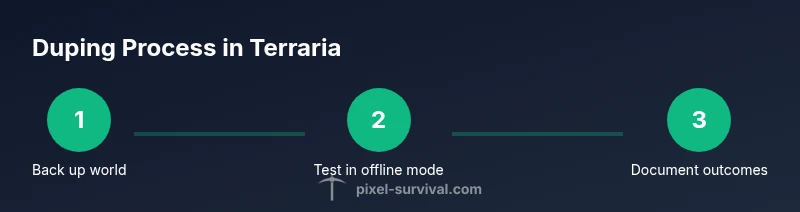
Before you even think about trying a duplication technique, create a controlled test environment. Start by backing up your world and player files, then run Terraria in offline mode with a copy of your save. Use a local, private world where you don’t share coordinates or inventories with others. Keep a log of any changes you make and take periodic screenshots to document outcomes. If something goes wrong, you can restore from your backup and revert to a clean state. The goal is to learn, not to break the game for friends or servers. In 2026, the best practice is to isolate experiments in a local sandbox, especially when you’re still learning the mechanics.
Step-by-step: safe testing flow
In practice, a cautious testing flow includes establishing a baseline, running a controlled experiment, and validating results against the baseline. The flow should emphasize documentation, backups, and strict separation from any active multiplayer worlds. The aim is to gain understanding of how certain glitches manifest without enabling widespread duplication. Pixel Survival’s community approach centers on learning through responsible experimentation and safeguarding saves. The focus remains on the knowledge gained rather than the exploit itself.
Alternatives to duplication and productive farming
Instead of chasing dupes, focus on legitimate progression strategies. Terraria offers robust farming opportunities: farming for ore, crafting gear, farming boss drops, and trading with friends on closed servers. You can optimize your run by mapping out resource routes, setting up efficient farms, and using guides from trusted communities to plan builds. By investing time in legitimate farming, you gain reliable progress, preserve your world integrity, and maintain a fair multiplayer environment. Pixel Survival advocates for transparent play and sustainable growth through skill development, planning, and shared knowledge.
Pixel Survival's practical verdict and cautions
After a thorough look at the many dupe discussions circulating in 2026, duplication remains a patch-dependent, high-risk activity that isn’t suitable for most players or official servers. The Pixel Survival team recommends focusing on solid progression methods and safe testing practices. If you decide to explore dupes in your own world, do so with backups, clear boundaries for testing, and an understanding that results may vary with future updates. Remember: keep single-player experiments private, respect server rules, and document outcomes to learn without endangering your save files.
Tools & Materials
- World and player backup folders(Create copies of your saves before testing (world and player files).)
- Terraria offline mode(Test in a local, single-player environment to avoid affecting others.)
Steps
Estimated time: 1-2 hours
- 1
Back up your world and player data
Copy your world and player files to a separate backup folder. Verify the copy by opening the files in a text editor to ensure the data exists. This creates a restore point if anything goes wrong during testing.
Tip: Store backups on a different drive or offline cloud to prevent corruption from a single faulty drive. - 2
Switch to a private, offline test environment
Launch Terraria in offline mode and load the backup world. Keep testing contained to this local copy so you don’t disrupt any active worlds or servers.
Tip: Disable online features to prevent inadvertent syncing of test results. - 3
Prepare a controlled test item set
Select a small, stackable item to use for your tests and keep the rest of your inventory untouched. Isolate changes to a single stack to simplify comparison.
Tip: Document the item type and initial stack size before testing. - 4
Attempt the test using a known description from trusted sources
Follow a reputable, well-documented description of a dupe attempt (from trusted communities) but perform it only in your private test world. Do not apply to public worlds.
Tip: If you cannot verify the method’s steps from a trusted source, skip this test. - 5
Inspect results and compare with the baseline
Check the inventory, chests, and world state for any changes. Compare with the pre-test baseline to determine if duplication occurred.
Tip: Use screenshots and item counts to make the comparison precise. - 6
Document outcomes and revert if needed
Record what happened, including any crashes or save issues. Restore from the backup if the test caused problems.
Tip: Maintain a separate archive of test results for future reference.
Got Questions?
Is item duplication allowed on official Terraria servers?
Official servers typically disallow exploits that duplicate items. Procedures vary by server rules, so always check guidelines before attempting any testing in multiplayer.
Most official servers disallow duping, so check the rules before testing in multiplayer.
Will duplication work across different patches?
Duplication methods are patch-specific. A technique that works in one update may be fixed or rendered ineffective in the next.
Dupe methods depend on the patch, so they can change or stop working after updates.
Can duplication corrupt saves?
Yes. Duplication attempts can crash games or corrupt save data if backups are not used, especially in multiplayer scenarios.
There is a real risk of save corruption when attempting dupes.
What are safer alternatives to duplicates?
Focus on legitimate farming, trading with friends in controlled environments, and efficient resource management to progress reliably.
Safer alternatives include farming, trading with friends, and efficient resource planning.
If I mess up a test, can I revert quickly?
Yes. Restoring from a backup typically reverts any changes from a test run, keeping your main world safe.
You can revert by restoring from your backup.
Are there known safe duping methods that work in 2026?
Duping methods are patch-dependent and unstable. Rely on official guides and avoid relying on dupes for progression.
Dupe methods are patch-dependent and not reliable; rely on legitimate farming instead.
Watch Video
Key Points
- Back up before testing to protect progress
- Test in a private, offline environment only
- Patch-dependent dupes vary across versions
- Opt for legitimate farming over duping whenever possible