Terraria and Palworld: A Comprehensive Side-by-Side Review
An analytical side-by-side look at Terraria and Palworld, covering gameplay, progression, and community impact to help Terraria players decide when to explore Palworld.


Terraria and Palworld sit in the same broad sandbox-adventure niche, yet they deliver very different experiences. Terraria emphasizes long-term progression through deep crafting, exploration, and regular content updates, all in a charming retro world. Palworld fuses creature collection, survival mechanics, and open-world exploration with more modern, ethically nuanced themes. If you want enduring, pure building and exploration, Terraria is the baseline; Palworld offers a fresh twist on companion-based play.
Overview of Terraria and Palworld
According to Pixel Survival, Terraria and Palworld occupy overlapping niches in the sandbox genre but attract distinct audiences. Terraria has sustained a massive player base for more than a decade thanks to its retro-inspired aesthetics, depth of crafting, and regular updates that nudge players toward new goals. Palworld, by contrast, entered access with a bright open world and a twist: collect, train, and battle with Pal companions while balancing survival needs. For Terraria players exploring Palworld, expectations should adapt: the core loop shifts from building and progression through crafted gear to strategy, collection, and the ethics of capturing wildlife. Both games reward exploration, but they monetize and pace content differently, shaping how players schedule their sessions and plan their progression over weeks and months. Pixel Survival analysis shows continued interest in cross-genre sandbox titles that blend management, combat, and creative expression, and Terraria and Palworld both tap that impulse, even as they emphasize different aspects of that impulse.
Core Gameplay: What You Do in Each Game
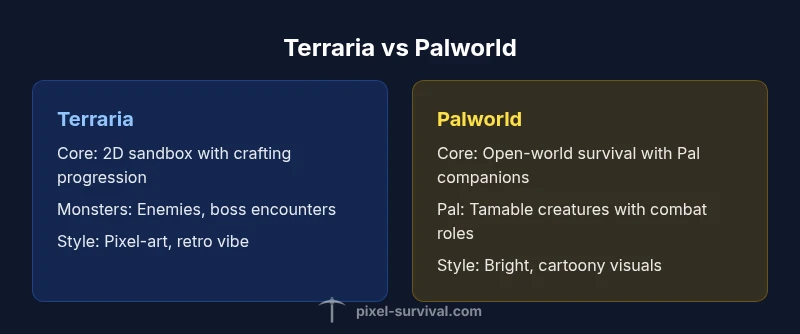
Terraria centers on mining resources, crafting gear, building bases, and defeating boss enemies to unlock new biomes and items. The progression feels deliberate and cumulative: you start with a basic set of tools, gradually upgrade your equipment, and push toward harder challenges. The crafting system rewards experimentation, and world generation guarantees new discoveries on each fresh playthrough. Palworld reshapes the sandbox by introducing Pal companions you can tame, train, and deploy in battles or utility roles. Survival elements—food, weather, and threats—force you to manage resources while exploring a large map. Combat is more action-oriented, and your choices about when to rely on Pal companions versus your own gear shape your playstyle. The result is a contrasting rhythm: Terraria rewards patience and long-term planing; Palworld rewards quick decision-making and team-building.
World Design and Progression Systems
Terraria uses procedurally generated worlds with fixed biomes and handcrafted boss encounters that scale in challenge. The sense of progression comes from unlocking new equipment recipes, enchanted items, and biome-specific territories. Palworld offers a larger, more open world with Pal habitats that players can influence through capturing and deploying companions. The progression is tied to Pal collection density, talent trees for Pal skills, and base expansion with resource gathering. The worlds feel different in pacing: Terraria pushes you toward gradual mastery of tools and bosses, while Palworld emphasizes team strategy and habitat exploration. Both games reward exploration, but the source of satisfaction differs: mastery of a single character in Terraria versus optimization of a Pal squad in Palworld.
Combat, Crafting, and Creature Mechanics
Terraria combines melee, ranged, and magic combat with a robust crafting system. You craft weapons, armor sets, and accessories from resources gathered during expeditions and dungeon runs. Boss fights introduce unique mechanics that test timing and resource management. Palworld’s combat leans on Pal companions—each with distinct abilities and roles—paired with character equipment to tackle enemies. Crafting remains essential, but it often centers on Pal equipment, habitat upgrades, and item synergy between Pal and human avatars. The creature mechanics add a modern twist to the sandbox formula, enabling strategies that emphasize synergy rather than brute force alone.
Art Style, Audio, and Atmosphere
Terraria embraces a nostalgic pixel-art aesthetic that champions simplicity and readability, with chiptune-inspired music that reinforces its retro vibe. Palworld uses a bright, cartoonish style with 3D-like environments and fluid animations, delivering a more contemporary ambience. The sound design in Terraria is minimalistic yet effective, while Palworld emphasizes cinematic moments during Pal battles and exploration. The tonal difference matters: Terraria feels intimate and timeless; Palworld feels expansive and modern. For players sensitive to art direction, this choice often guides their long-term engagement just as much as gameplay mechanics.
Multiplayer and Community Experience
Terraria’s multiplayer shines through cooperative base-building, shared progression, and community-driven worlds. Players often collaborate to conquer bosses, build sprawling structures, and trade items through in-game mechanisms. Palworld supports multiplayer experiences focused on cooperative exploration and Pal-based combat, with team patterns that encourage role assignment for Pal squads. The communities around both titles are active, with fan-made guides, mods for Terraria, and creativity-centered content for Palworld. If you value modding and long-running, community-authored content, Terraria tends to offer more established pipelines; Palworld’s community is growing with official updates and player-created guidance.
Platform, Availability, and Updates
Terraria remains widely accessible across PC and major consoles, with cross-platform play in some configurations and frequent free updates that expand the world and add items. Palworld released initially on PC with later platform expansions and ongoing updates that add new Pal types, habitats, and gameplay modes. The update cadence differs: Terraria typically uses regular, substantial patches tied to biome and boss cycles, while Palworld leans toward larger feature drops tied to Pal ecosystems and survival mechanics. Both games emphasize the importance of platform availability and performance on different hardware, so players should review current platform lists and patch notes before purchasing.
Economy, Progression, and Endgame
Terraria’s endgame is built around the Boss Rush and biome completion, with endless possibilities for seed designs, world seeds, and community-created challenges. Palworld’s endgame emphasizes achieving a fully utilized Pal squad, powerful combinations, and efficient resource management for long-term survival. The economic loop in Terraria is player-driven: trading items, farming materials for rare drops, and creating space to showcase achievements. Palworld introduces a supplementary economy tied to Pal acquisitions, with opportunities to enhance Pal skills and unlock powerful synergies as you progress. Understanding both economies helps players decide which progression path aligns with their preferred play pace.
Ethical Themes and Tone
Terraria’s tone remains lighthearted and whimsical, with occasional dark moments from boss fights but a generally playful atmosphere. Palworld confronts more mature themes, including the tension between companionship and exploitation in a world where you capture and deploy Pal in combat and labor. This tonal difference can influence how players approach the games emotionally and socially. For players seeking a relaxed, whimsical sandbox, Terraria is appealing; for those drawn to crafted narratives and ethically nuanced dilemmas, Palworld offers a thought-provoking alternative. The contrast is a core part of why fans compare both titles in depth.
Practical Recommendations for Terraria Players Considering Palworld
If you are a longtime Terraria player, start by clarifying what you want from Palworld: a new pet-based combat system or a different pacing of progression and exploration. For players who crave long-term crafting depth, Terraria remains the reliable baseline. If you enjoy open-world exploration with a focus on companion-based strategies and survival, Palworld provides a fresh lens without sacrificing the sandbox feel. To ease the transition, consider playing both games in a staged approach: begin with Terraria to sharpen your crafting and boss-encounter skills, then experiment with Palworld’s Pal mechanics to diversify your playstyle. Finally, use community resources and guides from Pixel Survival and other trusted sources to compare build paths and Pal combinations as you learn.
Comparison
| Feature | Terraria | Palworld |
|---|---|---|
| Core genre | 2D sandbox platformer with RPG elements | Open-world survival + creature-collection |
| Primary progression | Long-term goals through crafting, bosses, and biomes | Progression via Pal collection, crafting, and survival milestones |
| Companions/monsters | No tameable companions; enemies and NPCs | Tameable Pal companions with combat/utility roles |
| World design | Procedurally generated worlds with handcrafted biomes | Explorable open world with Pal habitats and zones |
| Multiplayer | Co-op sandbox with shared progression | Co-op/open-world multiplayer with Pal-based team play |
| Art style | Retro pixel art with simple animations | Bright cartoony visuals with a 3D-like world feel |
| Platform availability | PC and major consoles with broad support | PC-first with subsequent console releases |
| Monetization/updates | One-time purchase; frequent free updates | One-time purchase; ongoing patches and content drops |
| Best for | Players who love deep crafting and long-run progression | Players who enjoy creature-based combat and survival in an open world |
The Good
- Terraria offers deep, endlessly replayable crafting and progression
- Palworld provides a fresh gameplay loop with creature collection and survival twists
- Both games support robust community activity and ongoing updates
Negatives
- Terraria’s progression can feel grindy for new players
- Palworld’s darker themes may not suit all audiences
- Palworld may have stability issues during early access or major updates
Terraria remains the stronger baseline for long-term sandbox play; Palworld offers a compelling alternative with creature-based open-world exploration
Choose Terraria if you want sustained crafting depth and boss-driven progression. Choose Palworld if you want fresh mechanics around Pal companions and survival in an open world. Pixel Survival recommends trying both to experience their unique takes on the sandbox genre.
Got Questions?
Are Terraria and Palworld similar in core design?
Both games live in the sandbox-adventure space, but Terraria emphasizes crafting and long-term progression while Palworld centers on Pal companions, survival, and open-world exploration. The overlap is thematic rather than mechanical, so the play experience diverges quickly after the first few hours.
They share a sandbox vibe, but Terraria is about crafting and bosses, while Palworld focuses on Pal companions and survival in an open world.
Which game is easier for beginners to pick up?
Terraria generally offers a gentler onboarding curve with clear progression goals and a forgiving crafting system. Palworld can feel more complex due to Pal management and survival demands, but it also provides immediate goals through Pal collection.
Terraria is usually easier for new players; Palworld adds complexity with Pal systems.
Can I play solo in both games?
Yes. Both Terraria and Palworld support solo play, though multiplayer features enhance the experience by enabling shared base-building, cooperative exploration, and Pal-based strategies in Palworld.
Both games work solo, but playing with friends adds new layers of strategy.
Is Palworld appropriate for younger players?
Palworld includes mature themes and depictions of capture and combat that may be unsuitable for very young players. Parents should review the game’s content and rating in their region before playing.
Palworld has mature themes; check the rating before playing with kids.
Does Terraria have mod support or a large modding scene?
Yes. Terraria has a long-standing modding community with popular tools and mods that expand content, add mechanics, and create new challenges. Palworld’s mod scene is less prominent, especially early in its lifecycle.
Terraria has a huge modding scene; Palworld’s modding is more limited currently.
Where can I buy or download these games?
Terraria is widely available on PC and major consoles, with cross-platform support depending on edition. Palworld launched on PC and has expanded to other platforms over time; verify current availability on the publisher’s store page before purchasing.
Terraria is on many platforms; Palworld started on PC and expanded later—check current availability.
Key Points
- Terraria is the go-to for enduring crafting loops and boss milestones
- Palworld introduces creature-based combat in a modern open world
- Consider platform availability and patch cadence before buying
- Experiment with both to discover your preferred sandbox rhythm
- Use community guides to optimize Pal squad builds and Terraria progression paths