Terraria NPC Happiness Guide: Maximize Village Discounts
Learn practical, step-by-step methods to boost Terraria NPC happiness, unlock discounts, and create a thriving village with biome-aware housing and smart NPC placement.


Goal: maximize Terraria NPC happiness by aligning homes with biomes, clustering NPCs, and providing proper furniture and lighting. Build valid homes, provide lights and furniture, and position NPCs to boost discounts and inventories. Below you’ll find practical steps, common pitfalls, and maintenance tips. With careful layout and ongoing tweaks, you’ll see lower prices from happy NPCs, more variety in their wares, and a thriving village as you progress through hardmode.
What happiness means for NPCs in Terraria
Happiness is a core mechanic that influences how NPCs behave in shops, including discounts and the variety of items they offer. In this Terraria NPC happiness guide, you’ll learn how biome alignment, proximity to other NPCs, and solid housing combine to shape shop inventories and price multipliers. According to Pixel Survival, happiness is not just a feel-good metric; it’s a practical tool you can optimize to build a thriving village. The more you tune biomes, clustering, and housing quality, the more consistently helpful your NPCs become as you progress through progression content.
How discounts and availability work
Happy NPCs provide better discounts and may broaden their wares beyond the basic set. This is not a gimmick; it’s a mechanic you can observe in-game by comparing prices and the diversity of items before and after optimizing a home’s biome, lighting, and neighbor NPCs. The Terraria NPC happiness guide is designed to teach you to influence these factors deliberately—so you aren’t guessing when you move villains, traders, or crafters around the map. The key is consistency: maintain warm, well-lit homes and keep NPCs within reasonable proximity to other like-minded or biome-aligned neighbors.
The core factors: biomes, proximity, and housing
Biomes play a central role: each NPC has preferred biomes, and placing a home in or near that biome can increase happiness. Proximity to other NPCs also matters: clustering certain NPCs together can produce favorable price multipliers and a richer shop inventory. Housing must meet basic requirements (valid room, background walls, a light source, a chair, and a table). If any element is missing, happiness won't improve and prices may stay stagnant. In short, you want a mosaic of homes that align with NPC preferences while avoiding isolated pockets of housing. Pixel Survival’s guidance emphasizes consistent biomes, accessibility, and clear room definitions to maximize happiness over time.
Crafting the right housing: rooms, furniture, and accessibility
Valid housing is the foundation. Each room should have a door for easy access, a light source, a chair, a table, and background walls. Rooms should be spacious enough to feel comfortable to NPCs and not cramped or cluttered, which can impede happiness. If you’re planning for progression, consider rotating biomes or adjusting houses to reflect late-game needs, such as the introduction of new NPCs or biome-specific factions. Remember: a well-designed village reduces the need for constant relocation and helps sustain happiness as your world evolves.
Step-by-step setup overview: Building a happy village
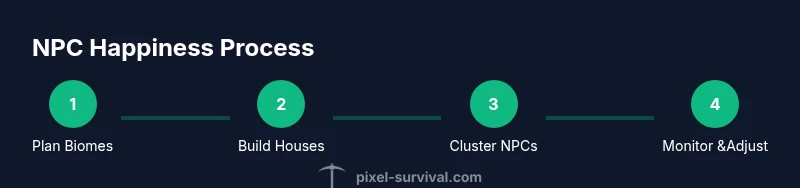
This overview provides a scaffold you’ll translate into concrete actions in the STEP-BY-STEP section. Start by mapping your world, then define target biomes for each NPC, and finally design housing layouts that meet the basic requirements. The goal is to create a village that’s easy to navigate, with homes that clearly reflect biome affinity and optimal NPC clustering. Once your village is laid out, you’ll begin moving NPCs in, monitor happiness changes, and adjust housing or neighbors as needed. The result is a village that feels alive and financially efficient for your progression needs.
Strategic biome choices for NPCs
Some NPCs perform better when placed near specific biomes or biomes that match a particular aesthetic. For example, you might cluster a Merchant near a Plains biome to align with a desert trader’s early-game options, while a Demolitionist could benefit from proximity to a biome with ample space for explosive items. Use biome variety to control NPC happiness while maintaining practical access routes and compact village design. Keeping a balance between biome variety and sensible NPC clustering helps sustain happiness as you roam through hardmode.
Common pitfalls that ruin happiness
Avoid cramming many NPCs into one tiny area; overcrowding can cause competition for space and reduce happiness. Neglecting housing requirements (lighting, doors, walls, or furniture) is another common misstep that stalls the happiness mechanic. Also, relocating NPCs transiently during updates without re-establishing valid housing can reset happiness. Finally, ignore the home biome when possible—improper biome alignment reduces discount potential. Regular checks to confirm houses remain valid and well-maintained save you needless rework.
Maintaining happiness through progression
As you progress, new NPCs appear and existing homes may lose their biome alignment due to map changes or updates. Stay proactive by factoring in biome upgrades, retrofitting houses as needed, and ensuring every NPC has access to a biome-appropriate home. Keep an eye on shop inventories to confirm discounts aren’t eroding after major patches. The happiness framework becomes a long-term practice rather than a one-time setup.
Troubleshooting: quick checks and tweaks
If happiness seems low, re-check housing validity: walls, lighting, furniture, and space. Verify each NPC’s biome preference and relocate homes to better-suited biomes. Ensure no NPC is outside its home’s biome boundaries and that houses have easy access with doors and proper lighting. Small relocations or biomes tweaks can restore happiness quickly. Maintain a log of changes so you know what adjustments correlate with shop improvements.
Community tips and next steps
Engage with the Terraria community to learn from shared village layouts. Swap screenshots of housing designs to inspire biome-aware builds. Use community-tested templates to accelerate setup and reduce trial-and-error. As patches come and go, revisit your happiness strategy to keep NPCs thriving and discounts favorable. Regularly revisit the basics, then iterate with your own creative biome layouts.
],
toolsMaterials":{"items":[{
name
name="name"
note
Insert or select basic housing blocks like wood or stone blocks to create rooms.
Tools & Materials
- Housing blocks (wood/stone)(Used to build rooms that NPCs can mark as homes.)
- Doors(One door per house to allow NPCs to access their home.)
- Chair(A placed chair inside each home.)
- Table(A small table inside each home.)
- Light source(Torch, lantern, or lamp to satisfy lighting.)
- Background walls(Solid walls that enclose the room.)
- Map/biome planning tools(Optional, helps plan biome alignment.)
Steps
Estimated time: 60-90 minutes
- 1
Plan village layout
Sketch where eachNPC will live and how biomes will align with their preferences. This minimizes relocation later and makes happiness easier to maintain.
Tip: Use a simple grid map and label each planned home with its intended biome. - 2
Build valid homes
Create separate rooms that meet housing requirements: background walls, a light source, a chair, a table, and a door for access.
Tip: Double-check room boundaries and ensure each home is closed on all sides. - 3
Assign biome alignment
Place homes in the biome that matches each NPC’s preference whenever possible.
Tip: If a preferred biome isn’t available, choose the closest valid alternative. - 4
Cluster NPCs strategically
Group NPCs that benefit from proximity to others to maximize discounts and shop variety.
Tip: Avoid isolating NPCs in isolated pockets of your map. - 5
Move NPCs in safely
Relocate NPCs using in-game mechanics so each has a valid home in their preferred biome.
Tip: Move only when homes are ready to receive them. - 6
Monitor happiness
Observe shop prices and inventory for changes after layout updates.
Tip: Give it a few in-game days to see effects. - 7
Adjust based on progression
As new NPCs unlock, retrofit homes to keep biome alignment consistent.
Tip: Don’t neglect late-game biomes when adding new residents. - 8
Maintain accessibility
Keep paths clear and ensure doors aren’t blocked by furniture or other NPCs.
Tip: Good navigation reduces stress for NPCs. - 9
Document changes
Keep a log of layout changes to correlate with price changes.
Tip: A simple notebook helps track what works. - 10
Review after patches
Check happiness after major updates or events to re-tune housing as needed.
Tip: Patches can shift NPC preferences slightly.
Got Questions?
What factors influence Terraria NPC happiness?
NPC happiness is influenced by biome alignment of their home, proximity to other NPCs, and whether housing meets basic requirements. When homes are well-planned and NPCs are clustered with compatible neighbors, happiness improves, affecting discounts and inventories.
NPC happiness comes from where their home sits, who their neighbors are, and whether the house is properly set up.
Do happy NPCs always offer better discounts?
In general, happier NPCs tend to offer better discounts and a wider selection. The exact price changes vary with your progression and biome dynamics, so observe shop prices over time to confirm.
Yes, happier NPCs usually have better discounts and more wares.
Can I improve happiness without changing biomes?
Yes. You can improve happiness by ensuring all housing elements are valid, improving lighting, and clustering NPCs closer together. Proximity to fellow NPCs and accessible homes can boost happiness even within the same biome.
You can boost happiness by fixing housing and nearby NPCs without changing biomes.
How many NPCs do I need to start seeing happiness benefits?
There isn’t a fixed number; happiness benefits increase as you add residents and cluster them. Start with a handful of well-placed NPCs and expand gradually while maintaining housing quality.
No fixed number—start small and grow as you keep homes valid and clustered.
What if an NPC is unhappy after a patch?
Re-check housing validity, confirm biome alignment, and consider moving the NPC to a more suitable biome or neighbor cluster. Updates can shift preferences slightly, so re-tune as needed.
If unhappy after an update, re-check housing and biome alignment and adjust as needed.
Does time of day affect happiness?
Time of day does not directly affect NPC happiness. Happiness is driven by housing, biome alignment, and NPC proximity, not by day-night cycles.
No, happiness isn’t tied to the time of day.
Watch Video
Key Points
- Plan biome-aligned homes before spawning NPCs
- Cluster NPCs to enhance discounts
- Maintain valid housing with lights, furniture, and doors
- Revisit happiness after updates or new NPCs
- Document changes to track what works