NPC Housing in Terraria: A Complete Step-by-Step Guide
Learn how to design and implement compliant NPC housing in Terraria. This comprehensive guide covers planning, layout, lighting, furniture, and practical tips to ensure NPCs move in reliably and your town thrives in 2026.


With this guide, you’ll learn how to create compliant NPC housing in Terraria: planning multiple homes, ensuring each is valid, and furnishing them for NPCs to move in smoothly. We’ll cover layout, lighting, walling, doors, and safety, plus common mistakes to avoid for steady town growth. Whether you’re starting a new world or expanding an existing town, these steps apply.
Understanding NPC housing basics
NPC housing in Terraria is more than just a few rooms. It’s a system that supports town growth as you explore, fight, and farm. According to Pixel Survival, NPC housing is the backbone of town progression, because NPCs won’t settle in a spot unless it meets certain conditions. A valid home must be a sheltered space that the game recognizes as a dwelling for NPCs to move in.
Key concepts include: every NPC should have a dedicated home with access, light, and furniture; housing isn’t just about looks—it’s functional for town balance; the game checks for background walls, a door, a light source, and furniture items in each house. In practice, you plan a cluster of compact rooms with consistent lighting, safe entrances, and proper flooring. You’ll often reuse common materials for walls and floors to keep a cohesive town look. The aim is to have several identifiable homes near your central activities: farms, caves, and mining rooms become convenient neighborhoods for NPCs. Note: the game will not accept an empty room as housing; it must meet the above criteria so NPCs can claim it as a home.
Planning your town layout for NPCs
Planning is the foundation of successful NPC housing. Start by surveying your world to identify safe, accessible zones with existing NPCs nearby or near your key work areas. Map out space for multiple homes with consistent spacing so NPCs can travel between plots without crossing dangerous zones. Consider accessibility: ensure each house is reachable via a simple path from your central hub (crafting stations, storage, and shop fronts). Use a grid-based approach to visualize plots, aligning doors and furniture to standard orientations. As your town grows, reserve buffer space for future expansion; overcrowding can lead to missing housing criteria or NPCs failing to move in. Finally, remember to balance aesthetics with practicality: clean lines, similar wall colors, and logical neighbors improve town cohesion and NPC happiness.
Minimum requirements and common layouts
A house must be a closed, enclosed space with background walls and a doorway, a light source, and essential furniture (chair and table) to qualify as NPC housing. While the game doesn’t publish a single fixed size, practical layouts use spaces roomy enough to place a chair, a table, and room to move. Common layouts include compact two- to four-room blocks arranged in a grid near your central work areas. Grouping homes by function—residence clusters near your farm, mine, or dungeon entrance—helps NPCs settle in quickly. Always verify each plot’s enclosure, illumination, and accessibility before considering it a dwelling. If a plot lacks any required element, it won’t count as housing and NPCs won’t move in.
Lighting, walls, and furniture: making a house feel real
Lighting is crucial for a valid home. Place a light source such as a torch or lantern so the interior is well-lit without creating glare or harsh shadows. Background walls must be continuous to enclose the space, and the room should be free of gaps that could let NPCs escape or prevent interaction. Furniture must include at least a chair and a table; you can substitute other furniture that counts as a “comfort item” or a suitable surface. The design should incorporate a door at an entry point and a flooring choice that suits the room’s purpose. Consider subtle decorations, but ensure decorations do not obstruct movement or violate housing rules. A well-lit, uncluttered home with clear access encourages NPCs to move in quickly and stay longer.
Building strategies for multiple homes
Efficient town-building hinges on modular design. Start with a templated housing module—a fixed footprint that includes walls, floor, a door, a light, a chair, and a table—then replicate across the town using different materials for variety. Modular designs help reduce guesswork and ensure every home adheres to the same housing criteria. Use consistent ceiling heights and wall colors to reduce visual confusion and make it easier to spot housing failures during iteration. When expanding, stagger plots to maintain clear paths and avoid overlap with other structures. Proximity to your core activities can influence NPC scheduling and vendor availability, so place houses strategically around workshops and shops for convenient NPC access.
Common pitfalls and how to fix them
Common mistakes include leaving a plot partially open, missing a light source, or forgetting essential furniture. Fix by auditing each plot: confirm a closed space with background walls, verify a door’s placement, and check for a chair and a table. Overcrowding can cause multiple plots to fail housing checks; resolve by adding new, clearly separated plots. Weather or biome considerations can also affect NPC movement; ensure houses are placed in safe biomes and away from dangerous zones. Finally, test after changes by inviting NPCs to move in and observing whether all intended homes register as valid housing.
Testing and iteration: ensuring NPCs move in reliably
After constructing your housing, initiate a “test phase.” Wait in-game days to allow NPCs to move in, then visit each home to verify NPCs occupy them. If any house is empty, re-check steps: is the interior sealed, lit, and furnished? If NPCs still won’t move in, reassess the plot’s size, entrance, or proximity to your main town hub. Iterative testing with small adjustments yields reliable results and a thriving town.
mainTopicQueryQuestionsAbsentUnsupported
Tools & Materials
- Pickaxe or Hammer(To clear terrain and shape rooms)
- Building blocks (wood/stone/brick)(Create interior walls, floors, and ceilings)
- Background wall blocks(Place to form enclosed housing spaces)
- Door (wooden or equivalent)(Access into each house)
- Chair(Comfort item to satisfy NPC housing criteria)
- Table or Workbench(Furniture surface required for housing)
- Light source (torch, lantern, etc.)(Ensures interior is lit and meets housing rules)
- Decorative items (optional)(Enhance ambiance without affecting validity)
Steps
Estimated time: 45-90 minutes
- 1
Plan your town layout
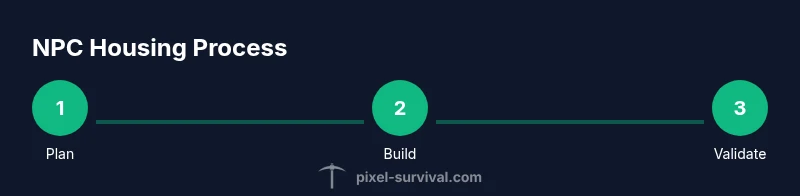
Begin with a rough map of where NPC homes will sit relative to your center of operations. Identify safe zones and ensure there is enough space between plots for doors and movement. Use a planning grid to align future rooms and avoid overlaps.
Tip: Start with a simple grid, then mark potential housing blocks near your workstations and shop area. - 2
Mark and clear housing plots
Select each plot on the map and clear the terrain to prepare the interior. Remove any hazards and ensure space is free of blocks that could interfere with NPC housing checks. Create clear entrances for easy access from common areas.
Tip: Leave a small buffer around doors to prevent NPCs from getting stuck. - 3
Build enclosed rooms with walls
Construct solid walls and apply background walls inside to create enclosed spaces. Make sure each room can be entered via a single door and is isolated from outside weather effects that might degrade lighting.
Tip: Keep walls continuous; gaps invalidate the housing criteria. - 4
Add essential furnishings
Place a light source, a chair, and a table in every room. Ensure there is a floor and a surface for interaction; avoid blocking the doorway or making the space feel cramped.
Tip: Do not substitute essential items with unsuitable alternatives. - 5
Check NPC housing validity
Use the in-game housing check (the tavern-like icon or building indicator) to confirm each plot qualifies as housing. If a plot fails, review why: missing item, poor lighting, or incomplete walls.
Tip: If a house fails, adjust one element at a time to identify the issue. - 6
Invite NPCs and monitor town growth
Wait for in-game days to pass and observe which houses are occupied. If some NPCs don’t move in, reassess individual plots and relocate them as necessary to improve town flow.
Tip: Keep a few extra plots ready for future NPCs.
Got Questions?
What counts as a valid NPC house in Terraria?
A valid NPC house is a closed space with background walls, a door, a light source, and furniture (chair and table). Each house must be accessible and adequately sized to accommodate NPCs. If any element is missing or misconfigured, NPCs won’t move in.
A valid NPC house has walls, a door, light, and furniture. If any part is missing, NPCs won’t consider it a home.
How many NPC houses do I need?
There isn’t a fixed minimum beyond what you need for the NPCs you want in your town. Plan enough houses to accommodate potential NPCs and some extra space for future growth. As your town expands, you may add more houses.
Plan enough houses for the NPCs you want, plus a few extra for growth.
How do I move NPCs into houses?
NPCs move in automatically when valid housing is available and you progress in the game. Ensure each house meets the basic criteria and is accessible; then wait for day-night cycles to run as NPCs settle into available homes.
NPCs move in automatically when you have valid homes and progress in the game.
Can I reuse existing rooms for NPC housing?
Yes, you can repurpose existing rooms as NPC housing as long as they meet all criteria: enclosed space, background walls, a door, light, and required furniture. Avoid spaces that are too close to danger or too cramped.
You can repurpose rooms if they meet all the housing rules.
What should I do if NPCs won’t move in?
Check for missing housing elements or accessibility issues in each plot. Verify walls, lighting, and furniture, and make sure doors lead to the exterior or a connected space. If problems persist, restructure the layout to improve town flow.
Double-check each house; fix missing items or bad layouts, then retry.
Are there dangers or mistakes to avoid with NPC housing?
Avoid blocking doorways, overcrowding plots, or placing houses in hazardous biomes. Keep plots clearly separated and ensure light sources are functional. Regularly test housing to catch issues early.
Avoid overcrowding and blocked doors; test housing to catch issues early.
Watch Video
Key Points
- Plan multiple, clearly separated houses
- Ensure every home has walls, a door, light, chair, and table
- Test housing after changes and adjust layout as needed
- Grow your town gradually with additional plots when NPCs move in