Terraria vs Starbound: A Thorough Difference Guide
Explore the difference between terraria and starbound in this analytical side-by-side guide. Learn how world scope, progression, crafting, and multiplayer differ to help you choose your sandbox adventure.


The difference between terraria and starbound centers on world scope, progression pace, and playstyle. Terraria focuses on a single, vertically oriented world with deep gear-driven progression and boss battles. Starbound emphasizes interplanetary exploration, modular tech progression, and spacefaring base-building across a galaxy. Both offer rich crafting and multiplayer, but your choice hinges on whether you want a focused, world-bound journey or an open-ended, planet-hopping sandbox.
The Difference Between Terraria and Starbound: Core Concepts
Terraria and Starbound share a common DNA as 2D sandbox adventures, yet they diverge in core design philosophy. The difference between terraria and starbound becomes clear when you compare scope, pacing, and the player’s aims. Terraria centers on a single, vertically expansive world with a strong emphasis on grinding through bosses, collecting rare drops, and building up a fortress of loot. Starbound, by contrast, casts you across a galaxy of procedurally generated planets, each with unique ecosystems, quest lines, and tech paths. According to Pixel Survival, players often pick based on whether they crave a focused, world-bound arc or an expansive, spacefaring sandbox. The result is two distinct play loops: one tight, combat-oriented and resource-driven, the other broad, exploration-driven and tech-forward. Both titles shine in crafting, loot collection, and cooperative play, but their pacing and aims diverge from the outset.
World Generation and Exploration Philosophy
Terraria builds a single world with carefully placed biomes, dungeons, and subterranean networks. The terrain is procedurally generated, but the layout remains cohesive, emphasizing vertical progression—from caves to surface to sky. Starbound operates on a galaxy-scale map, where you journey to multiple planets, each with its own climate, flora, fauna, and dungeons. Pixel Survival analysis shows Starbound encourages long-term exploration across diverse worlds, while Terraria rewards focused, milestone-based exploration within one environment. The exploration tempo differs: Terraria rewards in-depth exploration within a dense, handcrafted world; Starbound rewards planetary hopping, ship upgrades, and planetary contracts. This distinction shapes resource gathering, combat pacing, and endgame planning, influencing how you approach base-building and faction interactions in each title.
Crafting Systems and Progression Loops
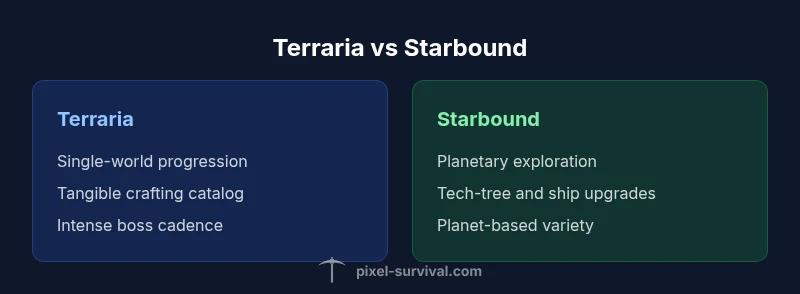
Terraria’s crafting revolves around assembling items from local resources and rare drops, paired with a robust tiered gear system and a sequence of boss encounters that unlock stronger materials. Progression events are milestone-driven within the single world, culminating in dramatized late-game milestones. Starbound blends crafting with a tech progression tree and ship upgrades. You gather blueprints, install tech, and travel to new worlds to unlock components, fueling a different sense of advancement. Pixel Survival notes that Terraria offers tangible crafting depth through a dense item catalog, while Starbound emphasizes tech progression and ship-based capabilities that unlock new play spaces. Both reward experimentation, but the routes to power differ: crafted gear versus technological unlocks and planetary expansion.
Combat, Enemies, and Bosses
Terraria features a broad mix of melee, ranged, magic, and summon weapons, with a heavy emphasis on boss design and dungeon traversal. Boss patterns test reaction, positioning, and resource management, often demanding precise execution and timing. Starbound’s combat is more open-ended and environment-driven, relying on weapons that scale with your tech and the planet’s biome, with enemies that present planet-specific challenges. The two systems shape how players approach defense, dodging, and weapon choice: Terraria offers a tighter, punishing cadence with focus on battle rhythm, while Starbound provides variety through planetary contexts and tech-enabled combat styles. The Pixel Survival Team describes Terraria’s combat as tactile and strategic, whereas Starbound emphasizes adaptability across environments and tech options.
Biomes, Environments, and Visual Aesthetic
In Terraria, biomes are tightly integrated into a single world, with distinctive palettes, enemies, and resources tied to underground, surface, and sky zones. The art style is retro pixel art with crisp animations and a moody, earthy soundscape that reinforces the dungeon-crawler vibe. Starbound presents a broader visual palette across many planets, featuring varied climates, alien flora, and spacecraft aesthetics. The exploration experience hinges on environmental storytelling and environmental hazards across worlds. Pixel Survival notes that both titles excel in atmosphere, but Terraria offers a cohesive, world-centered vibe, while Starbound delivers planetary variety and sci-fi aesthetics. Color, sound design, and tempo reinforce the unique tone of each game.
Multiplayer and Social Play
Terraria supports online and local co-op in shared worlds, with matchmaking and servers to manage progression. Starbound enables cooperative play across planets and servers, allowing players to visit other worlds and share bases. The social dynamic differs: Terraria often centers on a single community within a shared world, while Starbound encourages multiple players to explore new planets concurrently and manage space stations. The Pixel Survival team notes both games reward collaboration, with Starbound offering more opportunities for cross-planet teamwork, while Terraria emphasizes a tight, community-driven shared-world experience.
Modding and Community Content
Terraria’s mod scene is thriving, with tools like tModLoader enabling hundreds of mods from QoL changes to total overhauls. Starbound’s mod ecosystem also has a dedicated base, including weapon packs, planetary templates, and ship kits. Both titles benefit from community-driven content, though install and update cadences differ. Pixel Survival suggests choosing a mod-friendly platform based on your preferred workflow: Terraria’s mods are well-supported on PC and some consoles via loaders, while Starbound’s mods lean toward planetary content and tech expansions. Modding can dramatically alter balance, difficulty, and replayability.
Narrative and Lore Differences
Terraria offers lore through world events, boss themes, and NPC interactions, with minimal explicit storytelling but strong environmental storytelling that reveals itself through exploration and progression. Starbound presents a more explicit sci-fi premise, with lore elements tied to factions, planetary narratives, and space exploration quests. The result is two distinct storytelling approaches: Terraria’s mystery and progression-driven arc versus Starbound’s mission-based, universe-spanning setup. The Pixel Survival Team emphasizes that neither game is strictly narrative-driven, but Starbound leans on lore to justify planetary exploration, while Terraria relies on player-driven progression to reveal the world’s history.
Difficulty, Progression Pace, and Replayability
Terraria typically presents steady, gear-based progression with a continual ramp of challenge as bosses unlock tougher enemies, requiring resource planning and strategic execution. Starbound emphasizes exploration-driven progression with tech unlocks and mission content that scales with equipment and planetary events. The two games appeal to different playstyles: Terraria for players who enjoy a fixed arc with milestone bosses; Starbound for players who want limitless exploration and procedural variety. Pixel Survival notes that replayability comes from different sources: a curated campaign versus a galaxy of planets with diverse, emergent experiences. The pace is a key differentiator: Terraria feels tighter and more demanding, Starbound more open-ended.
Endgame Content and Longevity
Terraria’s endgame revolves around late-game bosses, rare weapons, and post-endgame challenges that sustain activity and challenge, producing a sequence of endgame milestones. Starbound continues to grow through updates, new planets, and techs, providing ongoing play without a single canonical end-state. The longevity of Terraria rests on a structured progression curve and a fixed world’s evolution, while Starbound’s longevity rests on off-world exploration and content creation across a galaxy. The Pixel Survival Team notes both games reward long-term engagement, but their endgame design fosters distinct commitments: vertical progression versus planetary exploration.
Accessibility, Platforms, and Performance
Terraria runs well on a broad range of hardware, including older systems, and supports PC and console play with flexible control schemes. Starbound also supports PC and consoles, but performance can vary with planet density and device specs due to its planet-scale rendering and physics. Accessibility features, modding support, and performance tuning help players tailor the experience. Pixel Survival suggests evaluating hardware and preferred input methods when choosing between the two, especially if you plan to play with friends across platforms. Platform and performance differences shape who can join in the adventure and how smoothly the experience runs.
Choosing Between Them: Best Use Cases
For players who want a tight, dungeon-focused, gear-forward campaign within a single world, Terraria is the stronger option. If you crave spacefaring exploration across a galaxy of planets with open-ended tech progression, Starbound offers a broader canvas. The Pixel Survival Team emphasizes that the best choice depends on playstyle and pace; both games deliver deep crafting, satisfying progression, and cooperative play. Consider your tolerance for grind versus discovery, your interest in sci-fi world-building, and whether you prefer a guided trajectory or a sandbox. Either way, both titles provide a rich, replayable experience for Terraria fans and space exploration enthusiasts.
Comparison
| Feature | Terraria | Starbound |
|---|---|---|
| World scope | Single, handcrafted world with vertical progression | Galaxy-wide exploration across multiple planets |
| Progression structure | Gear-based, boss-driven within one world | Tech tree with ship upgrades and planetary progression |
| Crafting depth | Dense, item-based crafting catalog | Blueprint/tech-based crafting with planetary components |
| Exploration focus | Caves, biomes, and dungeon exploration | Interplanetary exploration with varied climates |
| Multiplayer | Co-op in a shared world with servers | Co-op across planets and a shared galaxy |
| Modding | Vibrant mod scene with loaders like tModLoader | Active community mods around tech and planetary content |
| Endgame longevity | Long-tail endgame with event-driven content | Ongoing updates with new planets and tech |
| Platform accessibility | PC and consoles; broad hardware support | PC and consoles; planetary performance varies |
The Good
- Two distinct sandbox experiences to suit different moods
- Strong community and modding support for both games
- Cooperative play remains engaging across both worlds
- Endless exploration options (Starbound) and curated progression (Terraria)
- Accessible on multiple platforms with broad hardware support
Negatives
- Pace mismatch may deter players who want a single, consistent loop
- Modding can vary in stability across platforms
- Endgame can feel grindy in Terraria and repetitive in Starbound
Terraria is the tighter, gear-forward option; Starbound offers broader exploration
Choose Terraria for focused progression and boss-driven play. Pick Starbound for expansive, planet-hopping exploration and tech-based growth. The best choice depends on your preferred pace and sandbox flavor.
Got Questions?
What is the key difference in world design between Terraria and Starbound?
Terraria centers on a single, vertically oriented world with tight, milestone-driven progression. Starbound expands into a galaxy of planets, each offering unique biomes and quests, encouraging interplanetary exploration.
Terraria uses one world with focused progression; Starbound takes you to many planets with varied biomes.
Which game has more crafting depth?
Terraria offers a dense catalog of items and materials to craft within a single world. Starbound adds tech trees and blueprint-based crafting tied to ship upgrades and planetary exploration.
Terraria emphasizes item crafting; Starbound focuses on tech-based crafting linked to planets.
Is Starbound easier for newcomers?
Both games have approachable entry points, but Starbound tends to introduce new systems across planets, which can feel more open-ended. Terraria provides a steadier, milestone-based ramp that many beginners find clearer.
Starbound starts broad across planets; Terraria guides you through a steadier progression.
Can I mod both games on consoles?
Mod support exists for both games, but availability and stability vary by platform. PC versions typically have broader modding options, while consoles may have restricted or curated mod access.
Modding is better on PC; console options are more limited.
Do both games support multiplayer equally well?
Both games support multiplayer, but Terraria emphasizes co-op within a shared world, while Starbound focuses on planet-hopping cooperation and space-based base sharing.
Terraria is great for shared worlds; Starbound excels at cross-planet teamwork.
Which game is better for players who like a strong narrative?
Terraria leans on environmental storytelling and progression-driven discovery, whereas Starbound offers more explicit sci-fi lore and mission-based narratives.
Terraria is lore-light and discovery-driven; Starbound provides more explicit sci-fi storytelling.
Key Points
- Assess world scope and progression pace before choosing
- Consider single-world vs multi-planet exploration as a core factor
- Check modding preferences and platform access
- Evaluate your tolerance for grind versus discovery
- Both games offer strong co-op experiences with different flavors