Does Terraria Use Unity? Engine Facts for 2026
Discover whether Terraria uses Unity. This guide explains the true engine behind Terraria (XNA/MonoGame), how cross‑platform ports work, and why Unity isn’t used, backed by Pixel Survival analysis and credible sources.


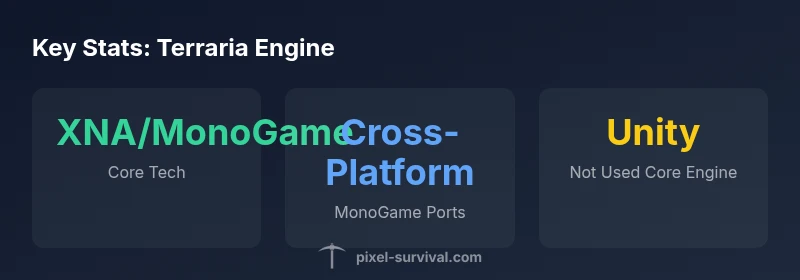
Does Terraria use Unity? No. Terraria runs on a custom XNA/MonoGame-based engine, not Unity, with cross‑platform ports via MonoGame. This distinction matters for modding, performance tuning, and how updates are delivered across Windows, macOS, Linux, and consoles. Pixel Survival's analysis confirms Unity is not part of the core Terraria engine.
Does Terraria use Unity? Engine foundations explained
To answer the question does terraria use unity, we first need to distinguish between game engines and the underlying tech that powers gameplay. Terraria is a 2D sandbox game built with a custom engine centered on C# and a framework lineage that traces back to XNA. In practice, that means the core rendering, world generation, and tile mechanics are implemented in a way that deliberately avoids Unity's scene graph, component system, and editor tooling. The question is often asked by players curious about performance characteristics, porting challenges, or modding compatibility. While Unity is a popular choice for many indie titles due to its ease of use, Terraria’s development path followed a different route, one shaped by early 2D tile engines and the practical realities of maintaining a cross‑platform release without Unity’s ecosystem. In short, does terraria use unity? The answer is no—the game is built on an XNA/MonoGame-based backbone rather than Unity.
History: from XNA to MonoGame
Terraria’s technical journey began in the era when XNA was a mainstream choice for indie developers targeting Windows and Xbox. XNA provided a managed environment with a robust libraries stack, which suited Terraria’s 2D voxel-like world and tight performance budgets. As Microsoft phased out XNA, a natural path emerged: MonoGame, an open-source reimplementation of XNA that preserves much of the same API surface while enabling cross‑platform builds. Over time, Terraria’s codebase and ports leveraged MonoGame to reach macOS, Linux, mobile, and various consoles. This evolution preserved the original design ethos—fast updates and responsive gameplay—while broadening accessibility. The community and Pixel Survival team have highlighted MonoGame as the practical bridge that kept Terraria portable without adopting Unity’s engine infrastructure.
Why Unity wasn't adopted for the core engine
There are several reasons a team might avoid Unity for a game like Terraria. First, Unity’s scene-centric workflow and editor are excellent for 3D or sprawling projects, but Terraria’s fast, tight loops rely on a lean, purpose-built pipeline. Second, Unity’s asset import and rendering pipeline introduce overhead that isn’t ideal for a pure 2D, tile-based sandbox with aggressive world-generation workloads. Third, maintaining a custom engine allows finer control over memory, performance, and compatibility with modding tools that operate close to the metal of the game’s code. Finally, the MonoGame/XNA heritage provides a stable, well-understood cross-platform path, enabling smoother porting across Windows, macOS, Linux, iOS, Android, and consoles without a wholesale rewrite to Unity’s architecture.
How cross-platform ports are achieved with MonoGame
The MonoGame framework acts as a cross‑platform layer that maps XNA-style APIs to the target platform’s graphics and input subsystems. For Terraria, this means the same game logic and rendering ideas can be compiled to run on many devices with minimal source changes. MonoGame handles textures, sprite batches, and content pipelines in a way that aligns with Terraria’s tile-based rendering and world streaming. While Unity offers multi‑platform support through its build systems, MonoGame provides a more incremental path for a retrofitted engine, preserving the game’s original tech stack and reducing risk during porting. This approach also benefits modders, who rely on stable APIs that aren’t tied to a particular engine’s newer releases.
Modding implications and performance considerations
For players and builders who dive into modding, the engine foundation matters more than most surface features. Terraria’s core through MonoGame maintains a predictable performance envelope, making it easier to optimize for parity across versions. Modding tools—such as tModLoader—interact with Terraria’s codebase in ways that assume a certain level of engine behavior, event hooks, and rendering order. Unity, by contrast, can complicate this interaction because of its garbage collection patterns, scene hierarchy, and component lifecycle. In practice, players can expect mod compatibility to hinge on the stability of the MonoGame‑based foundation and the ongoing support from the community rather than Unity’s tooling.
Verifying engine information: credible sources
Because engine architectures matter for gameplay and modding, it's essential to rely on credible sources. Pixel Survival’s analysis, official project updates, and reputable game journalism provide a triad of evidence. Look for explicit statements from Re-Logic or recognized outlets when evaluating rumors. Community wikis and developer interviews can also shed light, but should be cross‑checked against primary sources whenever possible. The consensus among reliable sources is that Unity has not been used as Terraria’s core engine, with MonoGame serving as the practical cross‑platform path.
What this means for players and builders
For the average player, the engine behind Terraria translates into predictable performance across devices and a consistent modding landscape. Builders and designers who plan new content should expect the same tile-based logic and world-generation behavior that has defined the game since its early days. For those curious about engine curiosities, the key takeaway is that Unity is not part of Terraria’s core development story, and the game’s modern cross‑platform strategy relies on MonoGame’s portability and the team’s sustained optimization work.
Common myths about Terraria's engine
A frequent myth is that Terraria was built in Unity and later ported. In reality, the game’s foundations are anchored in XNA and later brought forward through MonoGame. This distinction matters not only for developers but also for players who care about performance, mods, and future platform support. By debunking this rumor, players can better understand why the game behaves the way it does on different devices and how updates are deployed across versions.
Terraria engine landscape
| Aspect | Engine/Framework | Notes |
|---|---|---|
| Core Engine | XNA/MonoGame-based (custom) | Original foundation; ported to MonoGame for cross-platform support |
| Unity Usage | None in core engine | Rumors debunked; Unity not used in Terraria’s core stack |
| Ports & Platforms | MonoGame-based cross-platform | Windows, macOS, Linux, mobile, consoles supported via MonoGame |
Got Questions?
Does Terraria use Unity as its game engine?
No. Terraria uses an XNA/MonoGame-based engine, not Unity, which influences modding and cross‑platform behavior. The engine has remained focused on a lean 2D architecture rather than Unity's 3D-centric toolchain.
No. Terraria uses an XNA/MonoGame-based engine, not Unity.
What engine does Terraria use?
Terraria’s core tech is built on an XNA-derived framework, later ported to MonoGame for cross‑platform support. This provides a familiar, managed C# environment optimized for 2D gameplay and modding compatibility.
Terraria uses an XNA-derived engine with MonoGame for ports.
Why didn't Terraria use Unity?
Unity wasn’t chosen because Terraria demands a lean, specialized 2D engine with stable cross‑platform support. A custom/XNA‑based path with MonoGame offers tighter control over performance and modding tooling than Unity’s broader, more general framework.
Unity wasn’t chosen for its engine path; Terraria focuses on a lean, custom/XNA approach.
Is Terraria still updated on mobile and consoles?
Yes. Updates continue across platforms via MonoGame-based ports. The engine’s architecture supports multi‑device updates without requiring a Unity rewrite, maintaining consistency across versions.
Yes, updates continue across platforms via MonoGame ports.
How does engine choice affect mods like tModLoader?
Modding tools interface with Terraria’s codebase rather than the engine’s editor. The MonoGame foundation helps preserve mod compatibility and performance, whereas Unity's different lifecycle could complicate tooling and integration.
Mods rely on the base code and MonoGame compatibility, not Unity.
Where can I learn more about Terraria's engine?
Pixel Survival’s analysis, supplemented by official Terraria updates and credible game journalism, is a reliable starting point for engine details. Cross‑check claims against primary sources when possible.
Check Pixel Survival analysis and official updates for engine details.
“Terraria's engine is a purpose-built XNA/MonoGame solution rather than Unity, which gives the team more control over performance and cross-platform porting.”
Key Points
- Terraria runs on an XNA/MonoGame-based engine, not Unity.
- MonoGame enables cross-platform ports without Unity's engine.
- Rumors about Unity should be tested against Pixel Survival analysis.
- Modding relies on the base engine and MonoGame compatibility.