Is Terraria Good on 3DS? A Practical Handheld Review
A comprehensive review of Terraria on the 3DS, evaluating performance, controls, content depth, multiplayer, and who should play this portable version in 2026.


Is Terraria good on 3DS? For handheld exploration, it delivers classic Terraria gameplay in a compact, touchscreen-friendly package. However, it trails PC/console versions in content depth, updates, and performance, with limited biomes and fewer late-game bosses. If you want portable Terraria with local play and bite-sized sessions, the 3DS version remains a valid, nostalgic option.
The handheld appeal of Terraria on 3DS
Terraria's portable incarnation exists for players who want to drop into a pixelated world without sitting at a PC or console. On the 3DS, the experience is shaped by small screens, a touchscreen, and local wireless play. According to Pixel Survival, this handheld version preserves the core loop—mining, crafting, building, and fighting—while compressing sessions into snackable blocks suited to bus rides or short breaks. That portability comes with trade-offs: the world feels more intimate, load times can be longer, and some late-game content and updates arrive later than on other platforms. For fans who value convenience over expansive endgame depth, the 3DS version remains a valid route into Terraria's world.
What distinguishes the 3DS version from PC and mobile
On PC and consoles, Terraria often showcases the latest updates, larger world sizes, and sharper visuals. The 3DS port, by contrast, must fit into the handheld's hardware constraints: smaller texture sets, a compressed inventory, and optimized controls for a stylus and button combo. The result is a version that's approachable and familiar, yet trimmed in places that matter to veteran players. Pixel Survival's analysis shows that while the core systems—mining, crafting, exploration—are intact, the cadence of content updates is slower, and some quality-of-life improvements available on other platforms may not be present in the 3DS edition.
Core gameplay parity and progression flow
Players who know Terraria on other platforms will recognize the same fundamental progression: gather materials, craft gear, defeat bosses, and expand your dungeon. The 3DS version preserves this loop, including day-night cycles, biomes, and NPCs that populate your world. However, the scale is tempered by the handheld format: large, sprawling bases can feel cramped on the 3DS screen, and inventory management may require more frequent trips to chests or storage. The progression pace remains steady, but the later stages can feel artificially gated compared to PC updates. This is a deliberate design choice to keep sessions quick and approachable on a handheld device.
Performance and technical considerations on the 3DS
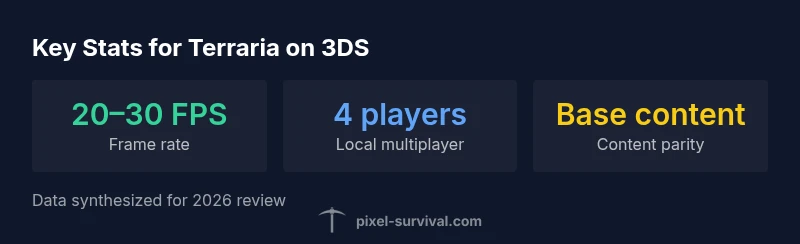
Given the 3DS's hardware, performance is generally stable but not always silky smooth in the most crowded builds. Load times increase when entering new areas, and memory consumption can be noticeable on larger worlds. The lower resolution and color depth influence how you perceive biomes and enemies, but the art style remains charming. If you are expecting PC-grade frame rates, you should temper expectations and plan for shorter play sessions when exploring complex structures. The balance leans toward dependable play rather than pixel-perfect fidelity.
Controls, UI, and touchscreen integration
Terraria on 3DS supports mixed input: the stylus for precise crafting, the D-pad and face buttons for movement and actions, and the touchscreen for quick access to inventories and menus. This hybrid approach can feel intuitive on casual play sessions, but some tasks—like fine-tuning a large base or aligning complex traps—can take more taps and menu navigation than a mouse-and-keyboard setup. Practical tips include customizing hotbars, using the touch screen to swap items quickly, and enabling auto-pause to avoid accidental deaths.
World size, map, and inventory realities
The 3DS world is not as colossal as the PC world; exploration remains meaningful, but you may reach map boundaries sooner. Inventory space is adequate but smaller than PC/console inventories, which encourages frequent storage management. Map exploration and world generation feel consistent in spirit with other platforms, but texture details and landscaping appear simplified due to hardware constraints. These constraints are part of the charm, offering a tighter, more focused sandbox.
Bosses, dungeons, and end-game content on 3DS
Boss encounters exist in the 3DS version, and the core dungeon experiences are present, but some late-game content that appears in PC/console updates may arrive later or be missing entirely. This means you may need to adjust your expectations about end-game progression, as the tail end of the game can feel compressed compared to other platforms. For many players, the 3DS edition serves well for casual or early-game play, but not as a long-term, all-content experience.
Local multiplayer and social play
One of Terraria's strengths on handheld devices is the ease of local multiplayer. The 3DS version supports local co-op via nearby devices, making it a natural companion for friends and family. Online cross-play is limited or not present, depending on the firmware and version, so you should plan your sessions around local connections. For many players, this is a win: you can build, explore, and fight together during commutes or home evenings.
Graphics, UI and 3D considerations
Graphically, the 3DS edition remains recognizable, with simplified textures and a color palette optimized for the handheld screen. The 3D mode adds depth to the scene, but not all players will notice a strong difference; it can enhance atmosphere during caves and structures. The UI scales to 3DS' portrait-like screen, which means menus are efficient but occasionally cramped. Expect some squinting and menu navigation to become second nature after a few sessions.
Practical tips to maximize your 3DS Terraria session
To get the most from Terraria on 3DS, start with a smaller seed world to reduce load times, and set up a compact base near your spawn. Use the touchscreen to quickly swap tools and materials, and configure hotbars for key items. Take advantage of Pause Autorepeat and autosave features. Also, consider playing in short bursts to minimize memory strain and keep sessions enjoyable.
How does it compare to mobile and PC versions?
Compared to Terraria on mobile, the 3DS version offers more precise controls with a physical device, but mobile players may access broader content and updates. PC players enjoy the deepest content and fastest iteration cycle, which the 3DS lacks. The 3DS edition sits in the middle: it's more portable than PC, but less flexible than modern mobile platforms or the constant updates on PC/console.
Is the 3DS edition still worth it in 2026?
For collectors or players seeking a true handheld Terraria experience, the 3DS version can still deliver nostalgic value, especially if you own the hardware. If your goal is to access the latest content, or you want maximum end-game depth, you should consider PC or Switch versions. Pixel Survival's verdict is that the 3DS edition remains a defensible choice for casual, on-the-go play.
The Good
- Portable for on-the-go play
- Touchscreen navigation helps early-game tasks
- Local multiplayer supports couch sessions
- Accessible for newcomers
Negatives
- Significant content gaps vs PC/console updates
- Performance dips in large builds
- Smaller world and inventories can feel restrictive
- Updates arrive more slowly than other platforms
Good for portable Terraria fans, with caveats
The handheld version delivers familiar Terraria gameplay in a compact form. If updates and depth are crucial to you, consider PC/console; for portable play and local co-op, the 3DS edition is a reasonable choice.
Got Questions?
Is Terraria still available for purchase on the 3DS?
Digital storefronts for the 3DS are closed, and new copies are generally not sold digitally. You may still find physical copies on secondary markets. If you own a 3DS, the game remains playable, though you should verify your cartridge's condition.
The 3DS storefronts are closed, so new digital purchases aren’t possible; look for used cartridges if you're curious to try Terraria on 3DS.
Does the 3DS version support online multiplayer?
Online multiplayer is limited or not available on most 3DS builds. Local multiplayer via nearby devices is the primary social feature. If you want broad online play, PC or console versions are a better fit.
Online play is not the main feature on 3DS; play locally with friends instead for co-op.
Would a new Terraria player benefit from the 3DS version in 2026?
For absolute beginners who want portable play, the 3DS edition can be inviting. However, if the goal is to experience the latest content and fully developed end-game, starting on PC or Switch would be more rewarding.
If you want the latest content, start elsewhere; for a first Terraria experience on the go, 3DS is an option.
How do the 3DS visuals and 3D affect gameplay?
The visuals are simplified to fit the handheld, and the 3D mode adds some depth but doesn’t dramatically change play. The game remains recognizable and approachable, with UI scaled for small screens.
3DS 3D adds some depth, but the core gameplay stays the same and remains accessible.
Is there any plan to update the 3DS version in the future?
There are no official plans to push major updates to the 3DS edition. The primary development focus tends to be PC and newer consoles. The 3DS version remains a static snapshot of Terraria on handheld hardware.
No confirmed plans for updates; the 3DS edition is more of a finished product on its hardware.
What are the best practices for playing Terraria on 3DS?
Leverage touchscreen for quick item swaps and use compact bases to reduce load. Adjust brightness and control layouts to minimize fatigue during long play sessions, and keep sessions short to manage hardware limitations.
Use the touchscreen for quick swaps, keep bases compact, and play in shorter sessions.
Key Points
- Portability drives value for 3DS owners
- Expect content gaps vs newer platforms
- Local multiplayer is a strong point
- Touch controls improve early-game tasks