Terraria: How to Build a House — A Practical Guide
Learn how to build a sturdy Terraria house with this comprehensive step-by-step guide. Plan your site, gather materials, place walls, doors, lighting, and furniture to attract NPCs and support early progression.


Your goal is to build a safe, welcoming house that NPCs will inhabit and defend from threats. In Terraria, success hinges on location, space, and resource efficiency. This guide walks you through picking a site, gathering materials, laying walls, doors, and furniture, and creating a compact, scalable layout that supports early-game progression and cozy living quarters.
Planning your Terraria house: fundamentals
According to Pixel Survival, the foundation of a good Terraria house is more than a simple shoebox. The goal is to create a safe, accessible space that NPCs consider 'housing' while fitting into your progression plan. For many players, the first house is as much about practice as it is about comfort. In terraria, your design choices influence NPC availability, trap avoidance, and farming efficiency. Before you swing a pickaxe, sketch a rough plan: decide the room's footprint, count the blocks you’ll need for walls and floor, and ensure a door or alternative entry. The phrase 'terraria how to build a house' is often used as a starting point for new players: keep it simple, durable, and expandable. Consider how the house sits on the world map—near resources you’ll use, away from dangerous biomes, and with enough light to prevent dark spots that spawn nuisances. This block sets the stage for practical housing that grows with you, not a temporary shelter that fails when night comes. Note how layout choices impact NPC traffic and defense strategies as you progress.
Site selection and housing size
Choosing the site is more than aesthetics; it affects NPC availability, light, and future expansion. In Terraria, houses must be enclosed spaces with background walls, a light source, a chair and table, and a door to be valid. Start with a flat area clear of hazards. Avoid sloped terrain that complicates walls and floors. Proximity to resources matters; a nearby chest, ore veins, or farming spots saves travel time. Keep the footprint compact but roomy enough for essential furniture. A common approach is to aim for a rectangular module with at least two tiles of space above and around furniture to prevent NPCs from glitching into walls. Consider biomes: some NPCs prefer certain biomes or spawn rates; placing houses in neutral areas reduces risk of hostile mobs crowding around you. Finally, plan for future expansion: leave a border when you lay the initial walls so you can extend without rebuilding the core housing later. The goal is to balance accessibility, safety, and expansion potential. Pixel Survival analysis shows that compact, accessible housing helps NPCs move in faster and supports early progression.
Materials, walls, and background
Materials and walls are the backbone. For the early game, wood is a reliable staple; you can craft wood walls by placing wood blocks and enabling background walls. Gather enough wood, stone, and glass for basic furniture: a workbench, a table, a chair, a light source, and a door. Put background walls behind everything; without background walls, NPCs won't consider the space a house. Lighting matters: torches are cheap and effective, but alternatives such as lanterns or glowstones increase aesthetics and visibility. Floors can be wooden, dirt, or stone; the key is consistency so NPCs don't wander and to keep maintenance low. When selecting walls, avoid mismatched colors that cause confusion or visual noise. The goal is to create a clean, readable interior that NPCs can path to, with enough space around furniture to avoid blocking. If you place a chest, ensure there's a path to the door and room for movement. This block lays the groundwork for a functional, inviting house.
Layout and interior design for NPCs
Layout and interior design: A good house guides NPCs naturally from entry to furniture. Start with a rectangular footprint and place the door so you never block the path. Put a table and a chair against a wall to satisfy the basic furniture requirement, and add a light source on or near eye level to ensure visibility. If you’re early-game, a simple workbench and a wooden chair adjacent to the door keep the space compact. Consider color and material consistency to reduce visual clutter; too many colors can make the area feel chaotic and confusing for NPCs and you. Plan for a future upgrade by leaving room for additional shelves, another light, or a second NPC with a larger space. The aim is to combine practicality with aesthetic clarity, making it easy to expand as you unlock more materials and NPCs. The Pixel Survival team highlights that clear, simple interiors improve navigation and NPC satisfaction.
Safety, progression, and environmental considerations
Safety, progression, and environmental considerations: Night brings roaming enemies; a well-lit, enclosed space is your best protection. Place houses away from aggressive biomes and ensure there’s a clear path to freedom in case you need to retreat. Think about progression: as you unlock new furniture and materials, you’ll want to replace cheap blocks with sturdier ones and expand the room. Use stairs or platforms to create multi-level layouts that save space without complicating movement, and plan for NPC shops to become convenient hubs rather than isolated rooms. Also consider accessibility: ensure at least one clear path to the door from any area of the house and avoid placing furniture that blocks the doorway. Finally, label rooms with exterior markers to avoid confusion when your town grows. Pixel Survival’s latest guidance emphasizes safety and scalability as you advance to more advanced builds.
Common mistakes and optimization tips
Common mistakes and optimization tips: Under-sized houses fail to count as housing; inconsistent lighting invites hostile mobs; missing background walls makes NPCs ignore the space; poor door placement disrupts pathing; using incompatible block types can hurt readability. To optimize, keep a consistent palette, ensure a clear path to the door, add a light source and essential furniture, and plan for future expansion. As you level up, upgrade materials and split larger plots into multiple compliant houses so NPCs can settle in without competing for space. A well-structured starter design reduces iteration time and helps you focus on progression rather than rebuilding
Starter templates for Terraria houses
Two practical templates you can copy: A compact starter house and a slightly larger multi-room setup. Template A (compact): Enter to a single room with a door, a workbench (optional), a table and chair along a wall, and a light source near the center. This design keeps housing simple, ensures the basic components, and is quick to build. Template B (two-room progression): Build a main living area with the door opening into a small second room. Add a second light, a second chair and table arrangement, and perhaps a chest near the wall. Both templates use neutral materials to ensure readability and easy expansion. As you unlock richer blocks, replace basic walls with better textures and add a second housing unit when you’re ready, keeping each space compliant with housing requirements. Bonus: keep corridors clear so NPCs can pass through and shopkeepers can reach you quickly.
Tools & Materials
- Wood blocks(For walls and basic furniture)
- Stone blocks(Foundations and floors)
- Background wall material(Needed to count as housing)
- Door(Entry to the house)
- Table(NPC interaction and furniture)
- Chair(NPC interaction and furniture)
- Light source (Torch/Lantern)(Prevents dark spots)
- Workbench(Optional but helpful in early rooms)
Steps
Estimated time: 60-90 minutes
- 1
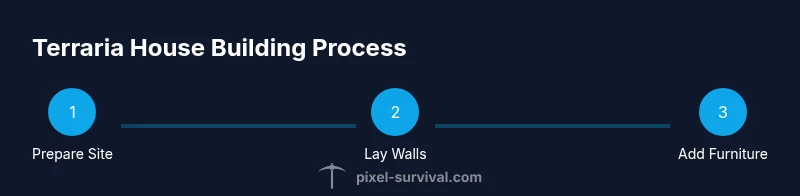
Prepare the site
Clear the area of hazards and level the ground to make wall placement straightforward. This reduces the chance of awkward gaps and makes later expansions easier.
Tip: Mark a simple rectangular footprint with temporary blocks to visualize space. - 2
Lay the foundation
Place a solid floor using stone or wood blocks. A stable base prevents accidental gaps that NPCs can’t stand on or path through.
Tip: Keep flooring consistent for readability from the doorway. - 3
Build the outer walls
Create a closed shell with your chosen wall material. Ensure there’s a doorway and enough width to move around furniture.
Tip: Aim for a compact footprint to maximize usable space. - 4
Install background walls
Fill the interior with background walls to satisfy housing criteria. Without them, NPCs won’t recognize the space as a house.
Tip: Background walls should be uniform to avoid visual clutter. - 5
Add furniture essentials
Place a table and chair, plus a light source. These ensure a valid housing setup and improve NPC comfort.
Tip: Position furniture to keep the doorway clear. - 6
Light and pathing check
Verify the space is well-lit and that NPCs can path from door to furniture without obstruction.
Tip: Test with a dummy NPC to confirm seating and light sufficiency. - 7
Test housing validity
Save and re-enter to trigger housing checks. If NPCs don’t move in, re-check walls, lighting, and furniture placement.
Tip: Keep a spare block of space for minor adjustments. - 8
Plan expansions
Leave room for additional rooms or larger furniture sets as you unlock new materials and NPCs.
Tip: Design adjacent spaces with shared lighting to save resources.
Got Questions?
What makes a valid house in Terraria?
A valid Terraria house must be enclosed by background walls, have a light source, a door, and essential furniture (table and chair). The NPC must have a clear path to the doorway. If any of these are missing, NPCs will not move in.
To be valid, a Terraria house needs enclosing walls, a light, a door, and seating; make sure NPCs can reach the doorway.
Can multiple NPCs share a house?
No. Each house is meant for a single NPC. If you want more NPCs, build additional compliant houses with their own doors, lighting, and furniture.
One NPC per house; add another housing unit for more NPCs.
Is a bed required in Terraria housing?
No. A bed is not required for housing. Space just needs a table, chair, light, and background walls. Beds can be decorative or used for spawn mechanics in some mods, but they aren’t a necessity for standard NPC housing.
Beds aren’t required for the basic housing criteria.
How do I know if my house is ready for NPCs?
Place the housing and wait for NPCs to consider it available. If an NPC doesn’t move in after a day or two, re-check walls, lighting, and pathing to ensure nothing blocks entry or access.
If NPCs don’t move in, double-check the housing setup for accessibility and compliance.
What are quick design tips for early-game houses?
Keep the layout compact, choose cost-effective materials, and ensure at least one window or bright light. Use simple, consistent furniture placements and plan for a second room as you unlock more items.
Start with a simple, compact house and grow it as you unlock more materials.
Watch Video
Key Points
- Plan space before materials to maximize expansion.
- Meet housing criteria: walls, light, chair, table, and door.
- Keep layouts simple and scalable for NPCs and progression.
- Test housing with NPCs to confirm validity and comfort.