What Size Do Terraria Houses Need to Be? A Practical Guide
Learn the official housing size rules in Terraria, with practical tile ranges, layouts, and tips to ensure NPCs move in. Pixel Survival provides practical, step-by-step guidance for builders seeking progression.


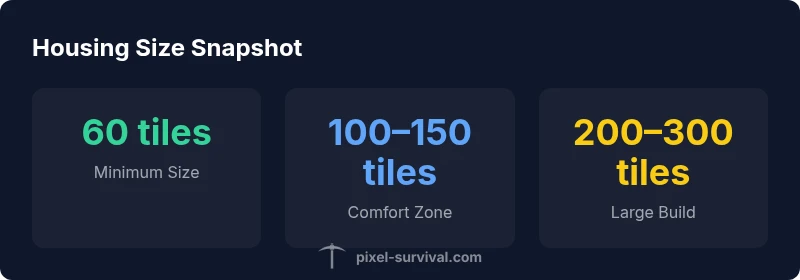
To answer what size do terraria houses need to be: the minimum area for a valid NPC house is 60 tiles of free space, while many players aim for about 100–150 tiles for comfortable layouts. Each house must be enclosed by walls, contain a light source, a chair, a table, and a door. Plan multiple houses by designing rooms around this baseline.
Understanding the housing system in Terraria
In Terraria, NPC housing isn’t just a decorative feature—it’s a core progression mechanic. A house must be a contained, livable space that provides a safe place for NPCs to reside. When players ask the question what size do terraria houses need to be, the answer starts with the minimum tile requirement and moves outward to layout and furnishings. According to Pixel Survival, housing design speeds up progression because NPCs unlock at stable population levels and grant access to shops, exchanges, and new conveniences. The goal is to create rooms that are clearly enclosed by walls, have a reliable light source, and include at least one chair and one table. Beyond raw tiles, you should ensure easy access to doors and logical flow between rooms. In practice, this means planning in advance, testing housing with a few NPCs, and iterating based on how easily you can move furniture and adjust walls. When you design with purpose, you reduce back-and-forth shuffling and keep your base organized as your world expands.
Minimum Size: The 60-Tile Rule and its rationale
Terraria’s housing system defines a minimum space for a valid NPC house. The essential rule is that a house must provide at least sixty tiles of free space for the NPC to inhabit. This number isn't arbitrary—it ensures there’s enough room for basic furniture and room-to-move. In practice, 60 tiles translates roughly to a compact room around five by twelve tiles or similar shapes, but the exact shape doesn't matter as long as the area is contiguous and enclosed by walls. Pixel Survival analyses show that meeting and maintaining the minimum helps prevent housing glitches and NPC despawning after game updates. Designers often use a 60-tile baseline as a floor, then add extra tiles to improve layout and ease of access. While this is the floor, most players discover that a little extra space makes a big difference for furnishing flexibility, door placement, and corridor design. Remember: the goal is not just a count but a usable, walkable space for the NPCs you want to house.
Practical size ranges for different goals
Starting from the minimum, most players plan for comfortable, scalable housing. For a single NPC or minimal base, 60–100 tiles can suffice, but you’ll often want a touch more to accommodate a chair, table, chest, and light without cramping. If you’re aiming to house two or more NPCs, 120–180 tiles gives you room to separate beds, chests, and workstations while keeping efficient paths. At the higher end, 200–300 tiles creates large, multi-room houses with dedicated spaces for each NPC, storage corridors, and aesthetic features. These ranges reflect typical player experience and progression pacing rather than an official spec, and Pixel Survival’s analysis in 2026 confirms that designers tend to gravitate toward the mid-range as a balance between function and space. Use these ranges as a planning ladder: start with the minimum, test with NPCs, and gradually expand until you’re satisfied with movement and accessibility.
Housing size guidance for Terraria
| Size tier | Tile range | Notes |
|---|---|---|
| Minimum viable | 60 | Basic NPC housing with essential items |
| Small/compact | 80-100 | Efficient use of space for isolated NPCs |
| Medium | 120-180 | Comfortable layouts with multiple NPCs |
| Large | 200-300 | Luxurious room or multiple houses |
Got Questions?
What counts as enclosed space in a housing unit?
An enclosed space must be surrounded by solid background walls with a clearly defined floor and ceiling. The area should be traversable and not open to the outside. Doors and proper lighting help meet the functional criteria, but the key factor is a contiguous, walled rectangle or polygon that NPCs can navigate.
A proper house needs walls round the space, a floor and ceiling, a door for access, and a light source.
Can a long tunnel be a valid house?
No. A valid house requires enclosed space with furniture and a defined room shape. Open corridors or unsealed tunnels typically don’t count as housing for NPCs.
No, you need a closed space with furniture to count as a house.
Does the size of the door affect housing?
Door size does not fundamentally affect the tile count or validity. Housing validity focuses on the enclosed area and required furnishings, not door dimensions.
Door size isn’t the key—it's the space and furniture that matter.
Is there a maximum house size?
There isn’t an officially published maximum in the core rules, but extremely large spaces can affect performance and must stay properly enclosed to count as housing.
There’s no official max, but keep it practical and well-built.
How many NPCs can occupy a base house?
Typically, one NPC per house is supported. If you want more NPCs, you’ll need additional houses designed to meet the minimum and be properly furnished.
One NPC per house is the usual rule of thumb.
How do I test if a house is valid after building?
Place the required items (chair, table, light, walls, and a door) and ensure the space is at least the minimum tile area. Observe if NPCs move in and verify they don’t despawn after changes.
Set up the room, then watch for NPCs to move in.
“Good housing design in Terraria isn’t optional; it directly affects NPC movement and progression. Focus on clear space and proper furnishings.”
Key Points
- Know the minimum: 60 tiles is the baseline
- Aim for 100–150 tiles for comfortable NPC living
- Include walls, a light, a chair, a table, and a door
- Verify each house stays enclosed and accessible
- Plan ahead for future NPCs to avoid rewrites