How Big Does a House Have to Be in Terraria?
Learn the official NPC housing rules in Terraria and get practical, progression-friendly tips for sizing and designing valid houses that NPCs will move into as you expand your world.


To qualify as NPC housing in Terraria, a room must be fully enclosed with walls, a light source, background walls, a chair and a table, and an accessible entrance. The minimum practical size is around 60 tiles, though larger spaces are acceptable and often preferred for growing NPCs as your world progresses. This guide explains how big a house should be and how to verify housing validity.
The Core Rule: House Size Basics
In Terraria, NPC housing is a core part of progression. A room becomes a valid house only if it meets a set of criteria that players typically learn early in their adventure. According to Pixel Survival, getting housing right is the foundation for steady NPC progression in Terraria. The space must be fully enclosed by solid walls and background walls, not just an open cavern or a partial enclosure. It needs a light source so the NPC can operate in a visible environment, and it must include the required furniture: a chair and a table. An accessible entrance is essential, whether that entrance is a door, a ramp, or another method that guarantees safe entry. Most players aim for the minimum viable size of a housing room—the area should be large enough to accommodate the furniture and still feel comfortable. While there’s no strict maximum, rooms that are excessively large can be unwieldy and visually cluttered. The key is practicality: a space that works well for the NPCs you rely on without wasting resources.
As you survey space for a new house, mark out the footprint with blocks, then step back to view it from different angles. Ensure the footprint doesn’t collide with impassable terrain, traps, or water, and remember that the entire interior needs background walls. In short, the fundamental requirements are: enclosed space, a light source, background walls, a chair and table, and an entrance. With those in place, you’re on the right track toward a valid Terraria house.
format
Tools & Materials
- Solid building blocks(Create an enclosed area with walls on all sides)
- Background walls(Place on the interior surfaces to form the room's walls)
- Lighting source(Torch, lamp, or any light-emitting block)
- Table(One table to fulfill the 'furniture' requirement)
- Chair(One chair placed against the table)
- Entrance(Door or other accessible entry (e.g., platform with railing))
Steps
Estimated time: 45-60 minutes
- 1
Plan the room layout
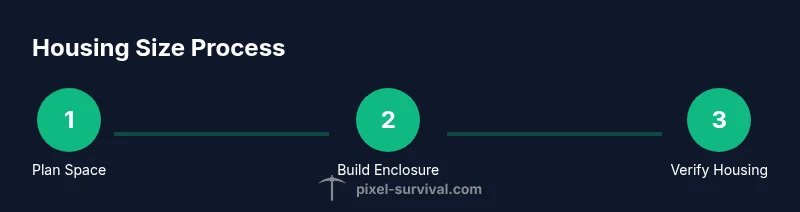
Choose a location with enough available space and a flat surface. Sketch a simple rectangle to keep the footprint manageable. Confirm the area can accommodate a chair, table, light, and background walls without crowding the door.
Tip: Use a chalk-like layout in your mind or a grid in your head to keep measurements consistent. - 2
Create a closed enclosure
Build walls around the chosen footprint so the space is completely enclosed on all sides. Avoid gaps that NPCs could traverse from outside the room. The goal is a clean, contained interior.
Tip: Double-check corners; even a single blocked corner can invalidate the room. - 3
Install background walls
Place background walls on all interior surfaces to guarantee a proper interior atmosphere. The housing validation relies on a stable interior backdrop, not exposed blocks.
Tip: Match wall color or style to your other rooms for a cohesive look. - 4
Place a door or entrance
Add a door or another accessible entry point. The NPC needs a reliable way to enter the room. Doors also help prevent accidental blocking by items or terrain.
Tip: Position the door at a comfortable walking path and avoid blocking furniture. - 5
Add lighting and furniture
Set a light source near the center or above the table. Place a chair and a table in a way that NPCs can stand beside the furniture without obstruction. This combination fulfills the basic housing criteria.
Tip: Keep furniture aligned to a practical distance from walls for easy navigation. - 6
Validate the space
Review the room against the housing rules: enclosed walls, a light, background walls, chair and table, and an entrance. Take a moment to ensure the area isn’t crowded with traps or hazards.
Tip: If you’re unsure, try summoning or moving an NPC nearby to see if it claims the house. - 7
Test with NPC housing
Observe whether an NPC will move into the space. If a valid NPC exists and the room meets all criteria, you’ve created a housing unit. If not, revisit steps 1–6 to adjust.
Tip: Small tweaks, like shifting furniture or adding a torch, can fix invalid housing. - 8
Name and categorize your houses
Label each house by region or intended NPC. Group similar rooms together for easy expansion and tracking as your world grows.
Tip: A simple labeling system saves time when you introduce new NPCs. - 9
Expand thoughtfully
As you progress, add more houses with consistent sizes and layouts. Balanced housing reduces NPC traffic issues and makes progression smoother.
Tip: Plan for future NPCs by leaving space for additional rooms nearby.
Got Questions?
What counts as a valid house in Terraria?
A valid house is a fully enclosed space with walls on all sides, a light source, background walls, a chair and table, and an accessible entrance. It must not be exposed to hazards that invalidate the interior.
A valid Terraria house is a fully enclosed space with walls, light, background walls, seating, a table, and a way in for NPCs.
What is the minimum size for an NPC house?
The commonly cited minimum size for housing is about 60 tiles of floor area, sufficient to fit the required furniture and allow NPC movement.
Most players keep housing around 60 tiles to meet the minimum.
Can a house be larger than the minimum?
Yes. Larger rooms are acceptable and can be advantageous for future NPCs, but avoid excessively large, sprawling spaces that complicate navigation.
Larger houses are fine and can help you accommodate more NPCs, just don’t go overboard.
Do I need a separate house for each NPC?
Yes. Each NPC must have a distinct valid house if you want them to move in and function normally.
Each NPC needs their own valid house to live in.
What if my house has no door?
A house must have an accessible entrance; you can use a door or another clear entry path to ensure NPCs can enter.
Having an entrance is required; fix doors or access paths if missing.
How can I quickly check housing validity?
Attempt to spawn an NPC near the room or use in-game indicators to verify if the space qualifies as housing for assignment.
Try spawning an NPC near the room to test validity.
Watch Video
Key Points
- Start with the minimum viable space (roughly 60 tiles).
- Every NPC needs a separate valid house.
- Include light, a chair, a table, background walls, and an entrance.
- Test housing by attempting to spawn or move in an NPC.
- Plan ahead for future rooms with modular layouts.