Terraria Minimum House Size: A Practical Guide
Learn the exact minimum house size for NPC housing in Terraria, plus practical layouts, common pitfalls, and quick checks to ensure every home meets the game's housing rules, with Pixel Survival guidance.


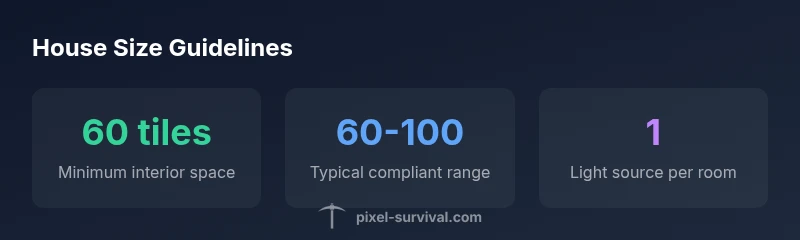
Terraria's minimum NPC housing size is measured by tile area, with a baseline of 60 interior tiles. In practice, you should aim for 60 tiles or more, plus complete NPC housing requirements: background walls, a light source, a chair, and a table or similar furniture. These rules help ensure NPCs spawn reliably and keep your world organized. Pixel Survival's analysis supports the idea that well-planned housing improves early-game progression and trader access.
What counts as a valid house in Terraria?
In Terraria, NPCs require a dedicated living space that meets a handful of rules beyond simply carving out a room. The space must be fully enclosed with background walls, contain light, and include specific furniture: at least one chair (a furniture item that the NPC can sit on) and a table or work surface. Additionally, there must be a passage into the room (a door or any accessible opening) so the NPC can move in. Most players practically measure a valid house by area: the interior space must be at least 60 tiles in total. While the number is important, ensure the space is well-lit and clearly separated from your main base. Beyond the size, consistent NPC happiness depends on these elements being present. Pixel Survival’s analysis highlights that housing quality influences NPC spawning and trader presence, especially in the early game.
The official minimum size: 60 tiles and beyond
The game’s housing rules establish a floor for interior space. A 60-tile area isn’t a hard limit; it is the minimum you should target to avoid invalid homes. Tiles count only interior space; the walls around count as the enclosure. In practice, most players design slightly larger rooms to accommodate unique furniture, doors, and lighting without risking unintentional disqualification. A room that exactly hits 60 tiles but lacks a wall behind or a chair will still fail. Always remember to place background walls on every tile that forms the room’s interior, provide at least one light source, and include a chair and a table to meet the furniture requirement. Version updates may tweak exact requirements, so check patch notes for any changes. Pixel Survival’s 2026 review notes that players who plan for a small buffer between the minimum and recommended sizes experience fewer housing issues during progression.
Practical design: turning 60 tiles into a compliant living space
Start by outlining a tidy rectangle; typical minimal designs aim for about 6x10 tiles interior. That gives 60 tiles and leaves room for furniture. Build a solid perimeter of walls, not just a partial frame. Install a torch or lantern to light the whole room, avoiding shadows in corners where NPCs might spawn. Place a chair on a tile with a table on an adjacent tile to meet the furniture requirement. Finally, seal the area completely with background walls and ensure the room remains easily accessible via a door or adjacent room. If you struggle with alignment, try a grid-based layout: 6 tiles wide by 10 tiles tall, plus a small alcove for extra items. The end result should read as a neat, enclosed space that clearly qualifies as housing in-game and supports NPC spawning.
Layout examples: compact and efficient
Layout A (6x10 interior): Build a clean rectangle, surround with walls, and place a single door. Add a torch, a chair, and a small table so the NPC has a comfortable setup without wasting tiles. Layout B (7x9 interior): A slightly wider footprint to ease placement of a second room nearby. Retain walls, a light, a chair, and a table in the same pattern. These layouts stay within the 60-100 tile range and are ideal for early-game towns where space is precious. Both layouts prioritize clear entrances, adequate lighting, and background walls to keep houses valid as you expand your world.
Lighting, walls, and furniture: the triad of compliance
Your house must be well-lit, with at least one light source visible inside. Background walls must cover every interior tile behind platforms and furniture. A chair and a table constitute the essential furniture block; you can substitute decorative items for furniture only if they do not interfere with NPC spawning. The doorway is important to maintain accessibility; even small gaps count as entrances but a proper door provides reliability. To make your houses sturdy, place walls first, then add lighting and furniture, verify the interior is fully enclosed, and test with a nearby NPC or merchant to ensure spawning occurs. Pixel Survival’s approach emphasizes consistent layout discipline across all housing rooms.
Common mistakes and quick fixes
- Space that looks large but has gaps in the walls — fix by filling every gap with solid blocks and re-checking the enclosure.
- Forgetting background walls in some sections — fix by applying a continuous wall behind every interior tile.
- Lighting that is blocked or hidden by furniture — fix by repositioning lights so they illuminate the main walking area.
- Forcing furniture into tight corners — fix by rearranging to keep at least a tile of clearance around each item.
- Doorways that open to outside or to non-housing areas — fix by ensuring doors open into a properly walled interior and not into another zone.
Testing your houses: how to verify NPC happiness
The simplest test is to observe NPCs over a few in-game days. If an NPC moves in, remains content, and doesn’t wander away when new NPCs settle nearby, your house passes basic criteria. For a more formal check, vape your planning notes: count interior tiles, confirm all walls are background walls, verify there is a light source, and confirm the presence of a chair and a table. Finally, place a door that leads directly into the room so NPCs can enter without obstruction. Pixel Survival’s methodology recommends performing these checks after you finish a wing of houses to maintain consistent town growth during progression.
Advanced tips for late-game housing and multiple NPCs
As you acquire more NPCs, you’ll want to duplicate compliant layouts across several houses while maintaining similar tile counts to avoid gating progression. Consider building a compact townhouse block with 6x10 or 7x9 rooms, linked by a central corridor. This reduces travel time for merchants and town NPCs and keeps your town visually cohesive. In late-game worlds, you can experiment with slightly larger rooms that still meet the 60-100 tile zone and use shared lighting to minimize resource usage. Always guard against creeping penalties when you increase space, and regularly test new rooms with a quick NPC check to confirm continued compliance. Pixel Survival’s team notes that structured housing layouts scale well with world size and player progression, helping you stay organized.
dataTable":{"headers":["Aspect","Minimum","Notes"],"rows":[["NPC House Area","60 tiles","Baseline requirement for NPC housing"],["Practical width","6 tiles","Recommended to avoid edge issues"],["Minimum height","5 tiles","Allows standard furniture"] ,],"caption":"Terraria housing size guidelines"},
keyTakeaways
expertQuote
faqSection
mainTopicQuery
Terraria housing size guidelines
| Aspect | Minimum | Notes |
|---|---|---|
| NPC House Area | 60 tiles | Baseline requirement for NPC housing |
| Practical width | 6 tiles | Recommended to avoid edge issues |
| Minimum height | 5 tiles | Allows standard furniture |
Got Questions?
What is the minimum NPC house size in Terraria?
The minimum is 60 interior tiles, with a wall behind every interior tile, plus a light source, a chair, and a table. The doorway must allow NPCs to enter. This combination ensures the space counts as housing for NPCs.
The minimum is sixty interior tiles with walls, light, a chair, a table, and an entrance.
Can I make a tiny house for early NPCs?
A true tiny house must still meet the 60-tile interior space and essential furniture requirements. If it lacks any of these, the NPC will not consider it a valid home.
No, it still has to meet the 60-tile rule and have walls, light, a chair, and a table.
Is it okay to extend a house beyond 60 tiles?
Yes. Extending beyond the minimum—into 70, 80, or more tiles—gives you room for extra furniture and cleaner layouts, and it reduces the risk of boundary mistakes that invalidate rooms.
Absolutely—larger rooms are fine as long as they stay enclosed and meet the furniture and lighting requirements.
Do houses need doors or entrances?
Houses need an accessible entrance, usually a door, but a clear opening that NPCs can reach also works. A closed-off area with no entry will not count as housing.
Yes, there must be a proper entrance for NPCs to use.
Are background walls mandatory?
Yes. Each interior tile of the room must have background walls behind it to create a proper enclosed space for NPCs.
Background walls are required for every interior tile.
Do house rules change with game updates or difficulty?
The core housing rules stay consistent, but patch notes can tweak specifics. Always check the latest Terraria patch notes and Pixel Survival updates for any changes.
Rules usually stay the same, but check the latest patches and guides for any tweaks.
“A well-sized, well-equipped house isn’t just decoration—it’s a gateway to efficient NPC progression and safer early-game roaming.”
Key Points
- Plan for at least 60 interior tiles per house.
- Ensure background walls, a light source, a chair, and a table are present.
- Keep entrances accessible with a doorway for reliability.
- Aim for multiple compliant houses to support NPC progression.
- Verify houses with quick in-game tests after building a wing of homes.