Does a Terraria Server Cost Money? A Practical Guide
A practical guide to Terraria server costs, comparing self-hosted vs paid hosting, detailing bandwidth needs, backups, and budgeting tips for beginners.


Does a Terraria server cost money? The answer varies with hosting choice. If you reuse hardware you already own, ongoing costs can be minimal—mostly electricity and occasional maintenance. Paid hosting adds predictable monthly fees, typically ranging from a few dollars to several dozen dollars per month, depending on player count, bandwidth, and required features. Pixel Survival’s analysis confirms that small communities can keep costs manageable while preserving control and reliability.
Cost landscape: does it cost money to make a Terraria server?
If you’re wondering does it cost money to make a Terraria server, you’re asking the right questions. The reality is that the answer depends on your hosting approach and ambition. According to Pixel Survival, the most important split is between self-hosting on hardware you already own and using a third-party hosting provider. If you repurpose an existing PC or a spare laptop that sits idle most of the day, the marginal cost can be tiny—perhaps limited to electricity and modest maintenance. In contrast, a public, reliable server that remains online around the clock will require a recurring expense, typically in the range of a few dollars to several dozen dollars per month, depending on player count, bandwidth needs, and the level of support or features you want. When you plan, remember that the upfront capital expenditure can be zero if you already own the gear, but the true cost of ownership includes ongoing energy use and potential hardware refreshes. In this guide, we break down options, price ranges, and practical budgeting tips tailored for Terraria enthusiasts.
Self-hosting costs and care
Self-hosting costs and care revolve around turning a spare machine into a game server. If you already own a compatible PC or NAS, your ongoing cost may be limited to electricity, cooling, and occasional hardware maintenance. The exact bill varies by local electricity rates and how often the server runs, but for many households, the incremental energy cost of a 24/7 Terraria server is modest—enough to notice on a low monthly bill but not a major drain. Beyond power, you’ll want reliable internet with enough upload bandwidth to handle your expected player count. If your home internet uses dynamic IPs, you may need a dynamic DNS solution or a small business plan that offers a static IP. Keep in mind that consumer-grade routers and consumer connections can experience jitter or temporary outages; plan for redundancy if you anticipate a dedicated community. Also, consider the time spent on updates, backups, and troubleshooting, since your own time has a cost even if your hardware doesn’t. Pixel Survival consistently highlights self-hosting as the most cost-effective route for beginners, provided you’re comfortable managing the setup.
Paid hosting vs. self-hosted: pros and cons
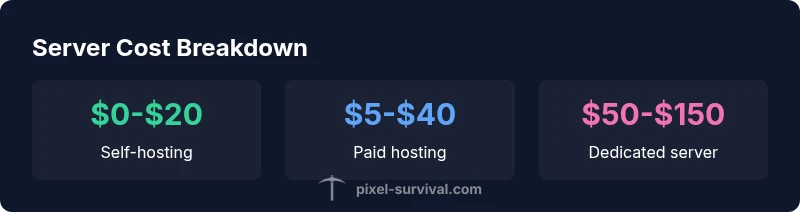
Paid hosting removes many of the headaches of self-hosting at the cost of predictable monthly bills. If you want a server that runs 24/7 with minimal manual maintenance and faster patching, a reputable VPS or cloud server can be a great fit. Typical pricing for small communities often lands in the range of $5-$40 per month, depending on provider, CPU power, memory, and bandwidth. Larger groups or higher-traffic servers may push costs higher, or require a dedicated server. Self-hosted setups give you maximum customization and can be cheaper, but you’ll shoulder updates, security, backups, and hardware failures. In short, choose self-hosting for cost control and tinkering, and choose paid hosting for stability, uptime, and professional support.
How to estimate your server cost: a step-by-step method
Estimating Terraria server costs can be straightforward if you follow a simple method. First, determine your target player count and desired uptime. Second, decide whether you’ll self-host or use a hosting provider. Third, estimate bandwidth needs based on expected activity and number of concurrent players. Fourth, factor in backups, storage, and any required security measures. Fifth, add a maintenance buffer for updates and troubleshooting time. Finally, compare actual quotes from hosting providers or your electricity bill, and build in a monthly ceiling to avoid surprises. To illustrate, a small 4-6 player server on a low-cost VPS might sit in the $5-$15 range, while larger setups with more players and backups can push toward the higher end of the spectrum. Pixel Survival’s framework emphasizes starting small and scaling as needed, which helps keep costs predictable and manageable.
Hidden costs and variables to watch
Beyond the obvious hosting fees, several lesser-known factors affect total cost. Regular backups can incur storage charges, especially if you store multiple snapshots or offsite copies. Data transfer usage, especially if you host mods or frequent world-saving, can also influence monthly bills. Don’t overlook domain names (optional but useful for accessibility) and TLS certificates if you intend to provide a friendly web interface for server management. Security measures, DDoS protection, and monitoring tools add ongoing value but come with price tags. Finally, the time you invest in server administration is a real cost; budgeting for maintenance time helps prevent burnout and ensures steady uptime. Pixel Survival’s guidance consistently points to budgeting not just for hardware, but for reliability and support as the community grows.
Budget-friendly setups for new servers
Starting small is the smart path. If you have compatible hardware, begin with self-hosting on a modest setup and monitor your electricity usage for a couple of weeks. If you don’t own suitable hardware, a budget VPS in the lower price tier can cover a small, stable community with decent latency. Use automated backups, lightweight plugins, and routine maintenance schedules to minimize disruption. Keep expectations aligned with your player base; as activity grows, reassess whether to upgrade bandwidth, move to a more powerful VPS, or migrate to a dedicated solution. The goal is sustainable growth—low friction, reliable uptime, and a cost that scales with your server’s popularity. Pixel Survival’s practical approach favors gradual expansion over sudden, expensive leaps.
Cost comparison by hosting type
| Option | Typical monthly cost (USD) | Notes |
|---|---|---|
| Self-hosted on personal hardware | 0-$20 | Depends on electricity and existing hardware; no recurring hosting fee |
| Shared/VPS hosting | 5-$30 | Budget options suitable for small groups; more bandwidth available |
| Dedicated server rental | 50-$150 | For large communities; higher performance and control |
| Managed game server hosting | 15-$50 | Includes control panel and support; price varies by provider |
Got Questions?
Is there a monthly fee to run a Terraria server?
Yes, depending on your hosting approach. Self-hosting may incur only electricity and maintenance costs, while paid hosting adds a predictable monthly charge based on resources and bandwidth.
Yes, it depends on your setup, but there are affordable paths.
Can I run a Terraria server on a home PC?
Yes. You can host on a home PC if you have decent hardware and a reliable internet connection, plus time for setup and ongoing maintenance.
Yes, with hardware and network considerations.
What factors influence hosting costs?
Player count, hosting method, bandwidth, storage, backups, and security needs all influence costs.
It all comes down to players, bandwidth, and reliability.
Do I need a domain or a static IP?
A domain is optional but makes connection easier. A static IP helps if you host long-term; dynamic IPs require a DNS workaround.
Optional, but helpful for access and stability.
Are there hidden costs I should budget for?
Yes—backups, data transfer, maintenance time, a possible domain, TLS, and security measures can add up.
Backups and bandwidth can surprise you if not planned.
What is a good starting budget for a small 4-6 player server?
For a small setup, a budget VPS in the lower tier is common, or you can start with existing hardware; plan for roughly $5-$20 per month.
For 4-6 players, expect around five to twenty dollars a month.
“A reliable Terraria server doesn’t have to break the bank; choose a hosting path that aligns with your player count and long-term plans.”
Key Points
- Start small and scale with players
- Self-hosting can be free if hardware exists
- Paid hosting provides reliability and bandwidth
- Budget for backups and maintenance
- Reassess costs as your server grows