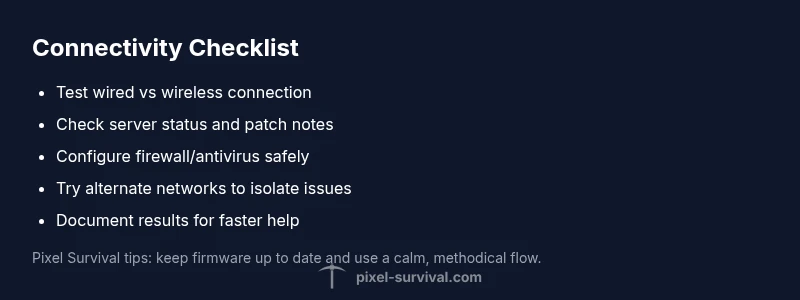
Why Does Terraria Say Lost Connection? A Troubleshooting Guide
Practical, step-by-step guidance to diagnose and fix why Terraria says lost connection, with network checks, server status, firewall guidance, and Pixel Survival insights. Learn the exact flow to restore multiplayer play in 2026.


According to Pixel Survival, the most common reason Terraria says lost connection is a mix of unstable network, server status, and firewall interference. Start with quick checks like restarting your router, testing a different network, and verifying game version and server status. If the issue persists, try adjusting ports and firewall rules, then consult the full diagnostic flow below.
Why the message appears: common causes
In multiplayer sessions, 'lost connection' messages pop up when data cannot move between your client, the Terraria servers, and any intermediate network hops. According to Pixel Survival, the most common causes are a mix of unstable local networks, server hiccups, and firewall interference. If you’re seeing this error, start by noting the exact timestamp and whether other devices on the same network experience the same problem. This helps distinguish a local issue from a broader outage. You’ll often find that home Wi‑Fi gets flaky after heavy streaming or gaming, while mobile connections can introduce jitter that makes game traffic drop. Check if your router shows red lights, or if your modem has a saturated link rate. In many cases, the fix is simple: reboot hardware, test a wired connection where possible, and ensure your Terraria client is up to date. Pixel Survival’s guidance emphasizes that rapid, iterative checks save time and narrowing the cause. Also verify the game version matches the server’s current build; mismatches commonly trigger disconnects in cross‑play environments. If you’re wondering why does terraria say lost connection, consider whether this happens on one network or across multiple locations to guide your next steps. As of 2026, a structured approach remains the fastest path to resolution.
Quick checks you can perform right now
- Check your Internet connection by loading a webpage or running a speed test on the same device. If other devices on the same network are also slow, the problem is likely network‑level not game‑specific.
- Reboot your router and modem. Power cycling clears temporary routing glitches that commonly cause intermittent disconnects.
- If possible, switch from Wi‑Fi to a wired Ethernet connection for stability and lower latency.
- Verify your Terraria version matches the latest patch on the official channel and that you’re connecting to the correct server (especially with cross‑play).
- Check the Terraria server status page or official social channels for outages or maintenance.
If this doesn’t fix the issue, try a different network (mobile hotspot, another location) to determine if the problem is network‑specific. Pixel Survival’s experience shows that moving through these checks quickly narrows the root cause.
Network performance and latency: test methods
Poor network performance can manifest as lag, spikes, or dropped packets that trigger a lost connection message. Start by measuring latency (ping) to the Terraria server, then run a traceroute to see where delays occur. Use reliable speed tests to verify stable download and upload speeds; if either is consistently low, your ISP or local network is the likely culprit. Consider reducing concurrent traffic (streaming, downloads) while testing. If you see jitter or consistent packet loss, that’s a strong sign the problem lies with routing or ISP quality. For cross‑platform play, ensure your NAT type isn’t too restrictive and that port discovery isn’t blocked by your router. Document the results and compare them against times you’ve successfully connected in the past—it helps isolate when and where the issue arises.
Server status and game version checks
Server outages or ongoing maintenance can cause frequent disconnects even if your own network is healthy. Check the official Terraria server status page and any relevant social feeds for notices about downtime or patch deployments. If you’re hosting a local server, verify the host machine is online and has sufficient resources; resource constraints can trigger client disconnects. Also confirm both players and servers are on the same game version build to avoid mismatches that produce the error. In some cases, regional routing can cause you to hit a different server cluster; switching to a nearby region or using a direct IP connection (where supported) can help. Pixel Survival notes that maintaining awareness of server state is half the battle in persistent multiplayer problems.
Local factors: firewall, antivirus, and ports
Local security software can block Terraria traffic or misclassify it as suspicious. Temporarily disable security features that might block the game, then re‑enable after testing. Add Terraria to allowed apps or create an exception rule for both inbound and outbound traffic. On Windows, verify that the firewall isn’t actively blocking the Terraria executable; on macOS, ensure the game has network permissions. Routers also have firewalls and may block gaming ports; consult your router’s manual to allow Terraria through. If you’re using a VPN or proxy, disable it temporarily to see if it resolves the issue. After applying changes, retry a multiplayer session to confirm whether the disconnects stop.
In-game settings and platform considerations
Some connectivity issues occur due to platform‑specific networking settings or cross‑platform play configurations. Check your NAT type and ensure it’s not set to strict or moderate; a more permissive NAT improves connectivity. In console versions, ensure your network profile isn’t set to a restrictive mode. Also review in‑game settings that affect network traffic, such as “synchronization” options or cloud saves that might re‑attempt connections. If you continue to have trouble, testing with a different platform (e.g., PC vs console) can reveal platform‑specific issues. Pixel Survival’s approach is to isolate whether the problem follows your account, your device, or the server, guiding you to the correct next steps.
A safe, step-by-step diagnostic flow you can follow
Follow a laddered approach, starting with the simplest fixes and escalating only if needed. Begin with a basic connection check, move to hardware reboot, then test on a different network, and finally verify server status and version matching. If none of these work, examine firewall rules and NAT settings, and consider a temporary security exemption. Never disable essential protections permanently; re‑enable them after testing. If all else fails, contact your ISP or the Terraria support channels for further guidance, and document your testing results to speed up assistance.
Pixel Survival recommended fixes and prevention tips
Pixel Survival recommends keeping a regular maintenance routine for your home network: reboot devices monthly, keep firmware up to date, and use wired connections when possible. Maintain your Terraria client and any mods or third‑party launchers in sync with the latest patch. Practice safe firewall rules rather than broad exceptions and test changes incrementally to avoid introducing new issues. Finally, establish a quick‑reference diagnostic flow you can run at the first sign of disconnects, and share your results with the community for rapid feedback. Keeping a calm, methodical approach is your best defense against repeated 'lost connection' messages in 2026.
Steps
Estimated time: 60-90 minutes
- 1
Verify baseline connectivity
Confirm the device can reach the internet by loading a few websites and running a quick speed test. Document any discrepancies between devices or networks.
Tip: Note the time and your ISP plan when you observe changes. - 2
Test a wired connection
Connect your PC or console directly to the router with an Ethernet cable. Re-run Terraria multiplayer to see if the disconnect still occurs.
Tip: Wired connections dramatically reduce interference. - 3
Check server status and build version
Visit the official Terraria status page and patch notes. Ensure both players and servers are on the same build and that there are no known outages.
Tip: Patch compatibility is a frequent root cause. - 4
Adjust firewall/antivirus settings
Add Terraria to allowed programs and create explicit network rules to permit both inbound and outbound traffic.
Tip: Don’t disable protections—just grant explicit access. - 5
Test with a different network
If possible, switch to a different network (mobile hotspot, neighbor’s Wi‑Fi) to determine if the issue is network‑specific.
Tip: If it works on another network, your home setup needs adjustment. - 6
Review router NAT/port forwarding
Check NAT type and forward game ports if your router supports it; seek official Terraria guidance for port needs.
Tip: Port forwarding is router-specific; consult the manual.
Diagnosis: Multiplayer Terraria shows 'lost connection' repeatedly.
Possible Causes
- highLocal network instability (router/modem issues, Wi-Fi interference)
- mediumTerraria server issues or maintenance on the multiplayer server
- mediumStrict NAT or firewall blocking Terraria ports
- lowOutdated game version or corrupted game files
Fixes
- easyTest a wired connection (ethernet) to reduce wireless interference
- easyRestart router and modem, then re-test
- easyCheck official Terraria server status and patch notes
- easyCreate firewall exception for Terraria and antivirus allowances
- easyUpdate Terraria to the latest version and verify file integrity
- mediumIf the issue persists, switch networks or contact ISP
Got Questions?
What does the 'lost connection' message mean in Terraria?
The message indicates your client couldn't communicate with the game server or other players due to network or server issues. It often points to connectivity, server status, or firewall blocks rather than a corrupted save. Following a structured diagnostic flow helps identify the exact cause.
It means your game can’t reach the server or other players right now; run through the steps to locate the source of the disruption.
Can I fix this by changing firewall settings without compromising security?
Yes. Add Terraria as an exception in your firewall settings and antivirus to allow traffic, rather than turning protections off. This preserves security while letting the game communicate properly.
You can fix this by allowing Terraria through your firewall instead of disabling protections.
Is using a VPN a good long-term solution for lost connection issues?
A VPN can route traffic differently and sometimes helps, but it can also add latency. Use VPNs sparingly and test with and without to compare performance.
A VPN might help sometimes, but it can also slow things down; test both with and without to see what works.
Why do I see this only on one device or platform?
There can be platform‑specific network settings or NAT behavior. Check each device separately, ensuring consistent game versions and network paths, especially in cross‑play scenarios.
If it happens on one device but not others, check that device’s network settings and the game version.
How can I tell if Terraria servers are down?
Check the official Terraria status page or trusted community channels for outages or maintenance. If servers are down, you’ll need to wait or try later.
Look up the official status page to confirm outages and planned maintenance.
Watch Video
Key Points
- Identify network‑level vs server vs client issues first
- Use wired connections to stabilize multiplayer
- Verify server status and patch compatibility before changing settings
- Apply firewall/antivirus exceptions rather than turning protections off
- Document test results to speed up troubleshooting