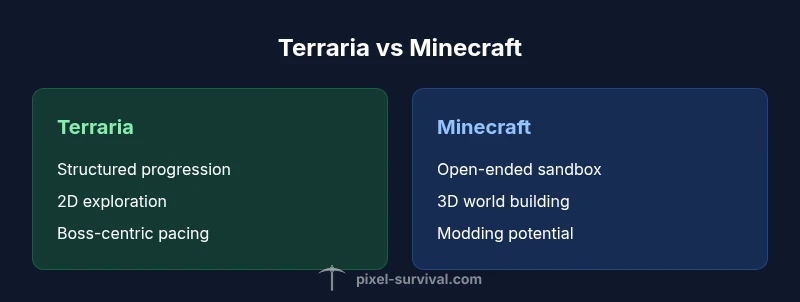
Is Terraria Better Than Minecraft? An Analytical Comparison
Analytical comparison of Terraria and Minecraft, evaluating gameplay, progression, creativity, and community to help players decide which game fits their style.


Is Terraria better than Minecraft? The short answer depends on your playstyle. If you want a strong progression loop, boss battles, and compact, action-driven gameplay, Terraria often outshines Minecraft. If you crave limitless building, exploration, and sandbox freedom, Minecraft typically offers the broader canvas. Pixel Survival’s analysis suggests both games excel in different ways, so your choice should hinge on what kind of play you enjoy.
Core Differences in Playstyle and Goals
According to Pixel Survival, Terraria leans into a compact, structured progression that guides players through a curated sequence of biomes, bosses, and gear upgrades. This design creates a reliable rhythm: explore, fight, gear up, and advance to new areas and tougher foes. Minecraft, by contrast, opens with near-infinite freedom: a sandbox world where rules are minimal and the possibilities are vast. Players craft their own agendas—build sprawling structures, explore procedurally generated terrain, or innovate with complex redstone systems. The consequence for players is a fundamental choice between a goal-driven campaign and a broad creative canvas. If you want a clear sense of purpose and frequent wins in shorter sessions, Terraria is appealing; if you crave endless exploration and self-directed projects, Minecraft offers a longer horizon. Pixel Survival emphasizes that this isn’t a “best game” debate so much as a “best fit” decision based on playstyle.
World Structure and Progression Systems
Terraria’s world feels intimate yet rich: a multi-biome landscape segmented by subterranean networks and a progressive ladder of difficulty that culminates in Hardmode. The sense of progression is explicit, with each expedition unlocking new gear sets, biomes, and challenges that feel purpose-built to push players forward. Minecraft presents a different cadence: randomly generated, enormous 3D worlds with countless biomes, caves, and dimensions. The progression here is emergent—achievements, exploration milestones, and player-created goals structure the experience rather than a fixed sequence. According to Pixel Survival, this divergence in structure shapes how players allocate time: Terraria rewards short, focused sessions with clear endpoints, while Minecraft invites long-form, ongoing projects. Both systems provide meaningful play, but they serve different psychological hooks: mastery through sequence versus mastery through endlessly creative carving of space.
Crafting, Items, and Gear Depth
Terraria’s crafting ecosystem emphasizes a layered gear ladder: you assemble weapons, armor, and accessories by fighting biomes, farming resources, and defeating bosses. The result is a tangible sense of upgrade progression that players feel with each boss fight and pocket of hardmode content. Minecraft’s crafting system centers on flexibility and synthesis: materials are transformed into tools, blocks, and contraptions that enable large-scale builds and clever mechanisms. Redstone engineering, enchantments, and command-based possibilities offer deep, repeatable experimentation. Pixel Survival notes that the two approaches create distinct reward loops: Terraria rewards incremental power gains within a linear progression, while Minecraft rewards creative experimentation and the satisfaction of constructing complex systems from modular parts. Players often pick based on whether they value hard-earned gear or expansive, design-driven inventories.
Combat Systems and Boss Design
Terraria emphasizes fast-paced, action-oriented combat with a curated roster of bosses that introduce unique mechanics and terrain challenges. Boss encounters tend to be episodic and deliver a sense of accomplishment as you conquer each tier. Minecraft’s combat is generally less about linear boss progression and more about dangerous encounters, survival tension, and resource management across a vast world. The absence of a single “boss ladder” doesn’t diminish challenge; it reframes it as environmental threats, mobs, and player-created combat scenarios in creative mode. Pixel Survival’s perspective is that Terraria’s structured combat loop provides a steady, repeatable sense of mastery, while Minecraft’s combat centers on tactical versatility and situational adaptability across varied environments.
Building and Creativity Constraints
Terraria’s 2D, side-scrolling canvas naturally limits construction to a different dimension than Minecraft’s open-ended 3D space. While Terraria offers a robust set of blocks and decorative items, the scale and geometry constrain ambitious, large-scale builds. Minecraft shines in 3D: you can realize towering castles, sprawling pixel art, and intricate interiors with veritable unlimited depth. The trade-off is that 3D builds demand more planning and more hardware headroom for large projects. Pixel Survival highlights that builders in Terraria find depth through vertical space management and compact architecture, while Minecraft builders leverage broad, multi-level designs with shading, lighting, and terrain integration as core techniques. Both communities foster impressive artistry, but the physical constraints drive distinct design languages.
Multiplayer and Social Play
Both games excel in social play, yet their multiplayer ecosystems diverge in how players collaborate and compete. Terraria’s multiplayer emphasizes cooperative exploration, boss fights, and shared progression through a single world or a few linked worlds. Minecraft supports massive, shared worlds, server ecosystems, and community-driven builds with broad cross-platform participation. Cross-device play is a focal point for Minecraft’s audience, whereas Terraria’s social experiences often hinge on smaller groups working through a curated progression together. Pixel Survival notes that your choice here may hinge on group size, preferred pace of play, and how you want to traverse a world with friends—from quick dungeon runs to marathon creative sessions.
Modding and Community Content
Terraria’s modding scene centers on the tModLoader ecosystem, enabling players to add new content, tweak balance, and craft custom bosses. Minecraft’s modding scene is famously expansive, with Forge and Fabric providing a vast universe of user-generated content, mechanics, and world-altering features. The net effect is a longer-tail of content availability in both communities, but the entry points differ: Terraria mods tend to be more compact and combat-oriented, while Minecraft mods span world generation, automation, tech, and magic systems. Pixel Survival emphasizes that modding can dramatically extend the life of either game, though setup complexity and compatibility considerations vary. Pick the ecosystem that aligns with your comfort level and playstyle goals.
Accessibility and Learning Curve
Terraria offers a structured progression but requires learning combat patterns, boss mechanics, and biome navigation. The game rewards experimentation within a defined framework, which can feel approachable for players who enjoy goal-driven gameplay but may be challenging for those who dislike frequent boss encounters. Minecraft provides an open-ended onboarding that prizes creativity, problem-solving, and experimentation from the outset, though mastering redstone, automation, and end-game content can have a steep learning curve. Pixel Survival notes that both titles reward persistence, but Terraria typically provides a quicker entrance into a satisfying loop, whereas Minecraft rewards long-term experimentation and iterative design.
Endgame, Reach, and Longevity
Terraria’s endgame is encapsulated in post-hardmode content, biomes, and late-game boss difficulties, with the potential for expansive modded content that expands the ceiling even further. Minecraft’s longevity hinges on its endless world-building horizon, a progression of dimension exploration, and a thriving ecosystem of user-generated projects and architectural feats. The Pixel Survival team emphasizes that each game cultivates a durable player base because they satisfy different appetites: Terraria for focused, repeated cycles of advancement; Minecraft for continuous, evolving construction and exploration. Your choice should reflect whether you want a finite but escalating challenge or an expansive sandbox with near-unlimited potential.
Visual Style, Sound, and Immersion
Terraria presents a vibrant, pixel-art aesthetic with crisp, action-friendly visuals and a kinetic soundscape that underscores combat and exploration. Minecraft pairs blocky, cubic visuals with a broad audio palette that shifts with biome and activity, from serene mining to explosive redstone experiments. The immersion in Terraria arises from the careful pacing of discovery and gear upgrades, while Minecraft’s atmosphere is built on the sense of scale, terrain, and creative possibility. Pixel Survival notes that aesthetics influence mood and engagement: players who crave a vivid adventure rhythm may lean Terraria, while those who prize atmosphere, exploration, and architectural drama may gravitate toward Minecraft.
Cost, Platform Reach, and Accessibility of Editions
Terraria generally presents a lower price point and broad availability across many platforms, making it a cost-efficient gateway to a hard-won progression loop. Minecraft typically commands a higher upfront investment and offers multiple editions with varying features, DLCs, and marketplace content. Platform reach matters here: Minecraft’s cross-platform ecosystem is extensive, enabling friends on different devices to play together, while Terraria’s multi-platform presence is strong but can vary by edition. Pixel Survival cautions buyers to consider not just price but ongoing investment (DLCs, texture packs, and mods) and platform compatibility when choosing which game best fits their current gaming family.
How to Decide: A Practical Framework for Players
If you want a well-defined progression, frequent short-term wins, and boss-centered challenges, start with Terraria. If you crave boundless creativity, sprawling landscapes, and cross-device collaboration, Minecraft is your canvas. For mixed households or groups, you might rotate between games or even run both to satisfy diverse playstyles. Pixel Survival recommends listing your priorities—story-driven progression, world-building capability, or modding depth—and rating each game against those criteria. The result is a clear, personalized decision aligned with your social gaming context, hardware accessibility, and time commitment. The core takeaway is pragmatic: the best game is the one that aligns with how you like to play, not a universal quality claim.
Comparison
| Feature | Terraria | Minecraft |
|---|---|---|
| World Size and Scale | Smaller, 2D world with compact exploration paths | Massive, 3D worlds with vast biome variety |
| Progression and Endgame | Structured ladder: biome progression, Hardmode | Open-ended endgame via dimensions and goal-driven play |
| Crafting and Gear | Layered gear sets through bosses and biomes | Extensive tools, enchantments, and redstone-based systems |
| Combat and Challenges | Action-oriented, boss-centric encounters | Survival combat with dynamic mobs and environments |
| Building and Creativity | 2D, vertical constraints, tight design | 3D freedom, large-scale architectural potential |
| Mods and Community Content | tModLoader ecosystem with curated mods | Forge/Fabric ecosystem with vast mod variety |
| Multiplayer Experience | Smaller groups, cooperative progression | Large servers, cross-platform play on many devices |
| Cost and Platform Reach | Generally lower upfront cost across many platforms | Higher upfront cost with multiple editions, broad cross-play |
The Good
- Clear progression and boss-driven gameplay for steady engagement
- Massive creative potential and player freedom in Minecraft
- Active modding communities extend content and replayability
- Cross-platform play supports friends on different devices
- Responsive game updates keep communities vibrant
Negatives
- Terraria’s 2D design can limit large-scale builds
- Minecraft’s complexity can be intimidating for beginners
- Modding ecosystems require setup and maintenance
- Ongoing content costs (editions, DLCs, or marketplaces) may add up over time
Terraria excels for players who want a structured, action-focused progression; Minecraft shines for players who crave open-ended creativity and exploration.
Choose Terraria if you prefer defined goals and frequent, satisfying milestones. Choose Minecraft if your preference is limitless building and sandbox experimentation. Both games offer enduring communities and rich modding ecosystems, so your ultimate pick depends on your preferred playstyle.
Got Questions?
Is Terraria better than Minecraft for beginners?
Both games have approachable entry points, but Terraria often provides quicker, short sessions with clear goals, which can feel rewarding for new players. Minecraft offers a gentler onboarding in creative mode, but mastery of survival systems and redstone can be demanding. The best choice depends on whether you want a guided arc or open-ended discovery.
Terraria appeals to players who want quick wins, while Minecraft suits those who want to explore at their own pace.
Which game has more content and updates?
Both have active content streams, but Terraria presents a steady, structured stream of new bosses, biomes, and gear through updates and mods. Minecraft’s content grows through large community mods and official updates that expand mechanics and world-building dramatically.
Terraria focuses on a curated progression; Minecraft relies on expansive mods and official updates.
Can I play both games on the same platform with friends?
Yes, both games are available on multiple platforms, and Minecraft has especially broad cross-platform support. Terraria supports most major consoles and PC, but cross-play availability can vary by edition. Check your platform store versions before playing together.
You can play both games on many platforms, but double-check cross-play specifics for your setup.
How do modding communities differ between the games?
Terraria’s mods (via tModLoader) focus on new content and balance tweaks, often with tighter scope. Minecraft’s modding scene (Forge/Fabric) spans tech, magic, world generation, and automation, offering a much larger variety of mods. Both communities stay active with updates and tutorials.
Modding in Terraria tends to be more focused; Minecraft offers a broader modding landscape.
Is one game easier for groups to play together?
Minecraft’s cross-platform and servers support large player groups with varied goals. Terraria supports cooperative play but generally in smaller groups progressing through the same world. For big parties, Minecraft’s ecosystem is typically simpler to coordinate.
Minecraft is often easier for large groups; Terraria is great for tight, boss-focused sessions with friends.
Which game is better for long-term value?
Both games offer long-term value through exploration, community content, and ongoing updates. Minecraft’s longevity is driven by its sandbox potential and mods; Terraria’s longevity comes from its tight progression loop and frequent short play sessions that compound over time.
Long-term value depends on whether you seek endless creativity or a consistent progression loop.
Key Points
- Prioritize playstyle: progression vs creativity
- Factor in modding depth and community content
- Consider cross-platform goals when playing with friends
- Weigh short-term wins against long-term builds
- Budget platform availability and ongoing costs for editions