Terraria NPC House Guide: Step-by-Step Homes for NPCs
Learn how to design, place, and verify NPC houses in Terraria with practical layouts, safe dimensions, lighting, and furniture. This step-by-step guide helps you attract vendors, expand your village, and keep housing compliant for progression.


In this terraria npc house guide you’ll learn how to plan, build, and verify NPC homes that satisfy Terraria’s housing rules and boost your village progression. You’ll cover room dimensions, required furniture, lighting, and layouts, plus a practical step-by-step build plan and a final housing checklist to keep NPCs moving in reliably. This quick answer sets up the deep dive to follow.
Terraria npc house guide: Essentials
In Terraria, each NPC requires a valid house to move in. According to Pixel Survival, a good house isn’t just a pretty room; it must meet a minimal standard: enclosed space with background walls, a door, a light source, and a furniture setup that includes a table and a chair. The town grows as you provide reliable housing, so start with a few basic homes that follow the same rules and then expand outward.
A core rule many players overlook is accessibility. Houses should be easy to reach from your main hub and not blocked by doors or decorative blocks. The next sections break down planning, materials, and design strategies so you can replicate successful layouts across multiple biomes and world seeds.
Planning the Housing Layout and Zoning
Successful NPC housing hinges on thoughtful layout. Plan a small village where each house has clear borders and enough room for background walls, furniture, and a door. Space houses evenly to prevent one busy area from hindering others, and aim for a mix of cozy, functional designs. By zoning your village, you reduce pathing trouble for NPCs and create natural routes for players to visit markets. Balance is key: too tightly packed houses can block movement, while too sparse layouts waste space and time you could use for more vendors.
When you place a new house, verify the surrounding area supports a second or third NPC. Regularly re-check housing validity during progression to ensure you aren’t blocking future spawns. A well-planned settlement also helps you test different decorative themes without compromising practical requirements.
Materials, Furniture, and Lighting: What Every House Needs
The backbone of a valid house is simple: background walls, solid flooring, a light source, a door, a table, and a chair. The rest is about materials and mood. Wooden houses feel warm early-game, while stone or brick walls offer a sturdy, more durable look for late-game NPCs. Choose lighting that provides sufficient visibility without glaring the room—torches, lanterns, or glowstone all work. Furniture should be placed to create a comfortable, navigable space; avoid clutter that blocks NPCs or makes the room feel cramped. Color choices can signal different biome vibes, but ensure contrast remains high enough for visibility on all screen looks.
Remember: higher-tier NPCs may prefer larger or more aesthetically pleasing spaces, so design an adaptable base that can be upgraded as you progress.
Accessibility and Aesthetics: Distinctive House Styles
A memorable NPC village uses variety. Create a few base templates and then swap materials, colors, and accents to evoke different themes—cozy wood with warm lighting, bright stone with glass accents, or earthy terracotta with terraced shelves. Each house should feel unique yet clearly a housing unit, not a random loot drop. Keep doors accessible, ensure a stable floor plan, and place a window or two for natural light. Aesthetics matter for morale, but never at the expense of housing validity; always verify that each variation still meets the core requirements.
Common Pitfalls and Quick Fixes
One common issue is neglecting background walls, which instantly invalidates a house. Another pitfall is placing too many lights or furniture that blocks NPC paths. If NPCs won’t move in, check for a missing table or chair, insufficient space, or a miscount of background walls. Also avoid creating houses that are cut off by terrain or blocked entrances. If you encounter a problem, replicate a known-good template and then adjust only one variable at a time to identify the root cause.
Final Housing Checklist for a Growing Village
Before you consider a town truly settled, run through this quick checklist for every house: enclosed area with background walls, accessible door, at least one light source, a table and a chair, and breathable space around furniture. Verify the room is at an appropriate size, ensure no blocks interrupt NPC paths, and confirm the house is not too close to hazards like lava or traps. After confirming each house, monitor NPC spawns and vendor availability to gauge progression.
Tools & Materials
- Pickaxe(Used to mine blocks and clear space.)
- Hammer(Needed to carve background walls and adjust blocks.)
- Door (any material)(For NPC access.)
- Background Walls (wood/stone)(Frames the interior and counts toward housing validity.)
- Flooring/Blocks (wood, stone, brick)(Create a clean, usable interior floor.)
- Furniture: Table(A clear surface for NPCs and activity.)
- Furniture: Chair(NPC must have seating to consider the house valid.)
- Lighting (Torch/Lantern)(Ensures visibility and prevents hazards.)
- Decor Items (optional)(Personalize without breaking rules.)
Steps
Estimated time: 25-45 minutes per house
- 1
Find suitable site
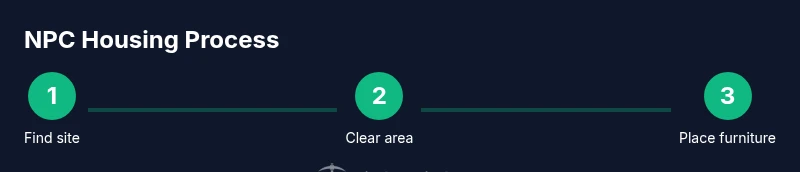
Scout a nearby area that is accessible from your central hub and free of hazards. Mark potential spots for multiple houses to prevent overlap. Keep pathways clear and easy to navigate.
Tip: Choose locations with natural light and avoid caves or lava zones. - 2
Clear and level the space
Remove obstructing blocks and level the interior to provide flat flooring. Ensure the space will comfortably fit a table, chair, and a light source.
Tip: Aim for a rectangular footprint that feels roomy but compact. - 3
Build the basic room
Construct walls using your chosen material and carve out a clearly enclosed room. Leave space for a door and ensure the interior is breathable.
Tip: Use consistent wall color to keep the space cohesive. - 4
Add background walls and door
Place background walls on all inner surfaces and install a door for NPC access. Background walls are essential for a valid house.
Tip: Test opening and closing the door to ensure smooth NPC movement. - 5
Position furniture and lighting
Place a table and chair with a clear path for NPCs. Install a reliable light source that covers the entire room but doesn’t glare.
Tip: Avoid cluttering the doorway; leave at least one block of clearance. - 6
Verify housing validity
Stand inside the house and confirm the game recognizes it as valid housing. Adjust if necessary so the NPCs can spawn.
Tip: If the house isn’t valid, review background walls and furniture requirements. - 7
Repeat and expand
Create additional houses using the same principles to support more NPCs and vendors. Maintain a balance between function and aesthetics.
Tip: Document your layouts to reuse proven templates later.
Got Questions?
What counts as a valid Terraria NPC house?
A valid house is a closed interior space with background walls, a door, light source, a table, and a chair. The space should be accessible and free of blocks that block NPCs. The room must be large enough for comfortable movement and not blocked by terrain hazards.
A valid Terraria NPC house is a closed interior with walls, a door, a light, a table, and a chair, plus enough space for NPCs to move. Make sure NPCs can access it and it isn’t blocked by terrain.
How many NPCs can inhabit a village?
Terraria allows multiple NPCs to inhabit a single world, each needing its own valid house. The practical cap depends on the number of houses you provide and the world size, but existence alone isn’t enough—each NPC must have a compliant home to move in.
Many NPCs can live in the world, but every one of them needs a proper house to move in. Build enough compliant homes to match the number of NPCs you want.
Can I relocate an NPC house after it’s built?
Yes. You can demolish or move components of a house, but ensure the new location still meets housing criteria. Keep the interior space intact to avoid invalidating the house during the move.
You can move a house by rebuilding it in a new location, just make sure the new spot still satisfies all housing rules.
Why won’t an NPC move into a newly built house?
Common reasons include missing furniture (table or chair), missing background walls, blocked entrances, or insufficient interior space. Double-check each required element and test the space by standing inside.
If an NPC won’t move in, recheck for required furniture, walls, and an accessible doorway. Make sure there’s enough room inside.
Do NPCs have preferences for house style or location?
NPCs don’t have explicit style preferences, but they do require valid housing increments and accessible, navigable spaces. Aesthetics can influence perceived village quality, but you’ll mainly focus on meeting the housing rules.
NPCs care about valid houses more than style, but a nice look helps your village feel alive.
Watch Video
Key Points
- Plan and space houses carefully to support NPC spawns.
- Ensure every house has walls, a door, light, table, and chair.
- Vary styles while maintaining housing validity for progression.
- Test each house by standing inside to confirm eligibility.