How to Check Terraria Coordinates: A Practical Guide
Learn how to check Terraria coordinates across PC, console, and mobile. Enable the coordinate readout, read them on the map, and use coordinates to locate biomes, chests, and bosses with clear, step-by-step instructions.


Learn how to check Terraria coordinates across PC, console, and mobile. This quick guide shows how to enable the coordinate readout, read coordinates on the map, and use them to navigate, locate biomes, and plan builds. According to Pixel Survival, understanding coordinates speeds up exploration and precise placement. It covers basic steps and platform differences, so you can start right away.
What are Terraria coordinates and why they matter
Terraria uses a tile-based world where every tile has an X and Y coordinate. Understanding these coordinates helps you map routes, plan builds, locate dungeons, chests, and biomes, and coordinate with friends in multiplayer. For new players, coordinates act like a compass and a precise map key. According to Pixel Survival, coordinates are not just numbers; they are a practical language you use to navigate the world more efficiently. When you learn to read X and Y values, you’ll spend less time wandering and more time collecting resources or crafting complex structures.
In practice, you’ll use coordinates to:
- Mark high-priority locations (spawn points, boss arenas, mining veins)
- Estimate the distance between two points by comparing X and Y values
- Find safe routes that avoid hazards by plotting waypoints on the map
The coordinate system is consistent across modes and platforms, so once you know how to read them in one world, you can apply the same approach to others. The key is to internalize the two axes, understand the origin, and keep a simple notecard of common coordinates you frequent.
How coordinates appear on different platforms and how to access them
Coordinate readouts and map overlays are generally accessible via the world map in Terraria. Across PC, console, and mobile, the basic idea remains the same: open the map to view coordinates tied to your current location. On PC you’ll typically access the map from the pause menu and toggle coordinate display in the map options. Console and mobile versions may present a slightly different navigation path, but the end result is a readable X and Y pair that helps you orient yourself in the world. Pixel Survival’s guidance emphasizes checking platform-specific settings if the coordinates don’t appear immediately, since UI layouts can differ between builds and versions.
Enabling coordinate readout and map overlay
To enable coordinates, start by pausing the game and opening the world map. Look for an option labeled Show Coordinates or similar in the map settings and turn it on. If you’re on mobile or a console, you may need to navigate to Settings > Interface or Map Options to enable the coordinate readout. After enabling, close the menu and return to the game; your current X and Y coordinates should appear on the map overlay or in a dedicated corner of the screen. If coordinates still don’t show, try restarting the game or switching to a different world to confirm the feature is available in your build.
Reading coordinates on the map and around the world
Once coordinates are visible, you’ll notice two numbers: X (horizontal) and Y (vertical). The origin is typically the top-left corner of the world, with X increasing as you move east and Y increasing as you move south. Use these values to pinpoint landmarks, chests, and biomes, then compare distances between points by subtracting one coordinate from another. A simple habit is to jot down common coordinates for frequent destinations, turning map navigation into a quick routine rather than a guessing game.
Practical examples: locating biomes, dungeons, and chests with coordinates
Coordinates become especially powerful when you’re targeting specific resources or areas. For example, if you’re hunting a biome like the jungle or cavernous layers, you can travel along a fixed X line while adjusting Y to reach the biome’s vertical zone. For boss arenas or prebuilt bases, set up coordinates as waypoints and plot paths between them. The more you practice reading coordinates, the faster you’ll recognize patterns like how certain resources cluster at particular depths and horizontal ranges.
Common mistakes and how to avoid them
Many players misread coordinates by assuming increasing values always indicate progress in the same direction. Remember: X is horizontal, Y is vertical; distant points can share similar X values but different Y values. Another common mistake is neglecting to save important coordinates; always record key locations after you discover them, so you don’t rely on memory alone. Finally, ensure you’re looking at the correct map view—some versions display coordinates only on the world map, not during exploration.
Advanced tips: coordinate-based builds and world exploration
Coordinate-based planning shines when you design tiled builds, rail systems, or farming routes. Create a rough grid in your notes, mapping where you want rooms, farms, or defensive towers. When seeding new worlds, you can compare coordinates of seed-generated features to your future builds, allowing you to replicate layouts or visit efficient starting points. If you play with friends, coordinate sharing becomes a powerful teamwork tool—agree on a center point and mark your sides with precise X/Y targets.
Troubleshooting: coordinate display not showing or laggy maps
If coordinates fail to appear, first confirm you’re in a standard world version without mods that disable UI elements. Check map settings again and ensure the overlay is enabled. If you recently updated Terraria, reset the game to apply new UI changes. Some players find that toggling the coordinate display off and back on can resolve minor UI glitches. As a last resort, verify game integrity or reinstall to fix corrupted data that may affect the map overlay.
Tools & Materials
- Terraria game (any platform)(Requires a loaded world to view coordinates on the map.)
- Input device(Keyboard/mouse for PC; controller for console; touch input for mobile.)
- In-game map access(Open the world map to view current coordinates; enable overlay if needed.)
- Notes or digital checklist(Record frequently used coordinates for quick reference.)
Steps
Estimated time: 20-30 minutes
- 1
Open the map and verify coordinate display
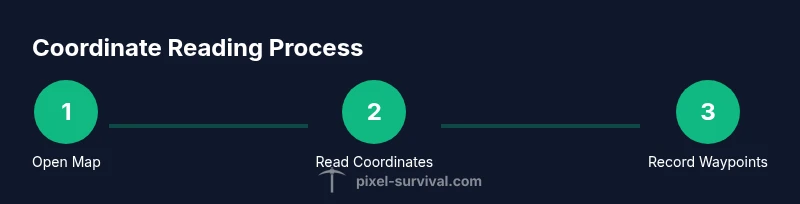
Pause your game, open the world map, and look for the coordinate readout. If coordinates aren’t visible, check the map options to enable 'Show Coordinates' or similar. This step establishes the baseline so you can read X and Y values reliably.
Tip: If you can't find the option, consult platform-specific help or reset the map to default settings. - 2
Read your current coordinates
Identify the two numbers representing your current location on the map. Note which axis changes as you move to the east or south to build intuition for future navigation.
Tip: Move a short distance and observe how the values shift to confirm axis directions. - 3
Record key coordinates
Write down coordinates for important landmarks (spawn point, chest corridors, boss arenas). Maintaining a short list saves you time during exploration and boss prep.
Tip: Use a dedicated note app or a small on-screen notepad for quick access. - 4
Plan routes between coordinates
When traveling, choose a primary waypoint and plot a straight or stair-step path by following consecutive coordinates. This reduces backtracking and increases efficiency.
Tip: Estimate distance by comparing differences in X and Y; larger deltas mean longer routes. - 5
Apply coordinates to builds
If you’re constructing bases or farms, map room centers to coordinates to ensure symmetry and ease of access. Coordinates act as a blueprint in your planning process.
Tip: Mark the center of each room with a unique coordinate pair for quick re-entry. - 6
Practice with a short waypoint test
Create a simple three-point waypoint test in a safe area to internalize reading coordinates under pressure. This builds muscle memory for longer expeditions.
Tip: Repeat the drill with different routes to reinforce familiarity. - 7
Troubleshoot if coordinates behave oddly
If the readout seems wrong, verify you’re in the correct map view, consider a UI reset, or check for mods that alter the UI. Coordinate glitches are usually UI-related rather than world-based.
Tip: Restart the game and re-check in a fresh world to isolate the issue.
Got Questions?
What are coordinates in Terraria and why should I care?
Coordinates are a two-number system (X, Y) that reveal your position in the world. They help you locate biomes, chests, dungeons, and boss arenas with precision, making exploration and planning faster and more reliable.
Coordinates tell you exactly where you are in the world, so you can plan routes and find loot more efficiently.
How do I display coordinates on PC, console, and mobile?
On the world map, look for an option such as Show Coordinates or Map Options and enable it. The exact steps vary by platform, but all versions provide a coordinate readout on the map once enabled.
Open the map and switch on coordinates; if you don’t see them, check map settings for your platform.
Can coordinates help with boss arenas or resource farming?
Yes. By marking the arena coordinates and route you can reach it reliably. You can also track where resources spawn by noting coordinates for frequent mining zones.
Coordinate planning makes boss prep and resource farming more predictable.
Are coordinates affected by mods or world seeds?
Mods can alter UI or how coordinates are displayed. Always check mod documentation for changes to the coordinate readout or map features.
Mods may change how coordinates appear, so verify with mod docs.
Where should I record important coordinates?
Keep a simple log in a notes app or a dedicated in-game map reference sheet. Consistent recording saves time during exploration and planning.
Note important coordinates so you can return to them quickly.
What should I do if coordinates seem wrong?
Double-check you’re viewing the correct map view and that coordinate display is enabled. If issues persist, restart Terraria or verify game files.
If coords look off, recheck your map and settings and retry.
Watch Video
Key Points
- Master coordinates early to boost navigation.
- Enable coordinates on the map and practice reading X/Y values.
- Record key locations and plan routes with coordinates.
- Use coordinates to optimize builds and boss arenas.
- If UI glitches occur, troubleshoot by resetting map options or the game.