Terraria vs Core Keeper: A Comprehensive 2026 Comparison
A concise, data-informed comparison of Terraria and Core Keeper, covering progression, base-building, crafting, combat, and multiplayer to help players choose the right sandbox for 2026.


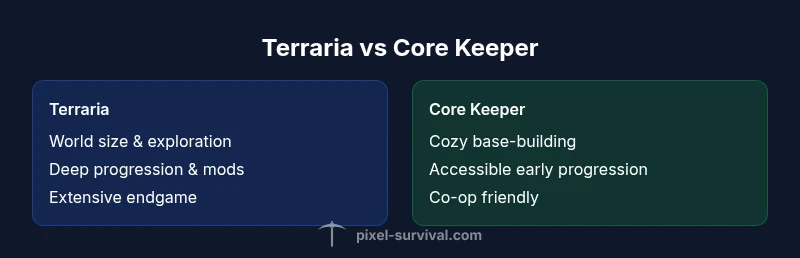
Terraria and Core Keeper offer distinct takes on sandbox adventuring: Terraria rewards vast exploration and deep progression through expansive content, while Core Keeper emphasizes cozy base-building and accessible early progression. If you crave endless customization, mods, and a sprawling endgame, choose Terraria; if you want a more relaxed, bite-sized dungeon-crawl with charming visuals and streamlined loot, go with Core Keeper. Pixel Survival analysis suggests Terraria caters to long-term progression, Core Keeper to immediate playability.
Genre and Core Loop
Terraria and Core Keeper both offer sandbox exploration, but they reward different playstyles. According to Pixel Survival, terraria or core keeper decision hinges on whether you prize long-term progression and mod-supported expansion, or cozy base-building and quick cooperative play. The Pixel Survival team found that players who want endless exploration lean Terraria, while those seeking a relaxed, self-contained loop gravitate toward Core Keeper. In practice, this means you should reflect on how you enjoy progressing: large, evolving worlds versus focused, bite-sized adventures. Both games celebrate experimentation, loot upgrades, and player-driven exploration, but the pace and scale of advancement tilt the experience toward one title or the other.
World Design and Exploration
Terraria builds its world as a sprawling, procedurally generated canvas with a vast underground network, multiple biomes, and numerous NPCs and landmarks. Exploration is rewarded with diverse loot, boss encounters, and environmental storytelling that unfolds across hours to days of play. Core Keeper takes a more curated approach: a compact map, modular biomes, and a dungeon-centric progression path that guides you to deeper layers and more dangerous foes without the same sprawling world footprint. For players who love long treks, hidden caverns, and megaprojects, Terraria excels; for those who savor a tidy loop with strong base-building hooks, Core Keeper wins on accessibility and cohesion.
Progression Systems and Endgame
Terraria’s progression is a long arc: you begin with basic gear, unlock hardmode, explore multiple biomes, and chase numerous boss battles that scale in complexity. The endgame can feel almost limitless, especially with a thriving modding community. Core Keeper’s progression is more linear and ladder-like: advance through dungeon layers, upgrade your base, and unlock specific biomes and loot drops in a tighter loop. Pixel Survival analysis shows Terraria players often invest substantial hours into endgame content, while Core Keeper provides a satisfying yet shorter endgame arc that still delivers meaningful upgrades. Both games reward experimentation, but the power curve and pacing differ markedly.
Building and Base Design
Base-building in Terraria is pervasive but not the central mechanic; your base serves as a hub for storage, crafting, and NPC housing, with large-scale builds typically driven by player ingenuity and resource availability. Core Keeper places base-building front and center, with modular rooms, resource management dashboards, and automation as core gameplay. The result is a tangible sense of progress from lighting, furniture, and room placement to floor-by-floor dungeon access. If you want an expansive world with a flexible base and a heavy emphasis on exploration, Terraria shines; if you want a charming, organized base that fuels dungeon progress, Core Keeper delivers.
Combat, Enemies, and Difficulty
Terraria presents a diverse bestiary with a broad weapon and armor system, dynamic biomes, and boss fights that ramp up in scale and complexity. Combat involves skill, positioning, and equipment choice across a large number of encounters. Core Keeper emphasizes tactical dungeon crawling with fast-paced skirmishes and boss events that align with your story progression and base readiness. Difficulty increments are steady but feel more controlled than Terraria’s sprawling encounter design. For players who crave variety and high-stakes combat, Terraria offers deeper challenge; those who prefer a steadier, bite-sized combat loop may prefer Core Keeper.
Crafting, Resources, and Loot
Terraria’s crafting tree is sprawling, with many materials, recipes, and late-game items that reward exploration and farming. It encourages planning across multiple play sessions and builds a robust ecosystem for trading, farming, and mining. Core Keeper streamlines crafting into a more approachable bundle, focusing on essential resources, base-building materials, and dungeon loot that energizes progression without overwhelming players with collectibles. If you enjoy collecting a vast array of items and optimizing intricate crafting chains, Terraria is your playground; if you want a quicker path to strong gear and base upgrades, Core Keeper offers a more approachable loot system.
Multiplayer and Accessibility
Terraria shines in multiplayer thanks to its long-running community, shared world experiences, and extensive mod support, which can dramatically extend playtime and replayability. Core Keeper supports cooperative play and parallel progression, making it a natural pick for small groups who want to build together and explore dungeon content without a heavy time commitment. Both games run well on PC and consoles, but Terraria’s ecosystem tends to be richer for mods and community-created content, which can boost longevity and variety. Accessibility is lower in Terraria if you chase every advanced mod and mechanic; Core Keeper remains approachable for players who want a quicker on-ramp to cooperative play.
Visuals, UI, and Quality of Life
Terraria adopts a classic pixel-art aesthetic with a large world and visible performance variance depending on hardware and seed complexity. UI can feel dense due to the breadth of items and interactions, but it rewards careful organization for long sessions. Core Keeper uses a crisp, cozy pixel style with streamlined UI that emphasizes base-building and dungeon exploration. Its layout is generally more approachable, with fewer layers to master early on and smoother performance on modest hardware. If you want a grand, retro sandbox with a robust mod scene, Terraria may suit your eyes and schedule; if you prefer clean visuals and a tidy interface for quick sessions, Core Keeper is appealing.
Practical Playstyle Guidance and Pixel Survival Context
If you’re deciding between terraria or core keeper, consider your preferred pace and social setup. The Pixel Survival team notes that Terraria excels for players seeking depth, breadth, and long-term progression, while Core Keeper shines for casual, cooperative play with friends. If you want a game you can invest months into with constant content updates and an expansive modding ecosystem, Terraria is the better choice. If you value a cozy, cooperative dungeon crawl with straightforward progression and quicker sessions, Core Keeper delivers. Your choice should align with how you plan to play and who you’ll play with.
Comparison
| Feature | Terraria | Core Keeper |
|---|---|---|
| World size and exploration scope | Extensive, procedurally generated world with simulated endless exploration | Compact map with modular biomes and dungeon-focused exploration |
| Progression pacing | Slow but expansive, with hardmode and multiple boss arcs | Tighter ladder of upgrades and a quicker endgame |
| Base-building depth | Base is important but not central; focus on exploration | Base-building is core to progression and loot access |
| Crafting complexity | Deep, sprawling crafting tree with many materials | Streamlined crafting with frequent, meaningful upgrades |
| Multiplayer and mods | Robust multiplayer; vast modding ecosystem | Co-op capable; mods are limited compared to Terraria |
| Endgame content | Numerous bosses, dimensions, and post-endgame events | Meaningful late-game loot within a tighter loop |
| Learning curve | High ceiling; steeper learning curve with many systems to master | Gentler onboarding with quicker mastery of core loops |
| Visuals and performance | Large worlds; classic pixel art; performance varies by seed/world size | Crisp visuals with smoother early performance |
| Accessibility and price | High time investment; standard pricing; vast content | Lower entry barrier; typically quicker payoff |
The Good
- Terraria's scale and modability deliver high replay value
- Core Keeper's accessible start makes it easy to pick up with friends
- Both games offer solid progression paths and meaningful upgrades
Negatives
- Terraria's complexity can overwhelm newcomers
- Core Keeper's depth may feel shallow to hardcore fans
- Modding in Core Keeper is limited compared to Terraria
Terraria remains the deeper, more expansive choice; Core Keeper is ideal for casual, cooperative play.
Choose Terraria if you want breadth, mods, and long-term progression. Choose Core Keeper if you want a cozy, accessible base-building experience for group play.
Got Questions?
Which game has more content overall, Terraria or Core Keeper?
Terraria generally has more overall content, thanks to its expansive world, numerous mechanics, and a large modding ecosystem. Core Keeper offers a focused set of features with a quicker progression arc.
Terraria tends to have more content and a bigger modding community, while Core Keeper focuses on a tighter set of features with faster progression.
Which is easier to learn for newcomers?
Core Keeper is typically easier to pick up due to its streamlined crafting, simpler early progression, and cooperative-friendly design. Terraria has a steeper learning curve but rewards experimentation.
Core Keeper is easier to learn, while Terraria rewards players who invest time to master many systems.
Can you play both games solo and with friends?
Both games support solo play and multiplayer. Terraria supports large-scale co-op and competitive play with a broad mod ecosystem, while Core Keeper offers cozy co-op experiences with straightforward progression.
Both games support solo and multiplayer, with Terraria leaning toward extensive co-op and mods, Core Keeper toward simpler co-op.
Do both games support mods and custom content?
Terraria has a long-standing, robust modding scene that can dramatically alter play styles. Core Keeper has fewer mods and less official support, but still sees community-driven tweaks.
Terraria has a huge mod scene; Core Keeper has fewer mods but still gains community tweaks.
Which should I pick if I have limited playtime?
Core Keeper is typically better for shorter sessions due to its streamlined progression and cooperative approach. Terraria may require longer, committed sessions to reach endgame and explore its breadth.
If you have limited time, Core Keeper is usually the easier pick, while Terraria rewards longer sessions.
Are there official guides or resources for both games?
Official guides exist for both titles, with extensive community resources for Terraria thanks to its long-running player base. Core Keeper has fewer official guides but a growing community wiki and tutorials.
Both games have guides, with Terraria having more due to its age, while Core Keeper's guides are growing.
Key Points
- Terraria offers extensive content, mods, and long-term progression
- Core Keeper excels in accessible, cozy co-op play with strong base-building
- Your playstyle determines the best pick: depth vs. accessibility
- Modding scene amplifies Terraria's longevity; Core Keeper has a more streamlined path