Why is Terraria Stuttering? A Troubleshooting Guide
Struggling with Terraria stuttering? This urgent troubleshooting guide reveals common causes, quick fixes, and safe optimization tips to restore smooth gameplay, with insights from Pixel Survival.


Why is Terraria stuttering? The most likely cause is a hardware rendering load clashing with background tasks and outdated software. Start with quick wins: close unnecessary apps, cap your FPS, and lower in-game resolution. If the stutter persists, update drivers and verify game files, then test vanilla Terraria before exploring mods. This approach rapidly narrows down the culprit.
Understanding the Stutter Problem and Why It Matters
Terraria stuttering is a common frustration for players who want fluid combat and exploration. The phrase why is terraria stuttering often points to multiple potential causes, from hardware bottlenecks to software and mod conflicts. According to Pixel Survival, most stuttering occurs when your system tries to render complex scenes while background processes consume CPU time. This article treats stuttering as a diagnostic puzzle with practical, repeatable fixes you can apply in sequence to reclaim smooth gameplay. By starting with simple checks and gradually escalating, you minimize risk and maximize the chances of a stable, steady frame rate.
Quick Causes at a Glance
- Hardware bottlenecks: GPU/CPU or insufficient RAM can struggle with large biomes and dynamic visuals.
- Outdated software: graphics drivers or OS updates that haven’t been applied.
- Background load: overlays, antivirus scans, file syncing, or streaming software stealing cycles.
- Mods or large worlds: shader packs and high-seed worlds can create texture streaming hiccups.
- Storage and memory: running out of free space or a failing disk raises texture load times.
- Multiplayer network factors: latency and jitter can appear as stutter in synced sessions.
Pixel Survival notes: testing vanilla Terraria with mods disabled often clarifies the root cause.
Start with the Easiest Checks: System Tasks and Power Plans
Begin with quick wins that don’t require a reinstall. Close nonessential programs, especially overlays (Discord, recording software, FPS counters). Check your power settings; set Windows to High Performance on desktops or laptops with power adapters. Ensure Terraria has permission to run without background throttling and that you’re not limited by antivirus scans or cloud backups during play. These small adjustments can reduce stutter dramatically and buy you time to progress to deeper fixes.
Tweaking In-Game and System Settings
In-game tweaks can drastically improve smoothness without sacrificing too much visual quality. Lower the game’s resolution or windowed mode to reduce GPU load, and cap your FPS to your monitor’s refresh rate to minimize frame drops. If you notice input lag, test with V-Sync on and off to see which yields a steadier cadence on your setup. Disable extra particle effects, turn off fancy lighting, and reduce texture filtering. After a change, re-run a familiar world to compare performance before moving to the next adjustment.
Driver Updates and File Integrity: The Software Hygiene Checklist
Outdated graphics drivers are a frequent source of stuttering. Visit your GPU maker’s site to grab the latest driver, or run Windows/macOS update utilities for chipset drivers. Verify game files through your launcher to fix corrupted assets that can silently degrade performance. Test with vanilla Terraria to confirm whether the fix holds before reintroducing mods. Pixel Survival emphasizes keeping a change log so you can track what improves or worsens the experience.
Modding, World Size, and Other Extras
Mods can improve or degrade performance depending on compatibility and resource usage. Disable mods one at a time and retest to isolate conflicts. Very large worlds or seeds with dense biomes can stress texture streaming and memory; starting a fresh vanilla world helps confirm whether the issue lies with the world data or mods. If you must use mods, choose lightweight options and ensure they are updated for the current Terraria version.
Storage, RAM, and System Health
A nearly full drive or a failing disk can introduce texture streaming hiccups and load pauses. Check free space and run a surface or SMART health check if you notice odd load times. Run a RAM test if you have symptoms of memory instability, especially on systems with multiple programs running. For SSD users, avoid unnecessary defragmentation; for HDD users, regular maintenance can help reduce stutter during texture streaming.
Network Considerations for Multiplayer Stuttering
In multiplayer, latency and packet loss can masquerade as stuttering when frames appear to freeze between clients. Test with a wired connection if possible and minimize other devices on the network. If you’re hosting, limit the number of concurrent players and avoid mods that increase network traffic. For single-player, disable cloud saves or autosync during play to prevent background pauses.
A Practical Plan: Diagnose and Fix in One Session
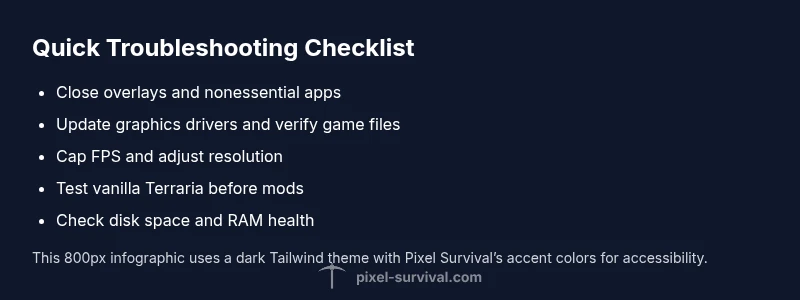
Follow a structured plan: start by closing overlays and ensuring a High Performance power profile, then update drivers and verify game files. Test vanilla Terraria with conservative settings, then incrementally reintroduce mods or changes. If stuttering persists, test a fresh vanilla world, and consider hardware checks (RAM, disk health). Schedule regular maintenance to keep performance stable.
Steps
Estimated time: 45-90 minutes
- 1
Close unnecessary programs
Exit overlays and background apps that could steal CPU time. Use Task Manager to end processes you don’t need while testing Terraria. Reopen them after you verify stability.
Tip: Only close apps you recognize to avoid closing essential system services. - 2
Set power plan to High Performance
Modify the power settings so the CPU runs at full speed while gaming. If you’re on a laptop, keep it plugged in to avoid aggressive throttling.
Tip: A temporary high-performance profile can dramatically improve stability. - 3
Cap FPS and adjust V-Sync
In-game, cap the frame rate to your monitor’s refresh rate. Toggle V-Sync on and off to test stability, since some systems benefit from either setting.
Tip: Record the exact FPS value that yields the smoothest play for future reference. - 4
Update drivers
Download and install the latest GPU drivers from the vendor’s site. Reboot, then re-test Terraria to see if stutter reductions hold.
Tip: If you’re unsure about risks, create a system restore point before updating. - 5
Verify game files and run vanilla
Use the game launcher to verify integrity of game files. Launch Terraria without mods to confirm whether stutter originates from assets or code.
Tip: Document any unchanged stuttering after verification. - 6
Tidy up mods and seeds
Disable all mods, then test with a known-compact seed. Reintroduce mods one by one to identify conflicts or heavy resources.
Tip: Prefer updated, smaller mods with good compatibility notes. - 7
Lower resolution and textures
Drop the resolution or switch to windowed mode to reduce GPU load. Turn off extra visual effects and fancy lighting to free up GPU memory.
Tip: Make a baseline test in a familiar world after each change. - 8
Check storage health
Ensure there is ample free space on your drive and scan for disk errors. Consider moving Terraria to a faster drive if stuttering persists.
Tip: Don't run heavy disk tasks during testing. - 9
Reboot and re-test
Restart your PC, then launch Terraria again and run a short test segment to confirm improvements.
Tip: If issues return, revisit steps 2 and 3 for further adjustments.
Diagnosis: Terraria stuttering or frequent FPS drops during gameplay
Possible Causes
- highPower-saving or throttling by the OS/hardware
- highOutdated graphics drivers or system updates
- highBackground processes consuming CPU/RAM
- mediumMods or large seeds causing texture streaming issues
- lowDisk health or insufficient free space
Fixes
- easyUpdate GPU drivers and apply pending OS updates; reboot after
- easyClose overlays and nonessential programs; switch to High Performance mode
- easyCap FPS to monitor refresh rate and adjust in-game settings; test vanilla
- easyVerify game files and remove or disable mods; test vanilla again
- mediumCheck disk health and free space; run memory tests if RAM is suspected
Got Questions?
What causes stuttering in Terraria?
Stuttering is usually caused by a mismatch between hardware performance and game demands, compounded by background processes, outdated drivers, or mod conflicts. Systematic testing helps identify the exact culprit so you can apply targeted fixes.
Stuttering happens when your computer struggles to keep up. Start by updating drivers, closing background apps, and testing vanilla Terraria to locate the issue.
Can mods cause stuttering in Terraria?
Yes. Mods can strain resources or conflict with the game’s rendering pipeline, leading to stutter. Disable mods to see if performance improves, then reintroduce them one by one to identify problematic ones.
Mods can slow things down. Try running vanilla first, then reintroduce mods one at a time to find the culprit.
Is multiplayer worse for stuttering than single-player?
Multiplayer can introduce latency and bandwidth-related pauses. Use a wired connection, limit players if hosting, and disable network-heavy mods to reduce stutter in online sessions.
Online play can add lag. Use a stable connection and test with fewer players.
Should I upgrade RAM to fix stuttering?
If you regularly run multiple programs alongside Terraria, increasing RAM can help. For many players, freeing up RAM by closing background apps yields faster in-game performance without hardware upgrades.
More RAM can help if you multitask a lot; otherwise, focus on optimizing current usage.
Does Windows Game Mode help Terraria?
Game Mode can help some systems by prioritizing game processes, but results vary. Enable it to test, then compare performance against your baseline.
Try Game Mode and see if it improves stability; not all setups benefit equally.
When should I seek professional help?
If stuttering persists after all software fixes and you suspect hardware faults (RAM, drive, cooling), consult a technician for a hands-on diagnosis.
If issues stay after fixes, a pro can check hardware and diagnostics beyond at-home testing.
Watch Video
Key Points
- Update drivers and verify integrity first
- Test vanilla before modding
- Balance visuals against performance with FPS cap
- Regular maintenance helps prevent future stutter