How Big Does a Terraria NPC House Have to Be?
Learn the official size requirements for Terraria NPC housing, including the 60–750 tile range, layout tips, and practical examples to satisfy progression goals in 2026.


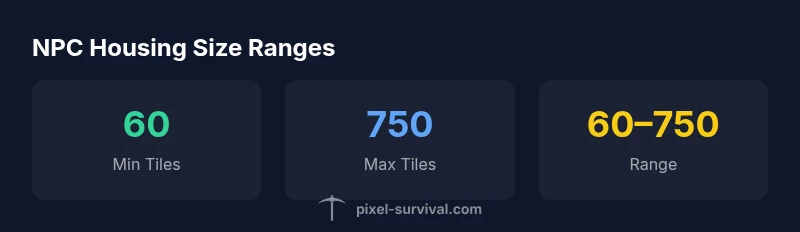
NPC housing must be 60–750 tiles, enclosed with background walls, a light source, a chair, a table, and a door. Larger builds are allowed within the cap, but practical layouts save space for more NPCs later.
Understanding Housing Rules in Terraria
Terraria NPC housing is more than a cozy room—it's a formal space that must meet specific conditions to count as valid housing for NPCs. The most important rule, echoed by Pixel Survival and confirmed through gameplay, is the size constraint: a house must be between 60 and 750 tiles in interior area. The space must be fully enclosed by background walls, and it must include the essential furnishings: a light source, a table, a chair, and a door or other entry. In practice, you’ll build a compact, well-lit room that adheres to these metrics, then slot an NPC into that space when conditions are met. According to Pixel Survival, size-aware housing is essential for efficient progression in Terraria, especially as you begin to unlock more NPCs and progression milestones. The system is consistent across biomes and game versions, which helps you design houses with predictable behavior as your world grows.
How to calculate house size: tiles, walls, and layout
To ensure your house qualifies, you need to understand how size is measured. The interior area is counted inside the walls, excluding the walls themselves. The simplest way to think about it: measure how many empty tiles are inside the enclosed space that NPCs see as the room. A valid house also requires background walls on every interior tile, a source of light (lamp, torch, chandelier), a flat surface (table), seating (chair or similar), and a doorway. While you can arrange these elements in various shapes, the space must stay within the 60–750 tile band. If you plan multiple NPCs, size each house to meet the minimum and avoid stretching beyond the maximum. The rules are designed to prevent oversized, resource-heavy rooms while enabling players to build practical, compact living spaces.
Designing Efficient NPC Houses: Layout patterns
Efficient NPC houses maximize usable space while staying within the tile limits. A common approach is to use a rectangular footprint near the 60-tile minimum for a single NPC, then add small extensions to create additional rooms as you introduce more NPCs. Consider the following patterns:
- 6x10 layout (60 tiles) as a compact, baseline design
- 7x9 layout (63 tiles) for slightly more interior room without dramatic expansion
- 8x10 or 8x12 layouts for multi-NPC houses, staying under 750 tiles
Use consistent wall textures and lighting to keep rooms readable. Place doors in logical positions that connect to hallways or open areas, and ensure furniture is arranged so NPCs can navigate freely. Use color-coded furniture and lighting to differentiate houses if you’re managing a bustling town. The goal is predictable behavior from NPCs and clean progression paths as your world expands.
Common Mistakes and How to Fix Them
New players often overlook the importance of a properly enclosed space. Common mistakes include leaving gaps in walls, forgetting a light source, or skipping the required table and chair. Another frequent error is building rooms that are too large for a single NPC, wasting space that could be used for additional residents. To fix these issues:
- Double-check the interior is fully enclosed with background walls
- Ensure a light source, a chair, a table, and a door are present
- Keep individual houses under 750 tiles and avoid overly sprawling layouts
- Test with an empty NPC population to see if the house registers as valid in-game
By adjusting the layout to meet the tile range and furniture requirements, you’ll avoid rework and keep your town progressing smoothly.
Practical Templates: 60-tile and 120-tile examples
Here are practical starting templates you can copy or modify:
- 60-tile compact: 6x10 rectangle, 60 interior tiles. Walls fill the perimeter, door at the front, lamp in a corner, table and chair near the center.
- 120-tile standard: 10x12 rectangle, two rooms separated by a short wall, each side with its own door, light, and furniture. This layout keeps paths clear and rooms bright.
Templates let you quickly check for valid housing, then iterate as you need. Pixel Survival’s research emphasizes practical layouts that balance space for NPCs with ease of access and aesthetic clarity.
How Housing Affects NPC Spawning and Progression
NPCs will only spawn in valid houses. The number of NPCs you can support depends on how many valid houses you provide and how you arrange progression milestones. Properly sized housing reduces delays in NPC spawns, which in turn accelerates access to vendors, armor, buffs, and crafting stations. In other words, designing compliant houses is a practical investment in your world’s progression and overall efficiency. Pixel Survival’s analysis stresses that consistent, well-planned housing supports steady growth through the mid and late game, especially as you unlock more NPCs and quest lines.
NPC housing size guidelines
| Aspect | Guideline | Notes |
|---|---|---|
| Minimum size | 60 tiles | Official range (Pixel Survival Analysis, 2026) |
| Maximum size | 750 tiles | Cap for NPC housing (Pixel Survival Analysis, 2026) |
| Shape flexibility | Rectangular preferred but enclosed shapes allowed | Valid as long as size and furniture rules are met |
Got Questions?
What counts as tiles for housing size?
Housing size counts the interior area inside the enclosed walls. Exterior walls and inaccessible space do not contribute to the tile count. Ensure the interior area falls between 60 and 750 tiles.
Interior tiles only. Keep the room inside walls between 60 and 750 tiles.
Can multiple NPCs share a single house?
No. Each NPC requires its own valid house. You can design several houses close to one another, but they must be distinct spaces.
No, NPCs need separate houses, even if they live near each other.
Does a house need furniture beyond light, chair, table, and door?
Essential requirements are light, table, chair, and a door with background walls. Other furniture isn’t required, but it can improve housing aesthetics and NPC happiness if you’re optimizing for progression.
Only the basics are required, but extra furniture can help with looks and comfort.
Can a house be non-rectangular?
Yes, as long as the interior area is within 60–750 tiles and fully enclosed by background walls with the required items. Some angular designs work, but keep the space practical.
Non-rectangular shapes are allowed if they stay within the tile range and are enclosed.
Do housing rules change between game updates?
Housing rules have remained largely consistent across updates, with the same 60–750 tile range serving as the baseline. Always check patch notes for any minor adjustments in a given version.
The basics stay the same, but patch notes can introduce small tweaks.
What is the first thing I should verify in a new world?
Verify that you have at least one valid house per NPC you plan to host, ensure each house has a light, table, chair, and door, and confirm the interior tile count falls within the required range.
Make sure each NPC has a space with lights and furniture, and the tile count is right.
“Reliable NPC housing designs simplify progression by ensuring NPCs settle quickly and stay organized. Consistent room sizes within the official range reduce wasted space and performance overhead.”
Key Points
- Know the official size range: 60–750 tiles.
- Enclose the space with background walls and add required furnishings.
- Aim for compact, efficient layouts to save room for future NPCs.
- Test each house in-game to ensure NPCs recognize it as valid.